Cultural center
CastleKrenglbach-Haiding
Haiding Castle
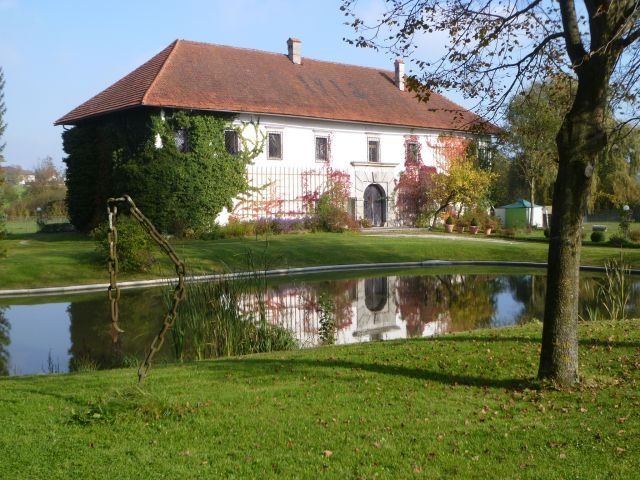
Haiding Castle, once a fortified moated castle, is situated in Krenglbach-Haiding in Upper Austria. Its history is marked by changing owners and a transformation from a fortress to a cultural center today.
History+
The first documented mention of Haiding Castle dates back to 1340. As early as around 1312, the Knights of Gelting had settled in Haiding and built a moated castle there. However, this was captured and burned down by the Schaunbergers, and the Geltings had to promise not to rebuild the complex as a castle. After the Schaunbergers' defeat by the Habsburgs, Ulrich Geltinger received Haiding back as a princely fief in 1386. After the Gelting family died out, the property passed to a Hostorffer. Later, the estate came into the possession of the Rondinelli family, from whom Hans Sigmund Rondinelli sold it to Count Engelbert Katzianer. By 1674, Sigmund Ferdinand Katzianer resided there. In 1727, Count Wilhelm Strattmann acquired the castle and incorporated it into his entailment of Peuerbach. Until the dissolution of the entailment in 1825, Haiding remained part of the Strattmann-Batthyany possessions. After a division of property, Haiding fell to Prince Philipp Batthyany. In 1879, Prince Wilhelm Alfred Montenuovo, who was married to Juliane Batthyany, inherited the castle. Three years later, he sold the uninhabited building to Hans and Maria Pauler, who used it as a farm. At the beginning of the 20th century, the castle fell into disrepair until it was renovated in 1970 by master builder Friedrich Achleitner and made accessible to the public.
Source: Wikipedia · Licence: CC BY-SA 4.0 · Image: http://commons.wikimedia.org/wiki/File:Wasserschloss_Haiding-Teichanlage.jpg
This description draws on the facts documented in the linked Wikipedia article; Wikipedia content is licensed under CC BY-SA 4.0. Wording and editing: Mobile History.
Location: 48.2129, 13.9741