Private property
CastleHaiming
Haiming Castle
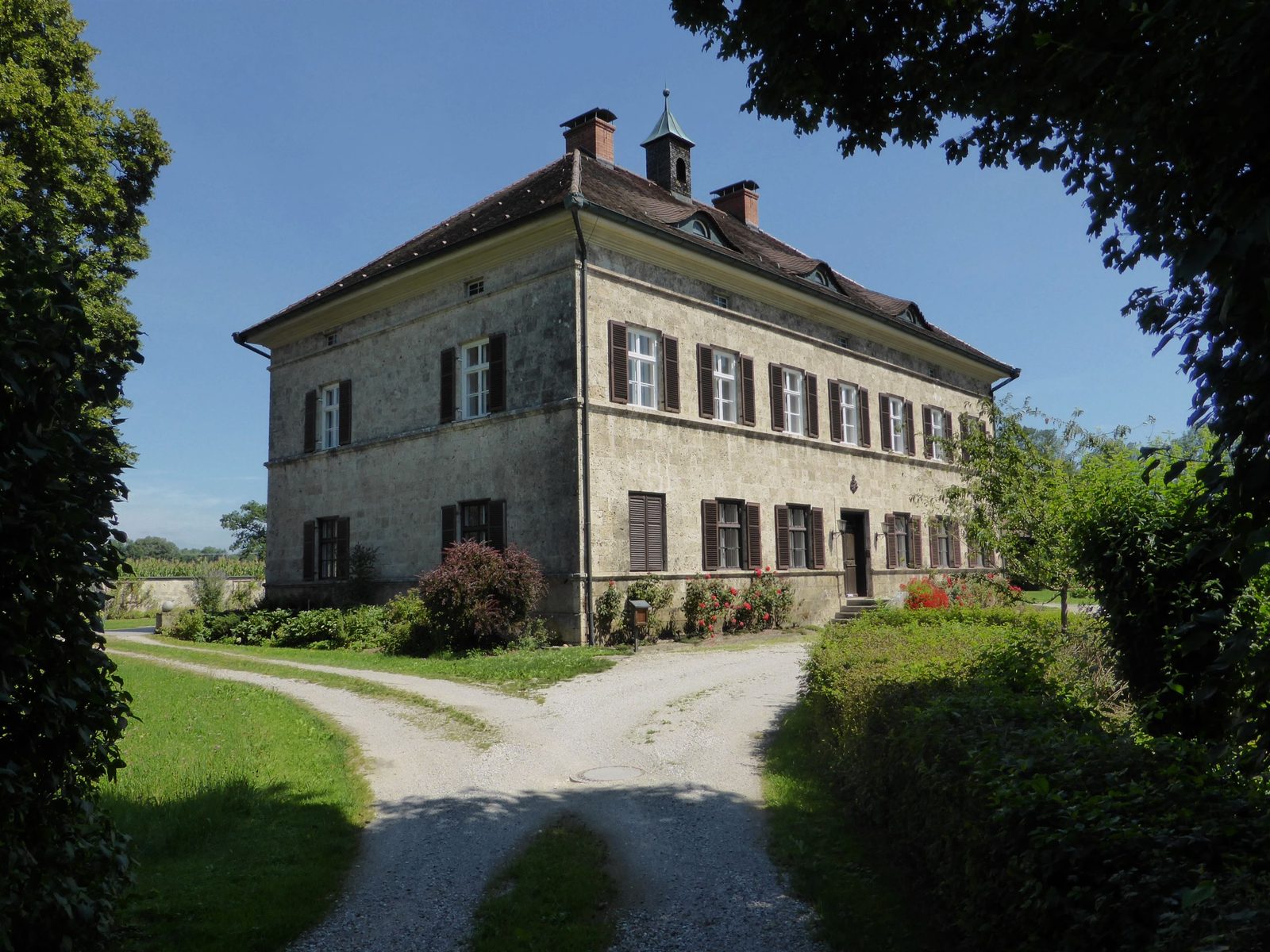
Haiming Castle is located in the municipality of Haiming in the district of Altötting in Bavaria (Flurstraße 14).
History+
Haiming is mentioned very early in the sources: a landlord named Hrodpald donated extensive estates here in the 8th century. Haiming is also the only place in the Mattiggau that did not belong to the Archdiocese of Salzburg, but to the Diocese of Passau. Bishop Waldrich of Passau established the parish of Haiming. The earliest mention of a noble refers to the nobilis Eberhard von Haiming, who donated his estate in Fillmansbach to Mattsee Abbey. In 1139, a Merbot and a Bertolf von Haiming appear as witnesses. In 1159, Haimo von Haiming attested to the transfer of an estate to Baumburg Abbey. A Wilhalmus de Haimmingen appears in the certification of the transfer of goods to Raitenhaslach Abbey. In a tradition document of St. Peter's Abbey, a Gebhard von Haiming is referred to as a miles of the noble Heinrich von Stammham, so he seems to have lost his noble freedom and descended into ministeriality. In 1180, a Renward von Haiming is mentioned in a tradition report of Ranshofen Abbey, and in 1201 and 1204 a Heinric von Heimingen in documents of Attel Abbey. After the death of the Passau canon Konrad von Stammham in 1204, his inheritance with Haiming fell to the Passau Hochstift. In 1258, there is talk of a hofmarchie Haiminge, which paid considerable tributes to the Passau cathedral chapter. In the feudal process, this Hofmark had come to Duke Friedrich II of Austria, who in turn enfeoffed it to Count Rapoto III of Ortenburg. Since both were without heirs, the Hofmark then fell back to the Diocese of Passau. In 1262, Haiming was sold by Bishop Otto von Lonsdorf to the Knights of Chalb. An indulgence letter from the Pope for the Haiming church from 1345 attests to Eberhard von Chalb as Lord of Haiming. When he died in 1354, he was buried in the burial place in Raitenhaslach. In 1376, a Niklas von Chalb von Haming, judge in Oettingen, is mentioned as the last of the Chalb in this area. The construction of the castle in the village pond (around 1400) is probably due to him. Next, the Knights Ausmholz are the Lords of Haiming. In 1401, Bishop Georg confirmed to Knight Johannes the right of presentation for the parish of Haimling. In a later document, he names Thomas Ausmholz and Leopold Ausmholz as his ancestors, from whom this right had passed to him. In 1404, Johannes Ausmholz fell into disgrace with the Bavarian Duke and was also captured. After that, he sold Haimling and subsequently settled in Burghausen, where his family took over the lucrative business of a toll collector. In 1404, Hans Tobelhamer, Kastner of Burghausen, acquired the lordship of Haimling. After his death, his son Andreas followed in 1414, Pfleger in Neuötting from 1441–1445. His son Friedrich died without male descendants, and the dispute over the inheritance that broke out among the daughters was decided by Duke Ludwig the Rich in 1463 in favor of Katharina Tobelhamer. Through her marriage to Jörg Pfaffenpeck (builder of St. Stephen's Parish Church in Haiming), he became the new Hofmark owner. In 1486, Jörg Pfaffenpeck died and Katharina married Sebastian Pelkhover, captain of the Landfahne of Burghausen. The son from the first marriage, Christoph Pfaffenpeck, had inherited half of the Hofmark. Only in 1522 could the inheritance disputes that subsequently broke out be settled. Christoph Pfaffenpeck died childless in 1523 and Sebastian Pelkhover in 1531. His son also died soon after, namely in 1535. Through the marriage of Barbara Tobelhamer, a sister of Katharina, to the knight Hanns Pürchiger, the rights to the Hofmark passed to him. An Achatz von Pürching calls himself in 1546 Achatz von Pürching zu Eckershaim and Haiming. His brother Benedikt acquired parts of the Hofmark and in 1562 the church fief, which also included the castle, was granted to them by the Bishop of Passau. Jörg von Pürching (son of Achatz) became the successor of both. In 1606, he additionally acquired the castle and seat of Winkelhaim from the heirs of Wolf Jahenstorf zu Winkelhaimb. The heirs of Jörg sold the Hofmark Haiming to Christoph Ulrich von Elsenhaim on July 6, 1612, after his death († 1610), and a year later he also acquired Winkelham Castle.
Source: Wikipedia · Licence: CC BY-SA 4.0 · Image: luckyprof · Wikimedia Commons · CC BY-SA 3.0
This description is a machine translation of an excerpt from the linked Wikipedia article. The source text was written by its authors, the translation is by Mobile History; like the original it is licensed under CC BY-SA 4.0.
Location: 48.2146, 12.8911