Museum
CastleFußgönheim
Hallberg Castle
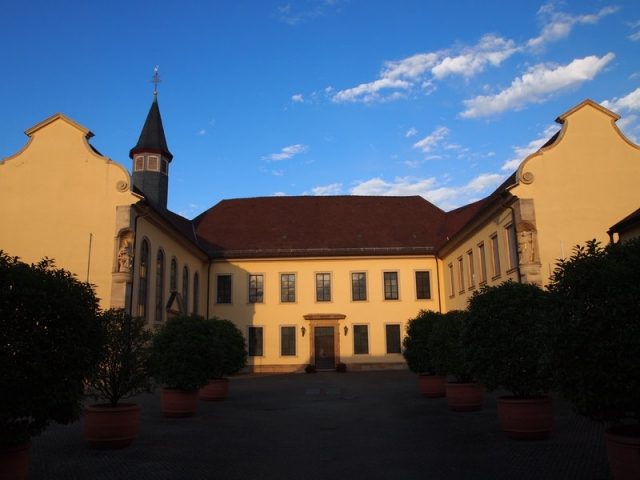
Hallberg Castle in Fußgönheim, Rhineland-Palatinate, once served as the residence of an Electoral Palatinate chancellor. A church is integrated into its structure, whose baroque furnishings are preserved.
History+
Hallberg Castle was built between 1728 and 1731 on behalf of the Electoral Palatinate Chancellor, Baron Jakob Tillmann von Hallberg. The builder established an entire wing of the castle as a Catholic church and, in 1742, founded the first Catholic parish in Fußgönheim since the Reformation. For the high altar of the castle church, a painting by Giovanni Antonio Pellegrini, who also painted Mannheim Palace, was created. A figure on this altarpiece is said to depict Jakob Tillmann von Hallberg. The completion of the castle church, now the northwest wing, is dated to 1741. Between 1788 and 1792, Heinrich Theodor von Hallberg, Electoral Palatinate-Bavarian envoy in Vienna, was the lord of the castle. In 1815, the castle was foreclosed and subsequently experienced various uses, including as a shop, barn, warehouse, cigar factory, prisoner-of-war camp, and Raiffeisen warehouse. In 1972, the Catholic parish of Fußgönheim acquired the property and restored it.
Source: Wikipedia · Licence: CC BY-SA 4.0 · Image: http://www.wehrbauten.de/thread.php?threadid=1348
This description draws on the facts documented in the linked Wikipedia article; Wikipedia content is licensed under CC BY-SA 4.0. Wording and editing: Mobile History.
Location: 49.4576, 8.2946