To be privately owned
Hambach Castle

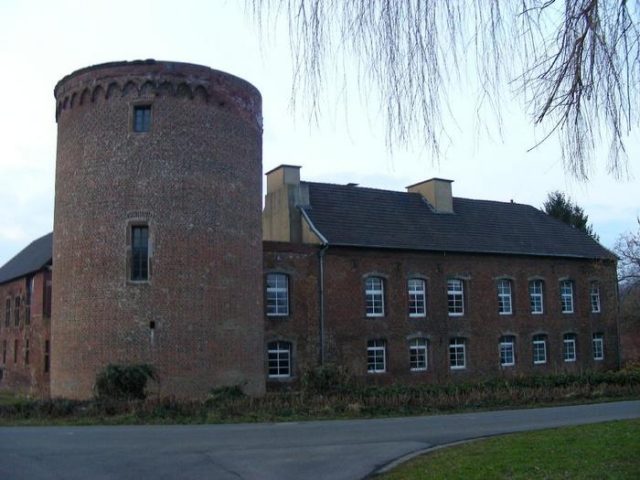
Hambach Castle, located in the Hambach district of the municipality of Niederzier in the Düren district, is a former hunting lodge of the Dukes of Jülich. The castle is a rectangular four-wing complex with four corner towers. However, only parts of two wings and three towers remain. The original size of the complex can be roughly estimated again after the recent restorations. Particularly impressive are the two towers flanking the entrance, which were converted into living space during the restoration.
Today's castle emerged from a fortress built around 1280 by Count Walram of Jülich. In December 1512, the building burned down due to a gunpowder explosion, was subsequently rebuilt and expanded by Duke Johann. Between 1558 and 1565, it was then converted into a representative Renaissance castle on behalf of Duke Wilhelm V of Jülich-Kleve-Berg and used by him as a venue for splendid hunting parties. Alessandro Pasqualini and his son Maximilian Pasqualini were responsible as architects. From here, the Duke and his entourage hunted in the game-rich Hambach Forest.
In 1659, the Landtag of the Duchy of Jülich met at the castle. In the 18th century, it was used as an electoral pleasure palace before being converted into a monastery in 1769.
The French declared it a national asset in 1794 and sold the inventory from 1801 to 1805. Furthermore, they demolished the north tower and the northwest wing. From 1805, meadows and associated land of the castle were leased to farmers, after the Second World War only the moat. In 1845, the castle became the property of the Claessen family from Frankfurt, whose descendants still inhabit it today.
In 1944, during the fierce fighting on the Rur, the building served as the headquarters of the German 959th Volksgrenadier Regiment and was subjected to heavy artillery fire by the Americans, which caused extensive destruction on the west side, while the actual residential building was only slightly damaged. After the Second World War, it was used as emergency accommodation.
Between 1957 and 1958, the west tower was restored, and from 1998 to 2002, the preserved ruins were secured, restored, and partly rebuilt. They now serve as apartments.
Take Mobile History with you
You are reading this text for free. Premium adds what matters on the road: descriptions read aloud, sites found through your camera, whole regions taken offline.
- Every description, including the ~17,700 Premium sites
- Audio guide: have descriptions read to you on location
- AR finder: see sites through your camera, with distance and bearing
- Unlimited saved sites
14 days free, then from €2.99 a month. Cancel anytime.
Source: Wikipedia · Licence: CC BY-SA 4.0 · Image: http://www.wehrbauten.de/thread.php?threadid=570
This description draws on the facts documented in the linked Wikipedia article; Wikipedia content is licensed under CC BY-SA 4.0. Wording and editing: Mobile History.
Location: 50.8999, 6.4407