To be privately owned
CastleLosenstein
Hammeries Castle
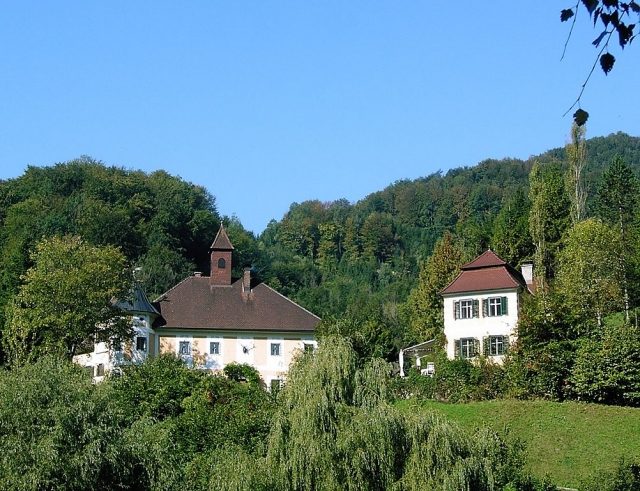
In Losenstein, Upper Austria, stands Hammeries Castle, an example of the development of rural aristocratic residences. It was first mentioned in the 13th century.
History+
The first documented mention of Hammeries dates back to the 13th century. The Hammerrieser von Weimar family, whose civilian name was Spitzer, belonged to the rural nobility and had the right to bear arms. The castle's name likely derives from the "Ries," the raw iron transported from Styria via the Enns River to Steyr and processed in hammer mills. After the decline of iron processing, a Silesian weaving mill was established on this site in 1801. Ownership changed frequently; names include Berger, Ritter von Bans, Jeckel, Winkelhofer, Dalberg, Pittinghofer, and Rudolf Sturm, whose successor was Johann Maresch. The castle was originally divided into three separate parts, which were unified into a single structure in 1527 by a central tower. This tower houses a marble entrance gate with an arch, above which the initials I. P. and A. P.
Source: Wikipedia · Licence: CC BY-SA 4.0 · Image: http://commons.wikimedia.org/wiki/File:Losenstein_Schloss_Hammerschmiedries_Laussastra%C3%9Fe_25_%2801%29.JPG?uselang=de
This description draws on the facts documented in the linked Wikipedia article; Wikipedia content is licensed under CC BY-SA 4.0. Wording and editing: Mobile History.
Location: 47.9369, 14.4215