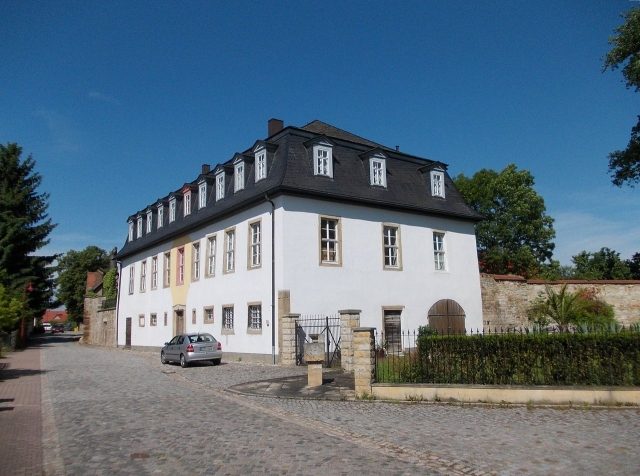
CastleHardisleben

Hardisleben Castle

Hardisleben Castle

To be privately owned

In the third century, a West Germanic tribal confederation, the Warnen from North Schleswig, settled in the area of Hardisleben. A hundred-strong group in Hardisleben found an ideal terrain for secure protection in the Lossabogen, on the Auberg. Fortifications were built in the form of a rampart and ditch. The first settlement founded by the Warnen was located in the Schenke up to the Niedermühle "Schenkenhohle". Warnen settlements were clustered villages, inhabited by a large clan. The families jointly engaged in pasture and field farming. Experts consider the 50-meter-long giant grave, ditches and ramparts in Harassholz, the redoubts and the ridge on the Loh to be traces from the Migration Period. A second settlement was founded by the Warnen around 300 in the area of today's Oberdorf. The fortified water castle became an Old Thuringian noble seat around 500 AD. In 531, the kingdom was shattered by the defeat of the Thuringians in the Battle of Burgscheidungen on the Unstrut. The area came under Frankish influence.

Through the settlement of Frankish soldiers, a street and row village subsequently developed. The Hardisleben castle complex was transformed into a Frankish manorial estate. This epoch is characterized by the transition from two-field to three-field farming and the beginning of viticulture. The field name "Auf dem Weingarten" (On the Vineyard) has its origin here.

Hardisleben was first mentioned in a document in 1230. The first reference to a fortification in the village was in 1239, when the witness Heinrich von Hardisleben was mentioned as a vassal of the Thuringian Landgrave. The property then passed to the Duchy of Saxony-Weimar. It was not until 1342 that the castle again came under a Thuringian lord. In 1508, the property passed to the Lords of Mühlich. In 1585, Duke Friedrich Wilhelm of Altenburg bought the Hardisleben manor, including the village and the localities of Teutleben and Essleben, from Kurt von Münlich, and in 1590 added Mannstedt. Duke Friedrich Wilhelm resided here in the castle temporarily for hunting until 1627. In front of the castle entrance was the Fronfeste (manorial prison), which had been built in 1772. It contained not only an apartment for the bailiff, but also four prison cells. The chains fastened there were still on the wall of the property until recently.

In 1679, after a fire, the castle and outworks, as well as large parts of the village, were destroyed. The ducal private estate was rebuilt after 1700 under Duke Johann Ernst III of Saxony-Weimar as a pleasure palace for his wife. By 1715, the parish church was rebuilt and furnished. After the death of the Duchess around 1738, the castle was converted into a hunting lodge. In 1739/40, the complex was expanded.

In 1945, parts of the building were demolished, and in 1995, large parts were rebuilt.

Take Mobile History with you

You are reading this text for free. Premium adds what matters on the road: descriptions read aloud, sites found through your camera, whole regions taken offline.

  • Every description, including the ~17,700 Premium sites
  • Audio guide: have descriptions read to you on location
  • AR finder: see sites through your camera, with distance and bearing
  • Unlimited saved sites

14 days free, then from €2.99 a month. Cancel anytime.

Source: Wikipedia · Licence: CC BY-SA 4.0

This description draws on the facts documented in the linked Wikipedia article; Wikipedia content is licensed under CC BY-SA 4.0. Wording and editing: Mobile History.

Location: 51.1536, 11.4257