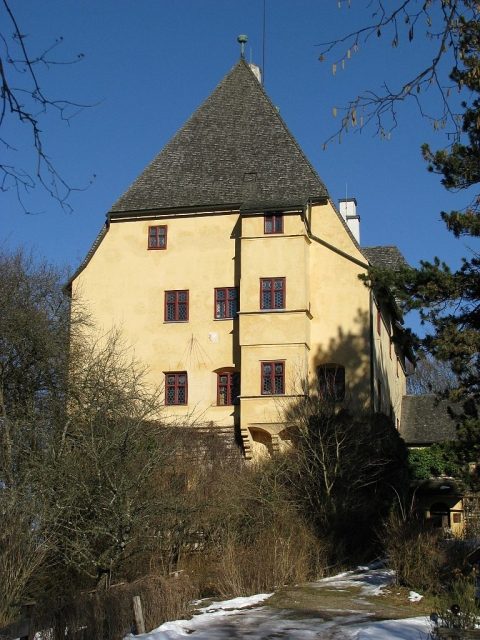
CastleHarmating

Harmating Castle

Harmating Castle

To be privately owned

Harmating Castle is located in the hamlet of the same name in the Upper Bavarian municipality of Egling on a moraine hill at the edge of the Isar valley, which widens somewhat to the northeast at this point. The oldest parts of the castle probably date from the 13th century, and it acquired its current Renaissance appearance in the 16th century. As a historical monument, it is of particular importance because it has largely been preserved in its original condition, both inside and out.

The medieval noble seat was probably built in the 13th century by the Lords of Harmating, who were first mentioned around 1140, as a tower castle. Around 1300, it belonged to the Counts of Hohenwaldeck. Other owners included the Lords of Egling, the Lords of Ross, and the Tyrolean family of Tänzls von Tratzberg. By 1531 at the latest, Harmating came into the possession of the Munich patrician family Barth, whose members were granted noble freedom along with lower jurisdiction by Emperor Rudolph II in 1596. In 1681, they were elevated to the rank of baron. From the Barth family, who supplemented their name with that of the castle, came, among others, the Munich mayor and landscape chancellor Ferdinand Barth (castle owner from 1689 to 1705) and one of the first explorers of the Allgäu Alps, Wetterstein Mountains, and Karwendel, Hermann von Barth (1845–1876), who spent his childhood at Harmating Castle.

In 1941, the von Schirnding family acquired ownership of the castle through inheritance. Today, the writer Albert von Schirnding lives there with his family. The last comprehensive renovation of the castle took place in 2002.

Architecture and Furnishings+

Harmating Castle is a three-story rectangular building with a striking, steep hipped roof and a chapel attached to the east facade. The bay window on the south side and the interior design of the rooms were added in the 16th century. Doors, furniture, and stoves from the Renaissance are preserved. The most art-historically significant rooms are on the first floor. There is a spacious room in the southeast of the building with a coffered ceiling from the early 19th century, decorated with medallions bearing the names of all Barths from 1324 to 1758. In a room named the Eurasburg Room, numerous family portraits hang. The Barth family had a connection to nearby Eurasburg at least from around 1700, when they came into possession of the castle there. In the Chancellor's Room, named after Ferdinand Barth's office, there are valuable ceiling paintings, possibly by Melchior Steidl. In the bay window, there are frescoes including the coats of arms of the Barth and Ligsalz families.

Numerous trophies in the building bear witness to its past use as a hunting lodge. The inventory also includes over 15,000 books from the possession of the von Schirnding family.

A late Gothic chapel was replaced in 1630 by the castle chapel dedicated to the Holy Cross. The single-nave building with a three-bay groin vault was renovated and slightly altered around 1708. The castle is not accessible to the public and cannot be visited.

Take Mobile History with you

You are reading this text for free. Premium adds what matters on the road: descriptions read aloud, sites found through your camera, whole regions taken offline.

  • Every description, including the ~17,700 Premium sites
  • Audio guide: have descriptions read to you on location
  • AR finder: see sites through your camera, with distance and bearing
  • Unlimited saved sites

14 days free, then from €2.99 a month. Cancel anytime.

Source: Wikipedia · Licence: CC BY-SA 4.0

This description draws on the facts documented in the linked Wikipedia article; Wikipedia content is licensed under CC BY-SA 4.0. Wording and editing: Mobile History.

Location: 47.8881, 11.5415