CastleTorgau

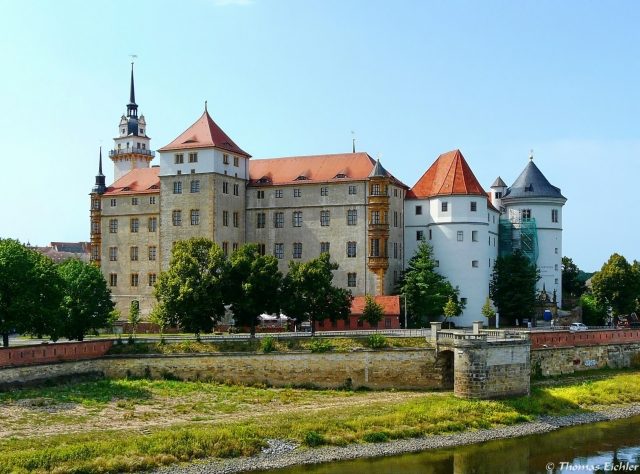
Hartenfels Castle

Hartenfels Castle

Cultural facilitie

Hartenfels Castle is a magnificent Renaissance castle in the city of Torgau in the Free State of Saxony.

When the Saxon ruling house of Wettin split into two lines in 1485 during the Division of Leipzig, the former main residence, Albrechtsburg Castle in Meissen, fell into the possession of the Albertine line of the Wettin family. Elector Frederick III and his successors later had Hartenfels Castle in Torgau expanded to become the new main residence of the Ernestine line. Construction of the castle began in the 15th century by Konrad Pflüger, a student of Arnold von Westfalen, and was continued in the 16th century by Konrad Krebs. It is the largest completely preserved early Renaissance castle in Germany. On the courtyard side of the so-called Johann-Friedrich Wing or East Wing is the representatively designed Wendelstein, an almost 20-meter-high self-supporting stone spiral staircase. According to Dehio, this courtyard side from 1533 to 1535 is one of the architectural "main achievements of the Early Renaissance in Germany." The Wendelstein (balustrades and pilasters) was made by Dresden sculptors from Elbe sandstone. The constructive model for this architectural reinterpretation was the Wendelstein at the late Gothic Albrechtsburg in Meissen.

The chapel or castle church of Hartenfels Castle was built in 1543-44 by Nikolaus Gromann. It is considered the world's first newly built Protestant church. It was consecrated in 1544 by Martin Luther himself. Until then, and for a long time afterwards, existing churches were rededicated depending on their denomination. However, Dehio points out that the spatial concept of the castle church was not determined by theological concepts of Protestant worship, but by the spatial concept of the castle building. Similar (pre-Reformation) castle churches had already been built in the region at the end of the 15th century at Wolmirstedt Castle or Ziesar Castle. The church is integrated into a three-story hall of the north wing. The double galleries rest on flat arches between the side buttresses. The pulpit is located on the south side of the hall. The altar from 1602 is a Dresden sculptural work from the circle of the Walthers and comes from the former castle church in the Moritzbau of the Residenzschloss, which was converted into living space in 1737. The furnishings include a memorial plaque from 1545, which shows Martin Luther between Princes Johann Wilhelm and Johann Friedrich. Its design goes back to Augsburg models of the Early Renaissance and was cast by the Dresden founders Wolfgang I and Oswald II Hilliger from the well-known bell and cannon foundry dynasty of the Hilliger.

After the Schmalkaldic War, in 1547, the castle came into the possession of the Albertines, as the Ernestines, who were ultimately defeated in the conflict, had to cede important possessions along with the electoral dignity. When the Albertines permanently moved their court to Dresden in the 16th century, the castle was mainly used as an administrative building. In 1815, it passed to the Kingdom of Prussia and now served the Prussian administration of the newly formed Torgau district.

As part of the Saxon Memorials Foundation, a Documentation and Information Center was established here to commemorate the victims of political tyranny. It deals with Torgau's role as the seat of the Reich Military Court and the associated local Wehrmacht prisons during World War II.

Hartenfels Castle served as a backdrop for the DEFA fairy tale film "Sleeping Beauty" in 1970.

In 2004, Hartenfels Castle hosted the 2nd Saxon State Exhibition entitled "Faith and Power – Saxony in the Europe of the Reformation Era."

Keeping bears in the moat has a long tradition. A bear was already captured for this purpose in 1425. The feudal custom was interrupted after the Battle of Torgau in 1760 and resumed in the 1950s.

Exhibitions+

The Documentation and Information Center (DIZ) Torgau presents the permanent exhibition "Traces of Injustice" at Hartenfels Castle, covering Torgau's role as the center of the Wehrmacht penal system during National Socialism, the history of Soviet special camps No. 8 and No. 10, and the GDR penal system in Torgau.

Electoral Guard – The Saxon Electors and their Bodyguards in the Age of the Reformation – Special exhibition of the Dresden Armory – A joint project of the State Art Collections Dresden, the district of Nordsachsen, and the Große Kreisstadt Torgau.

Take Mobile History with you

You are reading this text for free. Premium adds what matters on the road: descriptions read aloud, sites found through your camera, whole regions taken offline.

  • Every description, including the ~17,700 Premium sites
  • Audio guide: have descriptions read to you on location
  • AR finder: see sites through your camera, with distance and bearing
  • Unlimited saved sites

14 days free, then from €2.99 a month. Cancel anytime.

Source: Wikipedia · Licence: CC BY-SA 4.0 · Image: Thomas Eichler

This description draws on the facts documented in the linked Wikipedia article; Wikipedia content is licensed under CC BY-SA 4.0. Wording and editing: Mobile History.

Location: 51.5589, 13.0089