To be privately owned
Hausen Castle

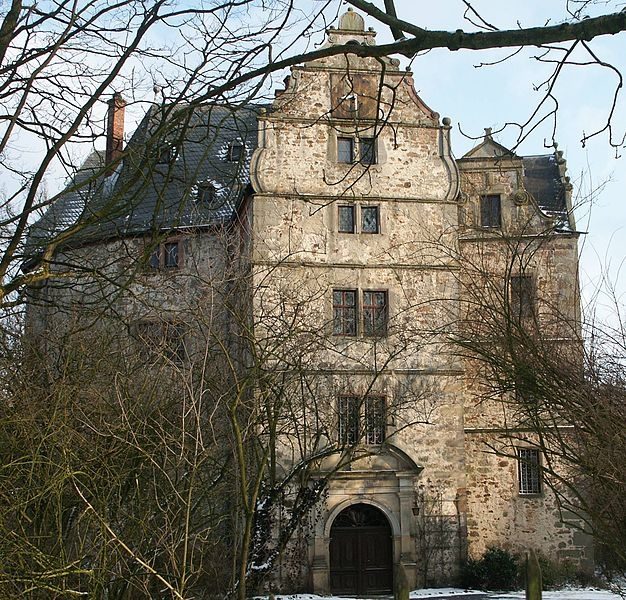
Hausen Castle is a castle in the Hausen district of the North Hessian municipality of Oberaula in the Schwalm-Eder district.
The village of Hausen was first mentioned in a document in 1160. At least since the 13th century, there was a moated castle of the Fulda Abbey, on the remains of which the Barons of Dörnberg built their Renaissance castle in 1674.
In 1311, Abbot Heinrich IV of Fulda assigned an hereditary fief to Knight Wernher von Lebenstein for Hausen Castle, in order to better counter the influence of the Counts of Ziegenhain, who were cathedral vogts of Fulda, in Fulda affairs. At the same time, the village of Hausen received "town rights". In 1339, the Lords of Vinken were appointed as castellans in Hausen. After them, the Lords of Falkenberg were enfeoffed with the castle and office of Hausen. In 1356, Otto the Archer, son of the Hessian Landgrave Heinrich II, devastated the village during a feud between the Landgrave and the Fulda Abbot Heinrich VII von Kranlucken.
From 1366, the Counts of Ziegenhain were co-owners. In 1400, Abbot Johann I von Merlau sold the Fulda part of Hausen to the Archbishopric of Mainz, which appointed Werner von Schlitz, also known as Görtz, as bailiff. In 1425, Kurmainz pledged the castle to Werner von Schlitz, who later sold his rights to the Lords Schengwalt.
After the death of the last Count of Ziegenhain, Johann II, in 1450, the Ziegenhain half passed as a Fulda fief to the Landgraviate of Hesse, which later also gained sovereignty over the Mainz half. In the years 1461–1463, the castle came into the possession of the Dörnbergs, who are still the owners today. It was the Upper Hessian Hofmeister Hans von Dörnberg, previously bailiff of the widow of the last Count of Ziegenhain, who took over Hausen Castle and the Mainz share of the Oberaula court as a pledge from Archbishop Adolf II in 1461 and took possession of it as a permanent fief on October 30, 1463.
At the time of the Reformation and the Peasants' Wars 1524–1526, Hausen moated castle had three drawbridges: one to the north, south, and west.
Around 1600, the castle was converted into a Renaissance castle, which was conquered, destroyed, and completely plundered by Bavarian troops in 1642 during the Thirty Years' War. The castle walls still show the traces of the destruction. On the three-meter-thick foundations, one can see the starting points of the new masonry, which is much weaker. The reconstruction in its present form was completed in 1687 by Johann Kaspar von Dörnberg.
Construction of the Renaissance Castle+
About a quarter of a century after the end of the Thirty Years' War, the castle was rebuilt. A more comfortable Renaissance building with large windows was added to the old fortified structure in the north. The three drawbridges were renewed. The year 1687 above the portal of the main entrance marks the completion of the restoration work.
In the course of the castle renovation, the moats were also renewed, and a stone building was erected in the forecourt as a dwelling, fruit, brewing, and baking house.
Miscellaneous+
Hausen Castle is known as the birthplace of Wilhelm von Dörnberg, who was born here in 1768.
After the Second World War, Hausen Castle served as a refuge and residence for numerous relatives of the von Dörnberg family. At present, the castle is only inhabited by the von Dörnberg family.
The castle garden should also be mentioned. 30 m high ash trees, ancient chestnut trees, spruces, elms, red beeches, and willows form a dense wall of leaves around the castle. South of the castle, a fountain is located in the castle park, showing the year 1748.
Only a castle pond and a stream now bear witness to the former moat of the moated castle.
Take Mobile History with you
You are reading this text for free. Premium adds what matters on the road: descriptions read aloud, sites found through your camera, whole regions taken offline.
- Every description, including the ~17,700 Premium sites
- Audio guide: have descriptions read to you on location
- AR finder: see sites through your camera, with distance and bearing
- Unlimited saved sites
14 days free, then from €2.99 a month. Cancel anytime.
Source: Wikipedia · Licence: CC BY-SA 4.0
This description draws on the facts documented in the linked Wikipedia article; Wikipedia content is licensed under CC BY-SA 4.0. Wording and editing: Mobile History.
Location: 50.8441, 9.4583