Christian Youth Village Organization of Germany
Hausen Castle (Bad Soden-Salmünster)

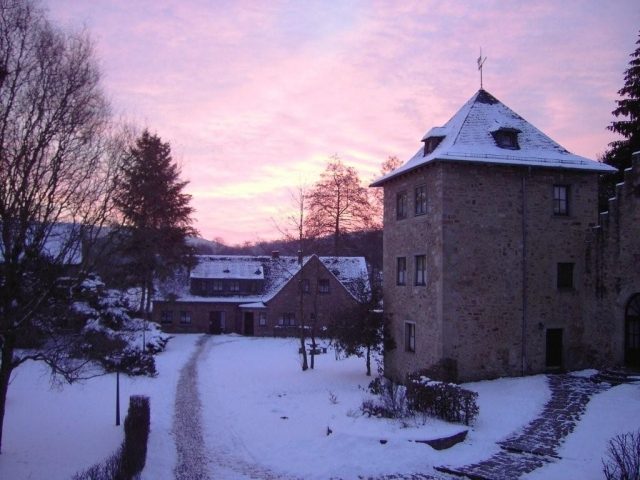
Hausen Castle in Bad Soden-Salmünster, Hesse, dates back to Hausen Castle near the village of Hausen (Husen) at the same location.
Today's Hausen Castle was originally designed as a water or motte-and-bailey castle, probably to secure access to the nearby Fulda possessions. The field name "Häuser Dick" may indicate a (now vanished) landwehr, consisting of thickets and/or a ditch.
The extensive castle complex is first described in a 1540 inventory created on the occasion of its sale to Mainz. In addition to the central tower and Kemenate building, the castle included numerous farm buildings, including sheepfolds and a mill. The administrative building of the Amtskellerei, built in 1581, has been preserved in its original state, while the old tithe barn (built around 1530) was renovated and converted by a private investor between 2004 and 2008.
Castle Phase
The place is first mentioned in a document in 1319 as Husen. The mention was made in connection with a donation from the Abbot of Fulda to the hospital in Salmünster, which included the reverted fiefs of Vogt Konrad. Konrad came from the family of Jazza or Jossa, who are considered the builders of Hausen Castle.
In 1345, Friedrich von Hutten bought the estates in Hausen. However, the property disintegrated through inheritances, pawns, and partial sales, so that the co-owners were repeatedly forced to appoint arbitration courts to settle disputes between them. Hans von Hutten zum Stolzenberg acquired the ownership rights of his cousins from the Franconian line of the Huttens in 1430, thereby establishing a third line of inheritance, namely that of the Lords of Hutten zu Hausen.
To consolidate their family property, the Lords of Hutten zum Stolzenberg concluded a new castle peace with their cousins in Hausen in 1517. However, Frowin von Hutten soon lost his estates in Hausen: his role in the Knight's War cost him all his possessions for a short time in 1522. He only managed to reacquire them in 1526. However, shortly before his death in 1529, Frowin transferred his share in Hausen to the competing Franconian relatives, much to the annoyance of the Stolzenbergs. The disputes between the two lines finally led to the sale of the Franconian shares to Kurmainz (1540).
Palace Phase
The Archbishop of Mainz, Daniel Brendel von Homburg, achieved the final settlement with the Hutten neighbors in 1558. Hausen Castle was transformed into a palace and became an administrative seat.
In the 18th century, the Oberamt Hausen lost importance until the administrative seat was moved to Orb at the end of the century.
Contemporary Use
The dilapidated castle complex was bought by the European Film Union in the early 1950s and underwent extensive renovation. However, the established hotel business had to be closed in 1955 due to financial problems of the investor, and the castle changed hands again. Since 1981, the complex has belonged to the Christliches Jugenddorfwerk Deutschlands.
Take Mobile History with you
You are reading this text for free. Premium adds what matters on the road: descriptions read aloud, sites found through your camera, whole regions taken offline.
- Every description, including the ~17,700 Premium sites
- Audio guide: have descriptions read to you on location
- AR finder: see sites through your camera, with distance and bearing
- Unlimited saved sites
14 days free, then from €2.99 a month. Cancel anytime.
Source: Wikipedia · Licence: CC BY-SA 4.0
This description draws on the facts documented in the linked Wikipedia article; Wikipedia content is licensed under CC BY-SA 4.0. Wording and editing: Mobile History.
Location: 50.2699, 9.3807