School
College
Heessen Castle

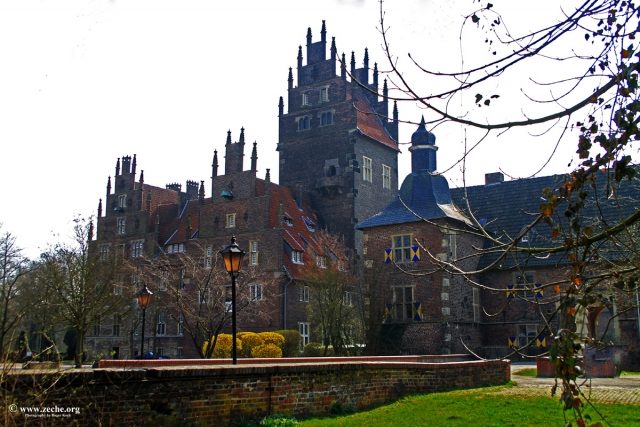
Heessen Castle is a castle complex located on the Lippe river in the Heessen district of Hamm and is the most renowned knight's seat in the area of today's city of Hamm. The three-winged main building is built of brick and features two 30-meter high stepped gables as its most striking architectural elements.
The estate is first mentioned as Hesnon in a document by Emperor Otto II from the year 975, as the hereditary property of the Bishop of Osnabrück. Around 1200, Countess Mathilde brought the estate as a dowry into her marriage with Count Arnold von Altena. The manor thus came into the possession of the Counts of Altena-Isenberg.
The murder of Archbishop Engelbert I of Cologne by Arnold's son Friedrich von Isenberg led to a bitter inheritance dispute between Friedrich's son Dietrich von Altena-Isenberg and his cousin, Count Adolf I von der Mark, known as the Isenberg Feud. The Peace of 1243 ended the warlike conflicts between the houses of Altena-Mark and Isenberg-Limburg and awarded the curtis hesne to the House of Limburg. Until its allodification in 1775, the court at Heessen remained a Limburg, then Bentheim-Tecklenburg fief.
The Counts of Limburg did not use the court themselves as a residence but handed it over to their ministerials. Initially, it was given to the von Rinkerode family, who also held the main court (Dren-)Steinfurt as a fief. Gostie, the daughter of the last Rinkerode named Gerwin, brought the Rinkerode inheritance to Dietrich von Volmerstein at the beginning of the 14th century. His grandchildren built a new moated castle about 500 meters to the east after 1350, which was better protected by the Lippe and was temporarily a Markish fief. When Johannes II von Volmerstein died in 1429, the houses of Heessen and Steinfurt fell to his sister Agnes. She, in turn, was the wife of Godert von der Recke zu Heeren. Their common son Dietrich von der Recke had himself enfeoffed by Emperor Sigismund in 1437 with the Volmerstein male fiefs and free seats. With him, a branch of this important Markish noble family took possession of Heessen for ten generations. Dietrich had a new manor house built. Between 1590 and 1600, his descendant Jobst von der Recke renewed the buildings of the outer bailey. In 1745, Adolf von der Recke died childless. Thereupon, Heessen, with the associated estates of Wolfsberg, Kurl, and Dahl, fell to his sister Anna Elisabeth. She, in turn, was married in a likewise childless marriage to Franz Arnold von der Recke from the Steinfurt line, which had separated in 1468. After his death in 1762, Steinfurt fell to the Barons von Landsberg. Heessen, however, was bequeathed by the childless Anna Elisabeth von der Recke in 1775 to a grandson of her aunt Joanna Rosine von der Recke, Baron Friedrich Joseph von Boeselager zu Nehlen and Höllinghofen.
The Protestant side of the von der Recke family did not agree with this donation, so von Boeselager's taking possession in 1778 triggered a decades-long legal dispute before the Imperial Aulic Council with the von der Recke zu Stockhausen, who descended from the Steinfurt line, with varying success. The legal representative of the von der Recke was Eberhard Friedrich von der Recke-Stockhausen, Prussian Minister of Justice since 1784. During this time, Heessen was still a "Herrlichkeit with jurisdiction" (abolished in 1812). Courts existed in the village of Heessen, in front of the castle gate, or on the bridge to the castle. The court sword is now in Höllinghofen, the residence of the Barons von Boeselager.
The legal dispute was primarily decided by changes in "grand politics." When the Prussian rulers became the new sovereigns in 1803, this happened to the advantage of the von der Recke. King Friedrich Wilhelm III finally decided ex officio in 1806 to return the estate to the von der Recke.
In 1806, the war between France and Prussia began, ending with the defeat of the Prussians in the Battle of Jena and Auerstedt. Napoleon Bonaparte, together with his Dutch allies, occupied Haus Heessen. The Prussian commission was dissolved.
After the incorporation of Münsterland into the Grand Duchy of Berg, the von Boeselager were provisionally reinstated in their old property rights on February 16, 1808. On September 21, 1810, the von der Recke concluded a settlement with the von Boeselager. For 66,000 Reichsthaler, they ceded all claims. In the Wars of Liberation of 1813, Heessen also suffered greatly, for example, from plundering soldiers from Poland, France, Russia, Saxony, Sweden, and Hanover.
As often in these years, the weather caused concern. Winters and springs were often unusually cold. In 1816, continuous rain and floods destroyed the harvest. In the winter of 1820, temperatures dropped to as low as -16 degrees Celsius. This endangered the lock at the castle and the buildings. Fish froze in the ponds, and there was a shortage of drinking water.
Haus Heessen has been rebuilt repeatedly over the centuries. Until the 19th century, the old castle, which had also been four-winged in earlier times, still stood. The 14th-century foundation consists of thousands of massive oak piles, on which the entire masonry rests and which already served as the foundation for its predecessors. They are constantly below the groundwater level, so they have survived the centuries almost undamaged.
In 1782, the manor house was rebuilt. From 1812, the property was managed exclusively as a large agricultural and forestry estate, including its own brickworks and brewery, whose land ownership steadily grew through the acquisition of surrounding farms and areas. In 1816, paved roads were laid. Running water reached the house via a pumping station, and in 1825, there was a sewage system. In 1826, the house was significantly rebuilt and whitewashed. Open fireplaces were replaced by cast-iron stoves. The first water closet from England was installed in 1846. There was a private brickworks and a castle brewery (1837). From 1839, the so-called "Bavarian Cellar" was built as a storage vault (today at the intersection of Schlossstraße/Dolberger Straße).
Rebuilt and redesigned several times under its various owners, the estate regained its old forms between 1905 and 1908, as they had existed in 1782, and thus its present appearance. The architect was Alfred Hensen from Münster, who gave the building a neo-Gothic appearance with tower constructions, Gothic battlements, and a castle chapel in the English style. At the same time, the park facilities surrounding the castle were expanded.
West of the gate, a Baroque garden was laid out around 1805 (riding path and central point still preserved). Around the same time, the so-called Rose Garden was created, a park in the English landscape style. Here, on September 18, 1826, Carl von Boeselager (1802–1869) and Adolfine von Wolff-Metternich (1808–1879), a friend of Annette von Droste-Hülshoff, who was also a guest in Heessen, celebrated their wedding. Little remains of both garden complexes today.
In 1828, the so-called "Liebesinsel" (Love Island) was created, a small park landscape in the shape of a triangle (300 m × 200 m × 200 m) between a Lippe weir arm and Alt-Lippe. Nowadays, the island consists of a small forest with a circular path.
Since the death of Baron Dietrich von Boeselager in 1920, Heessen has no longer been the family's residence. Since 1957, the buildings have housed a rural boarding school and private boarding school (Gymnasium).
In 2008, the film The Wild Chicks was shot in and around Heessen Castle.
Buildings+
The Schloss Heessen rural boarding school is divided into four buildings. Probably the largest building is the main building. It offers not only the large and small dining halls but also the teachers' room, kitchen, internet room, beverage storage, secretariat, classrooms, and living quarters for the junior and middle school boys and girls. The chapel is also in this building. In addition, there is a rent office, which has been converted into quarters for middle and senior school boys and classrooms. This building also contains the so-called "Vault," which is an in-house bar and restaurant. Celebrations are usually held here. Next to be mentioned is the gatehouse. This contains both quarters for senior school boys and additional classrooms. The cafe, which offers drinks, bread, and sweets, is also located here. The newest building is the school building. Initially, it still contained quarters, but these have been relocated, and now the functional rooms and classrooms are located here.
Take Mobile History with you
You are reading this text for free. Premium adds what matters on the road: descriptions read aloud, sites found through your camera, whole regions taken offline.
- Every description, including the ~17,700 Premium sites
- Audio guide: have descriptions read to you on location
- AR finder: see sites through your camera, with distance and bearing
- Unlimited saved sites
14 days free, then from €2.99 a month. Cancel anytime.
Source: Wikipedia · Licence: CC BY-SA 4.0 · Image: http://www.zeche.org/
This description draws on the facts documented in the linked Wikipedia article; Wikipedia content is licensed under CC BY-SA 4.0. Wording and editing: Mobile History.
Location: 51.6986, 7.8478