CastleDüsseldorf-Angermund

Heltorf Castle
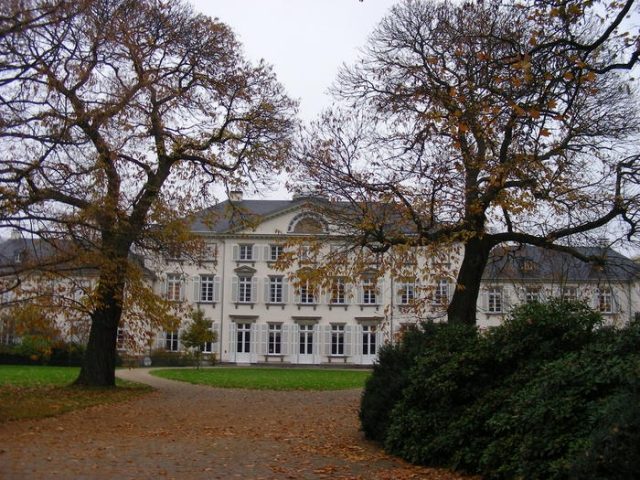
Heltorf Castle

To be privately owned

Heltorf Castle is located in the Angermund district of Düsseldorf, in the north of the city, on the Angerbach stream. It is surrounded by an English landscape garden.

The castle was built to administer the agricultural and forestry estates in the surrounding area. It is a moated castle. Forestry has been practiced in the area since the 12th century.

Heltorf is first mentioned in the 11th century as Hof Helethorpe in the rent roll of Kaiserswerth Abbey.

Early owners were the Lords of Heldorp. Otto von Heldorp is already mentioned as the owner of Heltorf Castle in 1167. He also appears in the document from approx. 1189, in which Nobleman Arnold von Teveren pledges his entire property on the right bank of the Rhine in Holthausen, Düsseldorf, Buscherhof, Eickenberg near Millrath, Monheim, Himmelgeist, on the Rhine bank near Holthausen and on the Anger for 100 Marks to Engelbert von Berg. Zobodonus de Heldorp, presumably identical with Albertus called Zobbe von Heltorf, mentioned at the same time, appears as a witness at the granting of city rights to Düsseldorf in 1288.

In 1360, Heltorf was sold by Adolf von Graschaf and his wife Jutta von Stein to Thomas von Lohausen called Troisdorf and his wife Aleide von Geynhoven. Heltorf remained in this family, who later called themselves von Troisdorf, for 5 to 6 generations, until the heiress Maria, daughter of Sibert von Troisdorf, brought it into her marriage with Wilhelm von Scheid called Weschpfennig in 1569.

Their granddaughter Maria, daughter of the Ducal Grand Master Johann Bertram von Scheid called Weschpfennig and Margaretha von Tengnagel, married Friedrich Christian von Spee in her second marriage at Haus Böckum in 1649. Thus, Heltorf Castle came into the possession of the Counts of Spee in 1662, after the death of Maria's parents, where it remains today.

Building+

The manor house was rebuilt in the early 19th century in the Neoclassical style according to plans by the Essen architect Heinrich Theodor Freyse. Inside, the frescoes of the Barbarossa cycle in the large garden hall are remarkable: the reconciliation of Frederick and the Pope in Venice and a supraporte are an early work from 1826 by the history painter Karl Stürmer, the main part of the hall's decoration was taken over by Heinrich Mücke with The Lifting of the Ban on Henry the Lion at the Imperial Diet in Erfurt (completed 1829), Humiliation of the Milanese from 1833, Frederick I's Imperial Coronation and a supraporte painted in grisaille in 1837, as well as in 1838 the individual paintings St. Bernard Preaching the Crusade and Bishop Otto von Freising, Carl Friedrich Lessing painted the Battle of Iconium in 1831 and Hermann Freihold Plüddemann painted the Storming of Iconium by Frederick of Swabia in 1840, and Frederick's Death in 1841. In addition, the castle possesses an extensive collection of old books, the Gräflich von Spee'sche Bibliothek Schloss Heltorf in the tower-like neo-Gothic extension built specifically in 1862 by Count Wilhelm by the Cologne Cathedral Master Builder Vincenz Statz.

The castle is not publicly accessible.

Mass celebrations are held every Sunday at 11:00 a.m. in the castle chapel next to the manor house.

Castle Park+

The castle park is laid out as an English woodland park, with the castle pond at its center. The idea for the English-style garden came from the French Abbé Biarelle in 1796. It was executed by Maximilian Weyhe in 1803. Special features include exotic woody plants from that time, such as Germany's second oldest rhododendron planting, which is worth seeing. The park covers an area of 54 hectares. It is open – for an entrance fee – from May 1st to October 31st on Saturdays, Sundays, and public holidays from 10:00 a.m. to 6:00 p.m.

Every year on Ascension Day at 4:00 p.m., a Marian celebration is held in the castle park in the open air with guests from the surrounding villages.

Agriculture and Forestry+

The forestry operation continues at Heltorf Castle. The management is based on the principle of sustainable management. The castle owns extensive land in Düsseldorf and the southern Ruhr area.

Take Mobile History with you

You are reading this text for free. Premium adds what matters on the road: descriptions read aloud, sites found through your camera, whole regions taken offline.

  • Every description, including the ~17,700 Premium sites
  • Audio guide: have descriptions read to you on location
  • AR finder: see sites through your camera, with distance and bearing
  • Unlimited saved sites

14 days free, then from €2.99 a month. Cancel anytime.

Source: Wikipedia · Licence: CC BY-SA 4.0 · Image: http://www.wehrbauten.de/thread.php?threadid=572

This description draws on the facts documented in the linked Wikipedia article; Wikipedia content is licensed under CC BY-SA 4.0. Wording and editing: Mobile History.

Location: 51.3423, 6.7705