CastleImmenstaad am Bodensee-Hersberg

Hersberg Castle
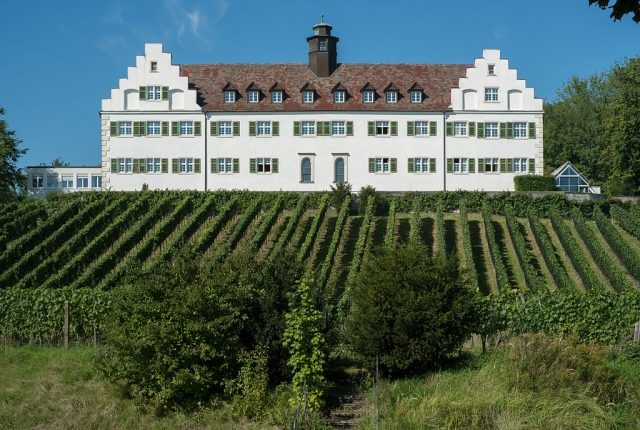
Hersberg Castle

Conference center

Hersberg is first mentioned in 1276 in connection with "Berctoldus et Henricus de Herisberch". On April 16, 1286, Heinricus von Hersperg is named as a witness in a deed of donation to the Baindt monastery. The Lords of Hersperg, who held low jurisdiction in this area, lived in a "wooden building resting on a stone support". In 1466, Jos. Rudolf from Überlingen calls himself "Jos Rudolf von Hersberg" as the owner of the estate. The squires of Hersperg subsequently served alternately in the service of the House of Austria, the Counts of Heiligenberg, the Imperial City of Überlingen, and the City of Constance. In 1550, the frontal building with its Gothic stepped gables, still widely visible today, was erected by Hans Rudolf von Hersperg. From 1595 to 1614, the trial of Ferdinand von Hersperg with the Bishop of Constance, the Count of Heiligenberg, and the St. Johann Abbey in Constance took place due to severe poaching and embezzlement of feudal property. In 1621, Abbot Bartholomäus Ehinger of Ochsenhausen bought Hersberg Castle and vineyard for 31,000 guilders from the widow of Ferdinand von Hersperg. From 1658 to 1780, the castle was modernized in the style of the time. A belvedere tower was erected on the frontal building, the east wing was extended, the castle church was baroque-ized, stucco ceilings were installed in various rooms of the house, and a flowing fountain was created in the inner courtyard. In 1779/80, the Imperial Abbey of Ochsenhausen acquired the county rights over Hersberg from the Prince of Fürstenberg, and thus high jurisdiction. In 1803, Hersberg came into the possession of the Austrian State Minister Wenzel von Metternich as a result of the secularization of the Imperial Abbey of Ochsenhausen. In 1831, Metternich sold Hersberg to the Württemberg Baron Gremp von Freudenstein. In 1838, Prince Konstantin von Salm-Reifferscheidt-Krautheim, adjutant to the Grand Duke of Baden, bought the "manor in an exceptionally beautiful location with a magnificent view". In 1846, the Württemberg exclave of Herrschberg became Baden through an exchange with Waggerhausen near Friedrichshafen. On February 7, 1929, the "Society of the Catholic Apostolate" (SAC) bought Hersberg Castle from Prince Franz Josef von Salm Reifferscheidt-Dyck. On May 19, 1930, the Pallottines (SAC) opened the late vocations seminary "St. Josef-Hersberg". In 1940, the school was closed. The house was then occupied by Bessarabian Germans.

In 1945, 22 prisoners and their guards from the Wehrmacht fortress prison in Küstrin were taken in, who were to be brought to safety from the enemy. These were officers in "Sippenhaft" (kin liability) in connection with the assassination attempt on Hitler. From 1945 to 1947, the castle served as barracks for the French occupation troops. From 1947 to 1992, school operations resumed, initially as a preparatory grammar school, then as a grammar school. Hersberg was massively expanded by the addition of the east wing (1956), the construction of the economy building (1960), and the large new school building (1968). Due to declining student numbers, the school was closed in 1992. From 1992, the complex was converted into an educational center. In October 1994, it was inaugurated as the Spiritual House of the Pallottines. An estimated 800 visitors came to the open day and admired Hersberg, which shone in new splendor with its premises.

Take Mobile History with you

You are reading this text for free. Premium adds what matters on the road: descriptions read aloud, sites found through your camera, whole regions taken offline.

  • Every description, including the ~17,700 Premium sites
  • Audio guide: have descriptions read to you on location
  • AR finder: see sites through your camera, with distance and bearing
  • Unlimited saved sites

14 days free, then from €2.99 a month. Cancel anytime.

Source: Wikipedia · Licence: CC BY-SA 4.0 · Image: http://commons.wikimedia.org/wiki/File:Immenstaad-5033.jpg

This description draws on the facts documented in the linked Wikipedia article; Wikipedia content is licensed under CC BY-SA 4.0. Wording and editing: Mobile History.

Location: 47.6661, 9.3543