CastleBeverungen - Herstelle

Herstelle Castle
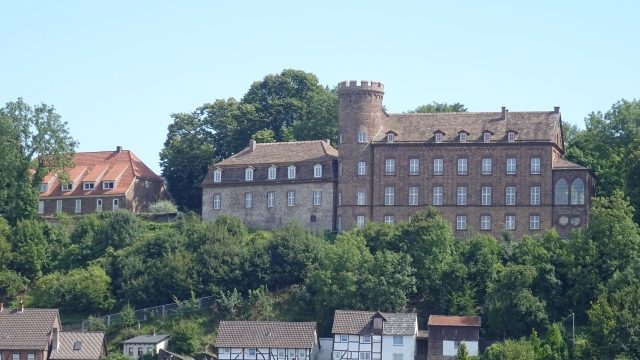
Herstelle Castle

To be privately owned

Herstelle Castle is a hilltop castle on an elevation in the Weser valley above the district of Herstelle in the town of Beverungen in North Rhine-Westphalia.

The hilltop castle was initially built in the early Middle Ages as a ringfort above a strategically important Weser ford. The construction period is unknown. From the 7th century, Saxons settled the area. In 797, they tried to defend the ford and the castle against Charlemagne but were defeated, as evidenced by the field names "Kemperfeld" (Fighter's Field) and "Totengrund" (Dead Ground). Charlemagne established his winter quarters here and named the castle Heristal Saxonicum. With this, he intended to announce Heristal's future function as a capital with an episcopal see for Saxony. Heristal in Francia, today also just a village (on the Meuse), was the cradle of the Pippinids and Charlemagne's main residence from 758 to 784, a main residence of the Frankish Empire and the place where the "Haristalense" (Capitulary of 779) was issued. On October 28, 797, a less harsh policy towards the Saxons began with the Capitulare Saxonicum. In Heristal Saxonicum, numerous wooden buildings were initially erected for the new Frankish settlement under the protection of the ringfort. The importance of this emerging royal palace at the time is also evident from the fact that Charlemagne's winter quarters unusually extended there until May 798.

It is not known why Paderborn, at the intersection of the Westphalian Hellweg and the Frankfurter Weg, became the episcopal see in the following year. Presumably, the sudden flight of Pope Leo III from Rome to the Paderborn palace due to accusations of adultery played a role here. The Pope secured the help of the powerful Frankish king not only by recognizing a bishopric in Saxony as early as 799 but also by Charlemagne's coronation as Roman Emperor at Christmas 800. Heristal Saxonicum, only two years after its founding, was far from being as developed as the Paderborn palace, which was founded in 776.

The Karlstein (Charlemagne's Stone) is intended to commemorate this earliest period of the castle. This rock table, only a few hundred meters from the castle on a cliff above the Weser, was created in 1835 during blasting for a chaussée (today's B 83). After 1835, the oldest cross stone in Westphalia, often referred to as the Boniface Cross, was also moved to this location and marked with the year 797 in memory of Herstelle's early history. Its origin is not known. W. Brockspäler describes it in his standard work "Steinkreuze in Westphalen" (Münster 1963, p. 63f) as possibly Old Frankish and writes of a possible stonemason in Charlemagne's entourage who might have crafted the cross "after the pattern of similar monuments in his homeland." The Boniface Cross could have come from the castle itself because the creation of the Karlstein in 1835 corresponds well in time with the modern construction work on the castle from 1825 to 1832. Furthermore, the spatial proximity of the castle and the Karlstein supports this. However, there is no proof.

The late medieval Herstelle Castle was first mentioned in 1292 as property of the Bishop of Paderborn. After being pledged in the first half of the 14th century, Bishop Simon II (1380-89) appointed the Knights of Falkenberg as officials there. On July 24, 1464, soldiers of the Hessian Landgrave Ludwig II, in a feud with Bishop Simon III (1463-98) in the Hesse-Paderborn Feud (1464-71) over Calenberg Castle and town, laid Herstelle Castle and village in ruins. By the end of the 15th century, the inhabitants rebuilt the castle and village with episcopal support.

Again plundered and burned down during the Thirty Years' War, another (almost complete) reconstruction of the castle took place around 1650. At the beginning of the 19th century, it finally fell into disrepair. However, some sections of the curtain wall, the former episcopal-Paderborn administrative building (1798) - a single-story, five-axis plastered building with a mansard roof - and a barn from 1757 still exist. After that, the castle served as a recreation area for various owners until 1983.

The current building was constructed between 1825 and 1832. In 1823, Fernandine Heereman von Zuydtwyck, a daughter of Werner Adolph von Haxthausen, acquired the complex and commissioned the Koblenz architect Johann Claudius von Lassaulx to build a new castle, slightly west of the old one. In 1832, the castle was completed, incorporating the idea of a castle complex in its architectural elements. The unplastered main house, built of quarry stone, represents the palas. The round stair tower to the right, with a round-arch frieze and battlements, is intended to evoke the keep. Both are located behind a short stone bridge, to which a seven-step staircase leads. In the 19th century, renowned artists and scientists, including Annette von Droste-Hülshoff and the Brothers Grimm, met at the castle. Neo-Gothic portal: The facades of the three-story castle are regularly structured by pilaster strips, a multi-layered wall construction, and a round-arch frieze in the eaves area. The windows frame red sandstone walls with profiled triangular gables. A high gable roof covered with Weser sandstone slabs and dormer windows in two rows crowns the building. The building, with its high Weser sandstone, is entered through a two-winged, Neo-Gothic portal with tracery decorations. On the opposite west side, a conservatory, extending over the entire width, is built on a high plinth floor. Today, after its restoration, the castle is in private ownership.

Take Mobile History with you

You are reading this text for free. Premium adds what matters on the road: descriptions read aloud, sites found through your camera, whole regions taken offline.

  • Every description, including the ~17,700 Premium sites
  • Audio guide: have descriptions read to you on location
  • AR finder: see sites through your camera, with distance and bearing
  • Unlimited saved sites

14 days free, then from €2.99 a month. Cancel anytime.

Location: 51.6405, 9.4169