Private Ownership
CastleLingen
Herzford Castle
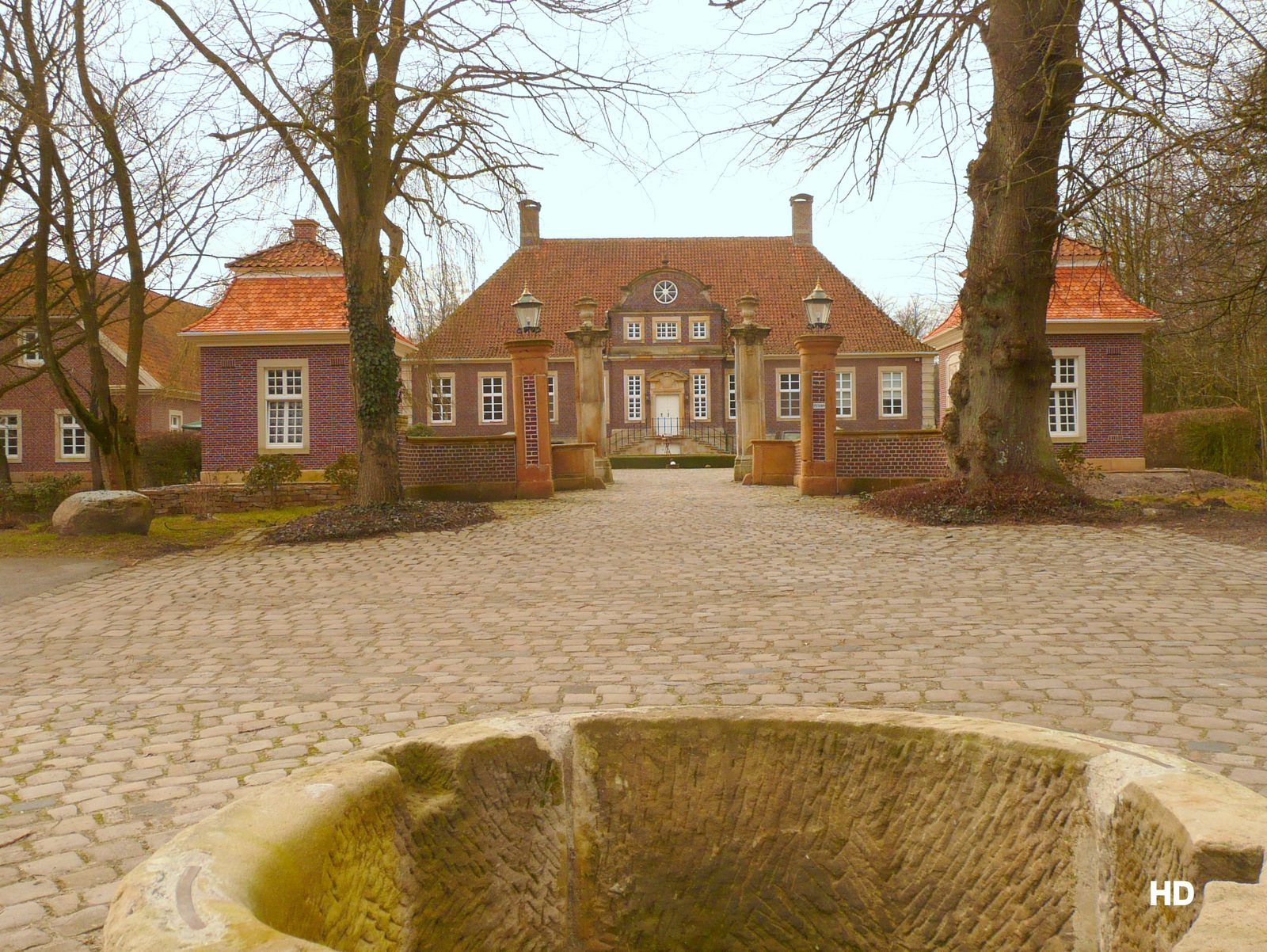
Herzford Castle is a moated castle near the town of Lingen in the southern Emsland. It was built in 1337 as the castle "thor Slipse" on the left bank of the Ems. Under the Münster court councilor and tenant Anton Helweg and the von Schorlemer family, the baroque manor house was built between 1717 and 1723, its architect being the Münster master builder Gottfried Laurenz Pictorius (1663–1729). The bridge system, the outer bailey and the gardens were planned by the late Baroque master builder Johann Conrad Schlaun. Herzford Castle changed owners many times. The Duke of Arenberg acquired it in 1853, who brought his Emsland property into Arenberg-Meppen GmbH in 1928. Until 1970, the castle complex continued to deteriorate. Then a Lingen manufacturer bought it and restored it.
Geography+
Location and Traffic+
The Herzford estate is located in the Lingen district of Schepsdorf on the left bank of the Ems, 3 kilometers south of the village of Schepsdorf. The estate is popularly known as "Vorgarten" (front garden). It is located on the edge of the Lingener Höhe. The "Herzforder Straße" (in the direction of Schepsdorf in the north and in the direction of Elbergen in the south) and the "Schottelhof" road (in the direction of Lohne in the west) lead through the Herzford estate district. Herzford is located near the federal highway 31 and not far from the intersection of federal highways 70, 213 and 214, which lead as bypasses around the city of Lingen.
Nature and Estate District+
Originally, Herzford had only a small, independent estate area when the district and the castle were established. It is known from reports that even in the 18th century, the grazing cattle from Elbergen were watered from the castle moat. The estate grew under the ownership of Schorlemer, to whom the local chapel had been given by the Elbergen commoners for the donation (tower construction), and larger common lands were ceded to him. A post mill stood on the edge of the Herzford forest between 1700 and 1939. In 1847, the rights of the estate were listed as follows: Landtag eligibility, i.e. an independent estate district with representation in the Landtag; private hunting on the estate, joint hunting, i.e. communal hunting in the parishes of Schepsdorf, Emsbüren and Salzbergen and the Münster enclaves on the right bank of the Ems with the authority to employ a salaried hunter and also to issue two hunting licenses. Fishing on the Ems was only permitted on the Herzford side along the estate boundary of approximately one mile (1.61 km). In 1852, the size of the estate was 617 Morgen (2.497 km²) of farm land, 800 Morgen of land in the large moor, 14 Morgen of woodland and 22 Morgen of meadows in the Elbergen Mark, as well as 100 Morgen in the Fuhrenkämpen of the Lohne Mark. Through land purchases and further requests, the area of Herzford increased to about 467 ha. Forest workers erected a wayside cross in Herzford forest in 1879 with their own funds. In the 1970s, the Heuerling families Bertling, Lambers, Menger, Rickling, Schomaker and Wenning moved to Schepsdorf. The former estate district also includes the farmsteads Schottelhof (now the Berling family), Bekel (later Bickers) and Hofschlag. The forests of the surrounding Herzford forest estate are owned by Arenberg-Meppen GmbH. Since 1989, the non-profit "Stiftung Herzog Engelbert-Charles und Herzogin Mathildis von Arenberg", named after the last owner couple, has been the sole shareholder. In the 1980s, the forest estate lost larger forest areas in the north due to the construction of federal highway 213 and in the 1990s in the west due to the construction of the A 31 motorway, which by 2010, mainly in the northwest, and most recently also through land exchange, regained its previous size. Today, the Herzford property comprises forest and agricultural land of around 467 ha (4.67 km²). The Herzford forest is a mixed forest and consists predominantly of pines, oaks, spruces, larches, beeches and Douglas firs.
History+
Naming+
In 890, the name "Hriesforda" (deer ford) was first mentioned in writing in the Werden tax register. In the Lingen region, the Ems formed several "Slipse" (also "Schlipse"), referring to a small strip of land. At that time, extensive deciduous forests with clayey soil were present along the Ems, where many deer lived. Today, meter-thick leaf deposits are still found in places in the Ems; for example, a sensational find of well-preserved deer antlers in the Ems riverbed a few years ago. The name Herzford developed from the original name Hirschfurt. Some sources (registers, maps, documents...) give various spellings, including Herzeforth, Herzenfurth, Herseforth, Hersenword, Herssevoerde and Herzfurt(h).
Castle "thor Slips" and Construction of Herzford Castle+
Bishop Ludwig II of Münster (1310–1357) had important reasons to build the castle "thor Slips bey Herzeforth" in 1336. The bulwark was intended to be directed against Count Nikolaus I, called Claus, of Tecklenburg and against the predatory Bentheimers (County of Bentheim) and Ottensteiners (County of Ahaus). With this, the bishop wanted to protect his Emsland possessions and secure the important connection via the main road from Rheine via Meppen to his northern Emsland territories, the Hümmling and East Frisia, which led to the left-Ems district of Elbergen. From the northern part to the southern part of the Diocese of Münster, the "connecting piece" Herzford between the counties of Bentheim (in the west) and Tecklenburg (in the east) was five kilometers long at its narrowest point. A Baron von Langen is demonstrably named the first castellan with the words "uppe dat hus, dat he tymmern denket thor slipse". Shortly before completion in 1337, the castle was destroyed by the two Counts Nikolaus I of Tecklenburg and Count Simon of Bentheim. Only in 1346 was the castle rebuilt at the instigation of the Münster Bishop Ludwig II. At the same time, he had to make great concessions to Count Otto III of Bentheim, including accepting him as the new castellan. In 1363, Bishop Johann I of Münster appointed Baron Cord von Langen as castellan. Count Otto VI of Tecklenburg attacked the castle and destroyed it. Bishop Heidenreich of Münster had a new castle built in 1385 near the old castle at the Slipse. He allied himself with Bishop Dietrich of Osnabrück and together they marched victoriously against Count Otto VI of Tecklenburg. Castle "thor Slips" then came under Münster ministerial (administration). In 1400, Count Nikolaus II of Tecklenburg renounced all rights to the castle with the statement: "an dem Slote van Herssevorede by der Slypse". This became meaningless and was razed. In 1432, the estate passed to Count Hermann von Münster from the Meinhövel and Botzlar family. From 1732 to 1734, the present Herzford Castle was built on the foundations of the demolished castle. The cross vaults in the cellar of the former castle have been preserved to this day.
Castle and Palace Owners+
After the futile attempts of Bishop Ludwig II of Münster to build the castle "thor Slips" against Lingen, his successor Bishop Heidenreich of Münster continued the fight against Count Nikolaus II of Tecklenburg. Weakened by a long and unfavorable feud with Osnabrück, he initially sought peace. The soon rekindled hostilities ended with the capture of the count, resulting in heavy losses for him. Thus, on June 20, 1400, he had to renounce all rights to the Herzford estate and to the left-Ems main road between Rheine and Meppen. After the breaking of Tecklenburg's power, Herzford lost military significance and the castle was demolished. The Herzford estate district came under Münster administration in 1400. In 1432, it was in the possession of Count Hermann von Münster from the Meinhövel and Botzlar family, who, when he was enfeoffed in that year with his family's castle fief located in front of Bentheim Castle, was referred to as "Lord of Herzford". In 1442, he married Gertrud von Langen, whose coat of arms featured lozenges, in his second marriage. The marriage remained childless. Herzford passed to his nephew Count Heinrich, son of Hermann's brother Count Bernhard (his wife Johanna von Ruinen, the heiress of the Lordship of Ruinen). Count Heinrich von Münster was married to Agnes de Vos van Steenwijk. His son Rolof von Münster was married to Bawina Heemstra, from Haus Duirsum (Dan Ham) near Loppersum (NL). He became Drost of the Dutch Amt Coevorden and the Province of Drenthe. In 1515, he was enfeoffed with the Bentheim castle fief and thus Lord of Herzford until his death around 1520. Their son Roelof van Münster († 1558) married Maria von Selbach (approx. 1510–1576) in 1535. They soon lived in Duirsum, both are buried in the church in Loppersum (gravestones). The grandson Roloff von Münster (1531–1600), enfeoffed with Herzford in 1563, was married to Ida von Onsta zu Sauwerd. Both can be admired today as large oil portraits in the Emslandmuseum in Lingen. Their son Count Roleff von Münster appears in the Münster Landtag lists from 1591 to 1654, the year of his death, because of Herzford. The enfeoffment with the Bentheim castle fief was granted to him in 1606. His marriage to Ela von Mönnich zu Eickhof remained childless. One of his sisters, Theodora, was married to Casper von Loen zu Borgenstede. The Herzford estate then passed to their son, the Rittmeister Franz Roland von Loen. In 1657, Rittmeister Franz Roland von Loen donated a new altar to the church in Schepsdorf. He still appears at Herzford in 1675. He was married to Marie Sophie von Loe zu Overdycke. Their son Johann Casper Rotger von Loen, who was enfeoffed with Herzford in 1700, died on November 13, 1702. With his wife Wilhelmine Johanna von Walfeld zu Klinke, he left behind a daughter Rotgera, who was married to Baron van Dongen. She was granted the enfeoffment with the Herzford estate in 1703 and 1708. Subsequently, on October 30, 1714, she sold Herzford to the Prince-Bishop of Münster, Franz Arnold von Wolff-Metternich, through the Münster court and chamber councilor Anton Helweg. On December 24, 1718, Prince-Bishop Franz Arnold von Münster sold the estate for 8,000 Reichstaler to Colonel Hermann Werner Joseph von Schorlemer (from the Overhagen line) and moved into the manor house in Herzford. The Schorlemer family belonged to the most important noble families of the Westphalian ancient nobility. Between 1717 and 1723, the castle was built on the foundations of the "thor Slipse" castle according to the design of the famous Münster master builder Gottfried Laurenz Pictorius. He was the architect of, among others, Nordkirchen moated castle, Dankern Castle and numerous noble estates in Münsterland. Only in 2011 was the building history of the castle redefined: samples of the building timbers were taken and the felling date was determined by dendrochronological analysis. Until then, it had always been assumed that the construction period was between 1732 and 1734. A historical correction must be made here. Above the castle portal and in the gable field of the rear side, the alliance coat of arms of the couple is affixed. Hermann Werner Joseph von Schorlemer later became Lieutenant General and Commander of the Münster troops. With his first wife, Baroness Antoinette Christine von Brabeck, he lived on the Herzford estate, where he also set up a chapel and employed a house chaplain. In 1740, Hermann Werner Joseph von Schorlemer agreed with the community of Elbergen that the house chaplain could hold services from Emsbüren in the local chapel on weekdays. Schorlemer built a tower on the Elbergen chapel and organized a large festival, which is still celebrated today in a large procession. Antoinette Christine von Schorlemer, née Baroness von Brabeck, died on June 12, 1735. Hermann Werner Joseph von Schorlemer then entered into a second marriage with Maria Alexandrine von Korff-Schmising zu Tatenhausen. Clemens August von Bayern, Prince-Bishop of Münster and Elector of Cologne, approved that Hermann Werner Joseph von Schorlemer could bequeath the estate to his second wife. A statue is still located at Herzford, on whose pedestal both coats of arms with the year 1742 are affixed. Around 1750, the most important master builder of Westphalian Baroque, Johann Conrad Schlaun, lived here for some time, wanting to implement his "Planum von Herseforth". This was to combine the lightness of Dutch broderie - parterre around a fountain basin with the exactly geometric, but then spatially massive penetration of moats and basins. A pavilion was to stand at the end of the garden along the central axis. Another plan design between 1775 and 1780 by Schlaun shows the layout of the gate and farm buildings and also the course of the moat in the garden. The plan was not implemented because utility was paramount. In addition to the castle, the following plans were realized: the graceful gate pavilions with mansard roofs next to the high bridge piers, which had to be demolished in 1950 due to dilapidation.
Source: Wikipedia · Licence: CC BY-SA 4.0 · Image: Famduling · Wikimedia Commons · CC BY-SA 3.0 de
This description is a machine translation of an excerpt from the linked Wikipedia article. The source text was written by its authors, the translation is by Mobile History; like the original it is licensed under CC BY-SA 4.0.
Location: 52.4763, 7.2854