To be privately owned
Hinterndobl Castle

Hinterndobl Castle is a small castle situated on a hill in the village of Hinterndobl, which belongs to Dorf an der Pram.
The actual builder of Hinterndobl Castle is unknown. The castle is first mentioned in 1560, its owner at that time was Leonhard Puchner (also spelled Puechner), administrator of Erlach, who obtained its elevation to a noble seat from the Emperor. His son Christoph Puchner was the builder of Puchberg Castle near Wels. His daughter Maria received Hinterndobl as a dowry when she married Hans Christian Wiellinger (Willinger) in 1570. A son from this marriage was the well-known peasant leader Achaz Wiellinger von der Au auf Hinterndobl, who was executed in Linz in 1627. Despite the execution of Achaz Wiellinger, Hinterndobl remained in the family's possession, as his son Johann Ernst (married in his second marriage to Anna Renata, née von Clam) had converted back to the Catholic faith. Anna Renata died on January 15, 1690, Johann Ernst on August 3 of the same year. In 1731, the property came into the possession of Baron Johann Ludwig von Gablkoven as the dowry of Maria Eleonora Wiellinger. Their son Achaz sold the lordship together with Innersee Castle in 1777 to Ernst Ignaz Gemberly, Knight of Weidenthal; the transfer of ownership then followed the same line of inheritance as Innersee Castle for about 100 years until approximately 1870, after which the properties were divided. The castle served for a long time as a brewery and as an inn (formerly the "Zum Bräu" inn).
Architectural History+
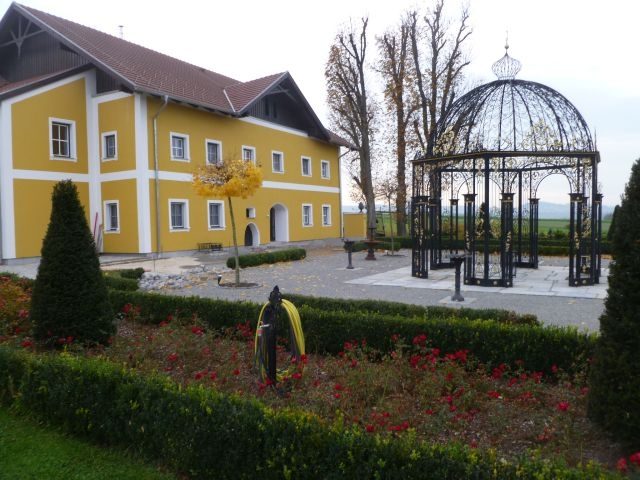
Hinterndobl Castle has undergone little change in the last 300 years until recently. The four watchtowers visible in Vischer's engraving have long since disappeared, as has the double-hipped roof. The attached Meierhof had previously lost its existing stable wing but was connected to the main wing by an arcaded passage. Today, this too has disappeared; instead, there is an extension with round arches and open arcades. The former castle chapel stood about 100 m from the castle; it was demolished in 1930. Inside the main building, a corridor runs through the entire house. It is equipped with a cross-rib vault. On the upper floor, Gothic wooden beam ceilings and door frames from the 16th century have been preserved. The current owner Josef Kaltenböck has converted the castle into a residential property with 12 apartments. In addition to the generously designed residential complex, the former castle is also intended to serve as a memorial to the Peasant War, according to a plaque placed in front of the entrance.
Take Mobile History with you
You are reading this text for free. Premium adds what matters on the road: descriptions read aloud, sites found through your camera, whole regions taken offline.
- Every description, including the ~17,700 Premium sites
- Audio guide: have descriptions read to you on location
- AR finder: see sites through your camera, with distance and bearing
- Unlimited saved sites
14 days free, then from €2.99 a month. Cancel anytime.
Source: Wikipedia · Licence: CC BY-SA 4.0 · Image: http://commons.wikimedia.org/wiki/File:Schloss_Hinterndobl_-_Hauptgeb%C3%A4ude_mit_Salettl.jpg
This description draws on the facts documented in the linked Wikipedia article; Wikipedia content is licensed under CC BY-SA 4.0. Wording and editing: Mobile History.
Location: 48.2554, 13.6250