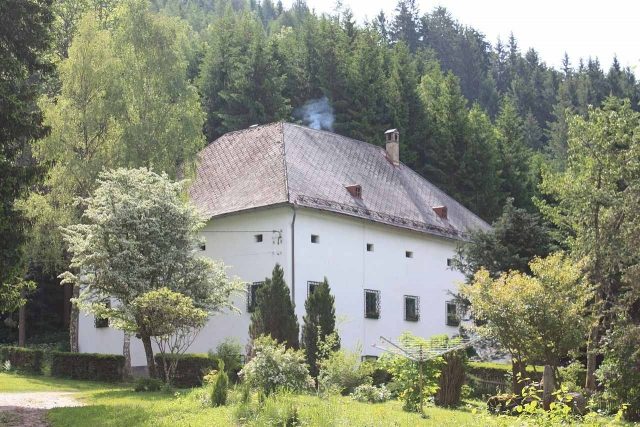
To be privately owned
Hörbach Castle
History of the Castle+
The castle was built by the Counts of Dietrichstein and later passed to the Bishops of Salzburg.
Early Beginnings and Construction+
The first documentary mention of a fortified structure at this location dates back to the year 1147. However, archaeological findings suggest that a settlement existed here much earlier. The actual construction of the castle, as we know it today, began in the 13th century under the rule of the Dietrichstein family.
Under their patronage, a mighty keep and the first residential buildings were erected. The strategic location on a hill offered excellent defensive capabilities and control over important trade routes.
Expansion and Golden Age under the Bishops+
In the 15th century, the castle came into the possession of the Prince-Archbishops of Salzburg. This period marked a significant phase of expansion and prosperity. The bishops recognized the strategic and representative importance of the castle and invested heavily in its development.
- Construction of the impressive chapel with its valuable frescoes.
- Expansion of the residential wings and the addition of stately halls.
- Fortification of the outer walls and the construction of additional towers.
During this time, the castle served not only as a defensive fortress but also as a summer residence and administrative center for the surrounding estates. Many important decisions were made within its walls, and numerous dignitaries were received here.
Challenges and Decline+
The 17th and 18th centuries brought various challenges. The castle suffered damage during the Thirty Years' War, although it was never completely conquered. Subsequent repairs were often carried out with a focus on functionality rather than artistic design.
With the secularization in the early 19th century, the castle lost its ecclesiastical significance and fell into state ownership. It was used for various purposes, including as a barracks and a granary, which led to further structural changes and a gradual decline in its original splendor.
Architectural Features+
The castle presents itself as a fascinating blend of Romanesque, Gothic, and Renaissance elements, reflecting its long and eventful building history.
The Keep+
The mighty, square keep forms the oldest part of the castle complex. With its thick walls and small, high-set windows, it is a prime example of Romanesque defensive architecture. It served as the last refuge in times of siege and as a symbol of power.
The Chapel+
The castle chapel, consecrated in 1480, is one of the most valuable parts of the complex. It impresses with its late Gothic ribbed vault and the well-preserved frescoes depicting scenes from the life of Saint Rupert, the patron saint of Salzburg. The altar, carved in wood, dates from the early 16th century.
Residential Wings and Courtyards+
The residential wings, arranged around two inner courtyards, show clear Renaissance influences. Large arched windows, arcaded walkways, and decorative sgraffito on some facades bear witness to the desire for more comfort and representation during the episcopal era.
The Great Hall
The Great Hall, located in the main wing, was used for banquets and receptions. Its impressive wooden ceiling and the large fireplace are particularly noteworthy.
The Knights' Hall
The Knights' Hall, with its robust stone walls and historical weaponry, evokes the medieval past of the castle.
Defensive Structures+
The castle is surrounded by a double ring of walls, reinforced by several round and square towers. A deep moat, once crossed by a drawbridge, further protected the complex. These structures highlight the castle's primary function as a defensive fortress.
Current Use and Tourism+
Today, the castle is a popular destination and a vibrant cultural center.
Museum Operations+
A large part of the castle houses a museum that provides insights into the history of the building and the region. Exhibits include historical weapons, furniture, and art objects from various eras. Special exhibitions are regularly held.
Events and Cultural Activities+
The castle serves as a venue for a variety of events:
- Concerts and theater performances in the courtyards and halls.
- Medieval festivals and historical reenactments.
- Christmas markets and craft fairs.
The unique atmosphere of the castle makes every event a special experience.
Gastronomy+
A castle restaurant offers regional specialties and a magnificent view of the surrounding landscape. It is an ideal place to relax after a tour of the castle.
Accessibility+
The castle is easily accessible by car and public transport. Parking is available directly at the foot of the castle hill. For visitors with limited mobility, a lift provides access to the main areas.
Take Mobile History with you
You are reading this text for free. Premium adds what matters on the road: descriptions read aloud, sites found through your camera, whole regions taken offline.
- Every description, including the ~17,700 Premium sites
- Audio guide: have descriptions read to you on location
- AR finder: see sites through your camera, with distance and bearing
- Unlimited saved sites
14 days free, then from €2.99 a month. Cancel anytime.
Source: Wikipedia · Licence: CC BY-SA 4.0 · Image: http://commons.wikimedia.org/wiki/File:H%C3%BCttenberg_-_Schloss_H%C3%B6rbach.JPG
This description draws on the facts documented in the linked Wikipedia article; Wikipedia content is licensed under CC BY-SA 4.0. Wording and editing: Mobile History.
Location: 47.0086, 14.5252