Private ownership
CastleSteindorf - Hofhegnenberg
Hofhegnenberg Castle
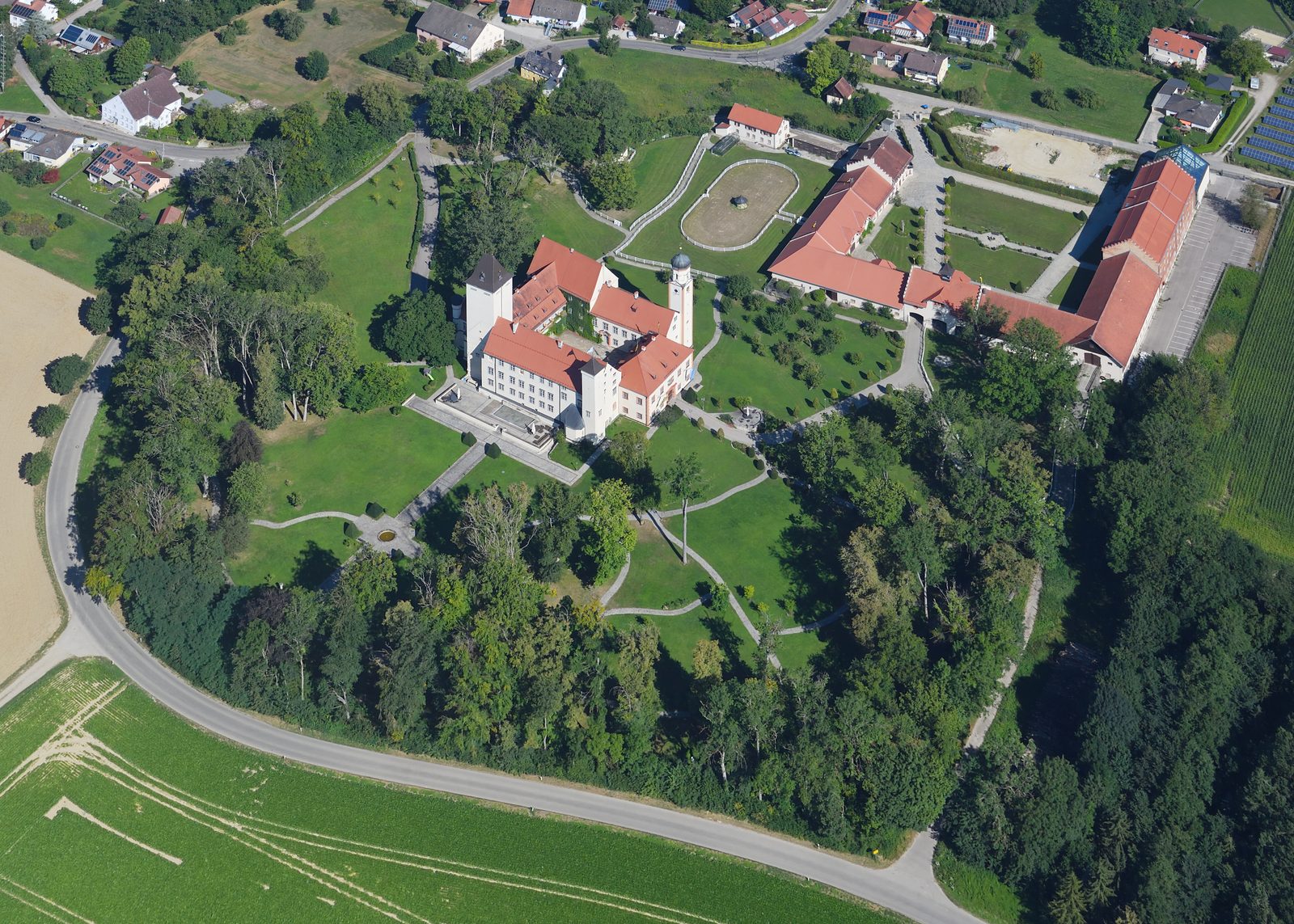
Hofhegnenberg Castle is located on the edge of the Steindorf district of Hofhegnenberg on a hill in the south of the Aichach-Friedberg district (Swabia). The well-preserved noble residence dates back to a high medieval castle complex, of which the stump of the keep is still visible.
History+
High Middle Ages+
The Lords of Hegnenberg probably originally came from Upper Swabia. At the end of the 12th century, Engelschalk and Hermann von Hegnenberg appeared as Welf ministeriales in written sources. The namesake seat of this ministerial family was the small motte-and-bailey castle (Burgstall Althegnenberg) on the southern edge of the nearby Althegnenberg in today's Fürstenfeldbruck district. Around 1300, the Hegnenbergers left their ancestral seat in the village and built a larger castle on the widely visible ridge about four kilometers away. In the late High Middle Ages, such a relocation of a ministerial seat to a higher elevation can often be proven. The originally mostly unfree ministerial families had by then established themselves in the lower nobility and wanted to document this with a representative hilltop castle. It is possible that the new castle construction was also started on ducal orders. In 1296, the Bishop of Augsburg had Kaltenberg Castle near Geltendorf destroyed to curb the expansionist ambitions of the Wittelsbachers. The Hegnenbergers were then part of the entourage of the new Duke Rudolf. The castle can therefore also be interpreted as a symbol of power and border fortification against the Prince-Bishopric of Augsburg. The first written evidence of the hilltop castle dates from 1354. In this document of October 24, the knight Winhart von Rohrbach bequeathed to the Prince-Bishopric of Augsburg, among other things, tithe income from nine Juchert of arable land "located behind the castle in Haegniberg". The mention of the still common field name "Roßberg" in this document proves that the mentioned castle is to be equated with the predecessor of the present castle.
Late Middle Ages+
In 1399, Arnold the Elder von Hegnenberg sold the ducal fief with the castle to the Friedberg administrator Hans the Pflaumdorfer. The agreed purchase price was 1800 new Hungarian gulden. The purchase deed for the first time recorded the full extent of the Hofmark, which remained unchanged until the 19th century. In 1405, Pflaumdorfer passed the lordship on to Jörg von Ersingen and "Paul the Aersinger" the Younger. Already in 1411, Paul Aeresinger sold the property back to Duke Wilhelm III. In 1462, Dukes Johann and Sigismund appointed Heinrich Adelzhauser as administrator of Hegnenberg. The dukes were at that time in constant financial difficulties and also owed Adelzhauser 1000 gulden. Until the full repayment of the loan, the lordship of Hegnenberg was left to the administrator for use.
Early Modern Period+
In 1515, Raphael Sättelin is mentioned as administrator in the Salbuech of Schloß Hägnenberg. Around 1540, the medieval castle seems to have been very dilapidated. In 1542, Duke Wilhelm IV enfeoffed his illegitimate son Georg von Hegnenberg with the Hofmark Hegnenberg. Georg, born around 1511, became the progenitor of the family von (Hof)Hegnenberg-Dux, whose last male descendant from a collateral line died in 1902. The main line died out already in 1786 with Baron Georg Ignaz Peter. Georg, "Knight of the Golden Spur", had large parts of the residence renovated. In 1557, the reconstruction and new construction were completed. However, the high medieval southwest tower continued to tower over the building complex. It was only capped around 1790, when the western castle entrance was also changed. The old state is preserved in an engraving by Michael Wening (1701). The high southwest tower (probably the former keep) then had a high tent roof, the two small round towers on the gatehouse had onion domes.
19th Century to the Present+
The "Dollling branch" of the Lords of Hegnenberg was elevated to the status of Imperial Counts in 1790. Through the daughter of the last count, the lordship finally passed in 1902 to the family of her husband Otto Wilhelm Freiherr von Gebsattel. The von Gebsattel family has inhabited the large castle building to the present day. The estate is surrounded by a large English park and is not publicly accessible. The castle served several times as a television set, for example from 1988 to 2006 for the television series Forsthaus Falkenau. At the end of 2008, the last noble lord of the castle sold the complex to the entrepreneur Peter Löw. After the acquisition, Löw renovated and restored the building.
Source: Wikipedia · Licence: CC BY-SA 4.0 · Image: Carsten Steger · Wikimedia Commons · CC BY-SA 4.0
This description is a machine translation of an excerpt from the linked Wikipedia article. The source text was written by its authors, the translation is by Mobile History; like the original it is licensed under CC BY-SA 4.0.
Location: 48.2177, 11.0215