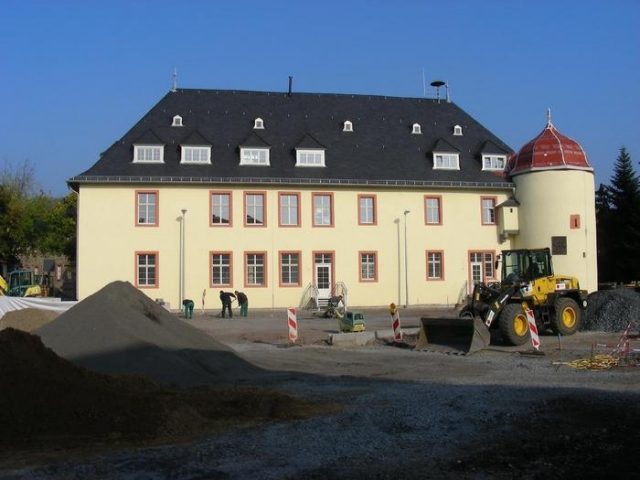
CastleHofheim

Hofheim Castle

Hofheim Castle

Cultural center

The Elector and Archbishop of Mainz, Lothar Franz von Schönborn, who was also Bishop of Bamberg, had the Kellerei building constructed between 1720 and 1722. It served as a residence and an official building for the district bailiff; thus, the building was essentially the seat of the regional administration. Because the district bailiff was also responsible for collecting taxes and duties, he was also called the "Kellermeister" (cellar master), and his official residence was therefore always simply known as "die Kellerei" (the Cellar) in the town.

The Kellerei building served not only as an administrative seat but also as a country and hunting residence for the Elector and his guests. This additional use also explains some architectural elements that might be considered excessive for a mere administrative building. These include the spacious staircase and the family crest located above the entrance.

Older than the Kellerei building itself is the tower integrated into the house. It is one of three verifiable towers of the 14th-century city wall. The name "Hexenturm" (Witches' Tower) comes from the fact that women accused of witchcraft were actually imprisoned here. Other prisoners are also said to have waited in the tower for their transport to court in Höchst. It served as a prison until 1810. The construction of the tower also points to this purpose. It was once accessible only a few meters high from the battlement of the city wall; where the door once was, there is now a window. There was an intermediate floor with an access hatch leading downwards. The internal access to the Kellerei building was only broken through the wall in 1935.

In the 19th century, the city acquired the building and used it as a school. During the First World War, it was used for the deployment of Prussian infantry regiments, thus also experiencing military use. When the war was over, a staff of the French occupation forces was quartered here. Later, it was used for various purposes, including again as a school and as an administrative building for the police and city administration. Since 1976, it has been the "House of Associations".

Source text: http://www.hofheim.de

Take Mobile History with you

You are reading this text for free. Premium adds what matters on the road: descriptions read aloud, sites found through your camera, whole regions taken offline.

  • Every description, including the ~17,700 Premium sites
  • Audio guide: have descriptions read to you on location
  • AR finder: see sites through your camera, with distance and bearing
  • Unlimited saved sites

14 days free, then from €2.99 a month. Cancel anytime.

Source: Wikipedia · Licence: CC BY-SA 4.0

This description draws on the facts documented in the linked Wikipedia article; Wikipedia content is licensed under CC BY-SA 4.0. Wording and editing: Mobile History.

Location: 50.0867, 8.4470