Museum
Hohenbrunn Castle

Hohenbrunn Castle is located at an altitude of 270 meters in the village of Enzing in the municipality of St. Florian in the Linz-Land district.
The castle is the former hunting lodge of St. Florian Abbey. It was built on the site of the birthplace of Provost Johann Födermayr according to plans by Jakob Prandtauer by master builder Jakob Steinhuber between 1722 and 1732. Provost Födermayr was a farmer's son from Pfaffenhofen who endowed St. Florian Abbey with a series of magnificent buildings (such as the south wing of the abbey building). His home, the Födermayrhof zu Phaffinhovin, has been documented since 1071. Originally, there was a farm here. The castle construction is interpreted as a monumentalization of a Vierkanthof (a four-sided farmstead). Provost Födermayr died in 1732, the year Hohenbrunn Castle was completed; his architect Jakob Prandtauer had already passed away in 1726.
The name of Hohenbrunn Castle derives from a well system with a high water tower built here between 1719 and 1724, which supplied the abbey with drinking water. The tower in the middle of the south front of the castle was removed in the first quarter of the 19th century for safety reasons.
A number of talented craftsmen and artists were involved in the construction and design, including the stucco artist Franz Josef Holzinger, the sculptor Leonhard Sattler, who created the statues of Diana and Actaeon above the entrance in 1729, the painter Johann Georg Faistenberger, the trellis painter Johann Christoph Heinz, the abbey carpenter Stefan Jegg, and the painter Matthias Müller.
Hohenbrunn Castle today+
After the death of Abbot Födermayr, the castle was used less and less frequently. Already 100 years after its completion, the castle was in need of renovation. At the turn of the 19th to the 20th century (1875-1927), one of Mauracher's organ workshops was located here. Even then, the castle was in poor structural condition. In 1913, the Imperial and Royal Ministry of Culture and Education demanded a large sum for the most necessary repairs; due to the outbreak of the First World War, this project was not carried out. In 1929, part of the ceiling collapsed. After the Second World War, the castle was acutely threatened by decay. In the summer of 1946, the rescue of the castle began; for example, the roof was re-covered from 1949-1957. In 1960, the castle was converted into a guesthouse. This was followed by another period of crisis. In 1961, a fundraising campaign for the rescue of the castle was initiated by the Federal Monuments Office and the Cultural Department of Upper Austria. The castle was first leased and then sold in 1963. The castle was finally revitalized by the Association for the Rescue and Preservation of Hohenbrunn Castle, founded in 1963.
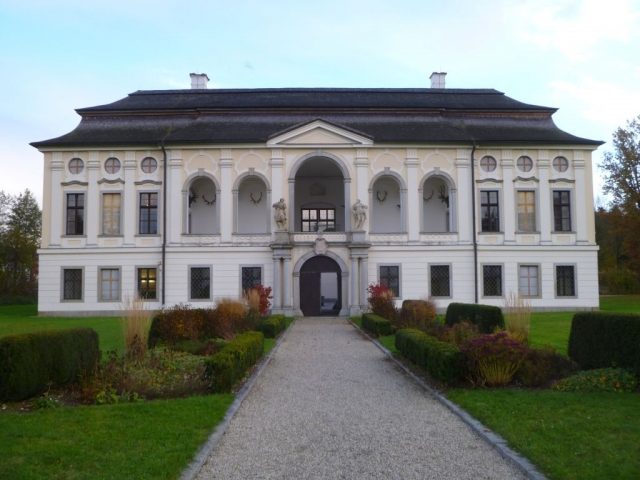
Hohenbrunn Castle is an almost square, two-story, four-winged building with a hip roof around a square inner courtyard. On the north and south facades are open loggias decorated with hunting trophies. The ground floor formerly housed utility rooms and servants' quarters. On the first floor, there are well-proportioned halls on the left and the abbot's apartment on the right. In the so-called Venetian Room, the walls are adorned with paintings of sailing ships. The altarpiece of the castle chapel depicts Duke Tassilo's youngest son Gunther, who is fatally wounded by a boar during a hunt. The front loggia is reminiscent of the staircase of St. Florian Abbey. Above the entrance, in addition to the aforementioned monumental figures of the hunting goddess Diana and Actaeon, are the coat of arms of St. Florian Abbey and the year of construction.
In the ascent to the northern loggia, lithographs by Josef Anton Strassgschwandtner are exhibited, showing the hunting methods common around 1850. There is also a hunting cynological collection with dog collars from 1580 to 1804. The castle is decorated with remarkable Baroque paintings (e.g., Bear Hunt by the Dutch painter Frans Snyders from Antwerp). A display case contains devotional objects commemorating Emperor Franz Josef I, who was known to be a passionate hunter (including a hunting chair, hiking stick, Ischler Stutzen rifle, tobacco box). A gun cabinet from Mayerling Castle commemorates Crown Prince Rudolf of Austria-Hungary. The castle also houses a collection of hunting weapons and a porcelain collection with hunting motifs.
In front of the castle is an elongated entrance building (the so-called Torstöckl) parallel to the castle, with a coat of arms commemorating the time of its construction. The oversized deer antlers above the portal indicate its function as a hunting lodge. The entrance portal offers an interesting perspective on the actual castle. A well-maintained garden leads to the castle. Above the gate to the Torstöckl is the following inscription: "Nachdem das Alt zu schimpff gekomen, den Namen Hoch brün hab ich genommen" ("After the old became a disgrace, I took the name Hoch brün"). Abbot Födermayr wanted to express that "Pfaff" had become a derogatory term since Martin Luther, and therefore Pfaffenhofen was renamed Hohenbrunn.
Today, the castle houses a hunting museum. It was opened on September 2, 1967, by Governor Gleißner. Hohenbrunn Castle is the seat of the Upper Austrian Provincial Hunting Association and its education and information center. The castle can be rented for festivities, family celebrations, and conferences. The owner is the Association for the Rescue and Preservation of Hohenbrunn Castle.
Take Mobile History with you
You are reading this text for free. Premium adds what matters on the road: descriptions read aloud, sites found through your camera, whole regions taken offline.
- Every description, including the ~17,700 Premium sites
- Audio guide: have descriptions read to you on location
- AR finder: see sites through your camera, with distance and bearing
- Unlimited saved sites
14 days free, then from €2.99 a month. Cancel anytime.
Source: Wikipedia · Licence: CC BY-SA 4.0 · Image: http://commons.wikimedia.org/wiki/File:Schloss_Hohenbrunn.jpg
This description draws on the facts documented in the linked Wikipedia article; Wikipedia content is licensed under CC BY-SA 4.0. Wording and editing: Mobile History.
Location: 48.1994, 14.3600