School
CastleLenggries
Hohenburg Castle
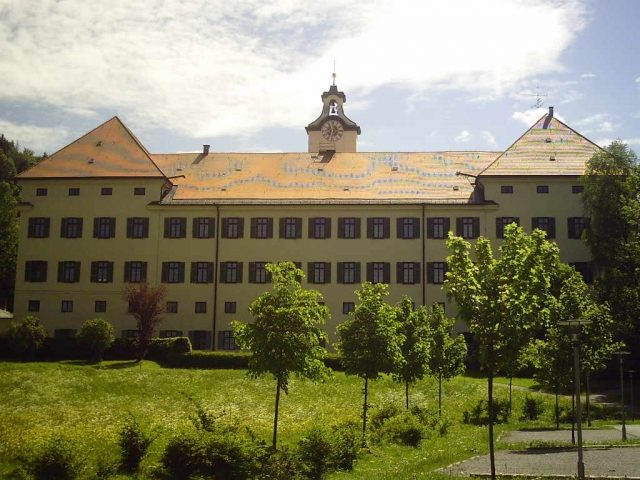
Hohenburg Castle is located near the town of Lenggries in the Isarwinkel region. As early as the 11th century, the mighty Hohenburg Castle stood near Lenggries, from where the fate of the Isarwinkel was directed for centuries. From 1566, this castle was owned by the Augsburg noble family and patricians Herwarth. During the Bavarian People's Uprising of 1705, the proud fortress was at the center of this rebellion, and subsequently, during the War of the Spanish Succession, the castle was occupied by Austrian soldiers. On July 21, 1707, the castle went up in flames under circumstances still unexplained today and was destroyed in the conflagration (more details about the castle in the main article Hohenburg (Lenggries)).
Count Ferdinand Joseph von Herwarth, who was lord of the castle at the time, therefore decided to have a castle built in the classical Baroque style about 300 m below the old castle. Five years later, from 1712 to 1718, this opulent Hohenburg Castle was built, with parts of the old castle being dismantled and incorporated into the new castle. In 1718, the building was completed, as it can still be seen today. The magnificent castle garden, modeled after Versailles, was laid out by Matthias Diesel. The Count also rendered distinguished service. He arranged for the construction of the new Lenggries parish church of St. Jacob (completed 1722), where he is also laid to rest in the crypt. Furthermore, he laid out the Calvary and built a new bridge over the Isar.
In addition to the large main building, the castle has two wings. There were once three wings that formed a large enclosed courtyard to the east. The actual residential building, an elongated structure with hip roofs, comprises three stories with a mezzanine in the central section; the corner risalits are even higher due to an additional half-story. A strong, wall-like bell tower sits above the courtyard-side courtyard risalit with the staircase. Worth seeing are the castle chapel, built in 1722, the former hunting hall, and the opulent staircases. Many rooms in the castle feature magnificent and valuable frescoes, paintings, statues, columns, and chandeliers. The dragon-like gargoyles on the castle roof are also noteworthy.
Later Owners
At the beginning of the 19th century, the Herwarth family died out, and the castle changed hands for several years. From 1807 it was owned by Zech, from 1817 by Kramer, and from 1833 by Taufkirchen.
Finally, in 1836, Prince Karl Emich zu Leiningen (* 1804, † 1856) acquired the castle along with extensive land. He was the last lord of the manor and had the exterior of the castle slightly altered, several rooms and halls refurnished, and the Baroque garden redesigned in the English style. He was also an enthusiastic hunter and established an extensive hunting ground here. Almost simultaneously, he had a neo-Gothic Waldleiningen Castle built in the Odenwald. His mother, after the death of his father Emich Carl Prince zu Leiningen in 1814, was married in a second marriage to Edward August, Duke of Kent and Strathearn, whose only child was the later Queen Victoria. Thus, the new owner was a half-brother of Queen Victoria.
In 1857, Baron Carl von Eichthal acquired the now severely dilapidated Hohenburg Castle for only 32,000 guilders. His father was Simon Aron Baron von Eichthal (formerly Seligmann). The latter, among other things, financed the art purchases of Crown Prince Ludwig I and brokered Bavarian government bonds to Greece. In 1834, he was one of the founders of the Bayerische Hypotheken- und Wechselbank and a co-founder of numerous railway companies in the Kingdom of Bavaria. His son Carl, also ennobled, bought the secularized monastery of St. Blasien in the Black Forest and operated an ammunition factory and a cotton spinning mill there. The family was then considered the wealthiest family in the Grand Duchy of Baden.
In 1870, Duke Adolf von Nassau-Weilburg, who had been expelled from his Duchy of Hesse-Nassau by the Prussians in 1866, bought the castle and the extensive surrounding hunting grounds.
Source: Wikipedia · Licence: CC BY-SA 4.0
This description draws on the facts documented in the linked Wikipedia article; Wikipedia content is licensed under CC BY-SA 4.0. Wording and editing: Mobile History.
Location: 47.6722, 11.5872