School
Hohenlehen Castle
Hohenlehen Castle is located in the Ybbs Valley of the Eisenwurzen region in Lower Austria, and is part of the municipality of Hollenstein an der Ybbs in the Amstetten district. As the Hohenlehen Estate, it was a hunting and forestry estate at the beginning of the 20th century, but today it houses the Hohenlehen Agricultural College (LFS Hohenlehen), formerly known as the Forest Farmer School, and now also the Mountain Farmer School.
Hohenlehen Castle is situated at (430 m above sea level) halfway between Opponitz and Hollenstein above the Ybbs, on an alluvial terrace of the Donnerkogelgraben at the foot of the Gaflenzer Kaibling. South of the castle lies the area of the Meierhof, known as the Forest Farmer School.
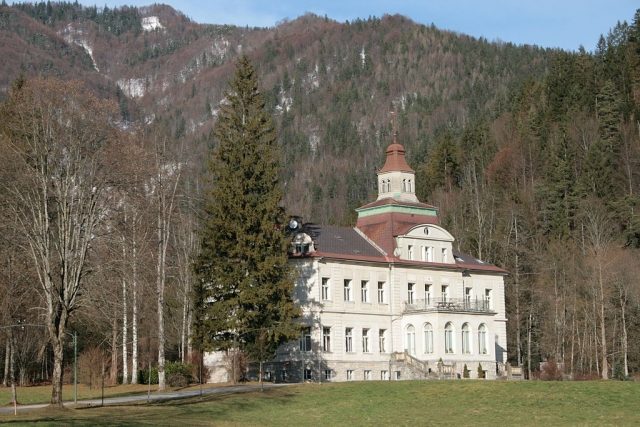
The main building, called the Castle, is a monumental two-story Belle Époque building with a tower-like elevated central section and a spacious balcony on the bel étage with staircases on both sides. The tower top is elevated in the form of a round-arched dormer to a tower floor, and the tower is crowned by another small room in the form of a lantern. At the rear, a gable-end wing and a corner wing with another small tower project, offset from the axis, forming a small semi-courtyard. The facade is kept in a comparatively simple historicist ashlar (rustication). The architect was the Viennese city master builder Maximilian Katscher, a student of Ferstel.
The Forest Farmer School, the old Hohenlehen estate, 300 meters from the castle and connected by an avenue, is a four-sided farmstead surrounded by several other buildings. The complex is modern for its time of construction and features a representative porch, on which a monumental, classical gable contrasts with the otherwise soberly structured facade.
Further up the Ybbs, there are still buildings on the property, with a park and sports facilities in between. There stands the former garden house, today the (old) boarding school building, a two-story building, with the show front featuring a pointed-gable central risalit and four roof dormers. It extends two side wings to the rear and is enclosed to an inner courtyard by a long rear wing that projects beyond the show front on both sides. In its facade design, it is adapted to the main building.
The entire building ensemble, both the castle and the Forest Farmer School, are listed as 28179!Hohenlehen Castle Complex under the Monument Protection Act according to § 2a.
Hohenlehen Estate
Gustav Davis, founder of the Kronen Zeitung, acquired the lands of several small farms that had fallen into disrepair after the decline of the Eisenwurzen small iron industry between Opponitz and Kleinhollenstein, after the valley became accessible with the construction of the Ybbstalbahn in 1896, by 1906. At that time, it was a forest and hunting estate covering approximately 1500 hectares. As a residence, he had a monumental villa with a park, garden house, Meierhof, administration building, gatehouse, and staff residence built by 1910 and named it Hohenlehen Castle and Estate. In 1908, he also bought the Geyersbichl Estate and in 1913/15 the northern Seeburg Estate and Bärengschwandt Estate, but gave up Seeburg again after the First World War.
With approximately 80% forest area, the property was primarily intended as a private hunting ground. The economic estate was developed into a model agricultural enterprise, especially after the First World War. In March 1920, negotiations took place for a forced return of purchased farmsteads under suspicion of "Bauernlegung" (dishonest takeover of peasant properties by large landowners) according to the Resettlement Act of 1919 (WBG), but this was only enforced for two estates in 1924.
Gustav Davis died in 1951 at the age of 95 in Hohenlehen. The former estate is now distributed among the localities of Garnberg and Hohenlehen, and the remaining private property (the estate now called Hohenlehen is the locality of Waidach in Opponitz, on the other bank of the Ybbs).
Forest and Mountain Farmer School
On September 21, 1949, the Lower Austrian Chamber of Agriculture (LLWK-NÖ) bought the castle and about 100 hectares of land, establishing a forestry training center; the Mountain Farmer School had already been founded in Gaming in 1926. Economic buildings were erected, and in 1951, the former garden house was converted into a boarding school building. Extensions took place in 1962 and 2000/2001. Since the beginning, there has also been the Unterleiten College (LFS Unterleiten for ecological agriculture and home economics), originally as the girls' school, as an outpost.
On January 1, 1971, the institute was taken over by the State of Lower Austria and established as the Hohenlehen Forest and Mountain Farmer School. It was initially run as a two-semester winter vocational school, and from 1978 as a three-stage vocational school-replacing winter vocational school. Since 1990, it has been a compulsory school-replacing vocational school with four school levels. The current Mountain Farmer School, with a focus on alpine agriculture, has been run as a school experiment since 1994. The forestry branch is the only school of the Forest Vocational School (FFS) type in Austria and belongs to the Agricultural and Forestry Training Institutions (LFLA), which are directly subordinate to the Ministry of Agriculture and Forestry.
Directors
- Franz Klikovits 1949–1966
- Gerald Schlimp 1966–1978
- Karl Peter 1978–1987
- Adolf Schnabel 1987–1999
- Leo Klaffner since 1999
Student Numbers
The average number of students for the school years 1983–1989 was 108, then rose to about 144 in the period 1996–2002 due to the conversion to a four-year school, where it remains today.
School Profile of the Hohenlehen Agricultural College+
The school is a compulsory school-replacing vocational school for rural grassland and forest management with a focus on mountain farming, and after 4 years leads to a full professional qualification (vocational school diploma with skilled worker certificate). Admission requirement is a positive completion of the 8th school level, or an entrance examination for transfer to the 2nd school level. In the 3rd year, the farm manager course with home practice and 6 months of external practice or commercial apprenticeship is integrated, completing the educational path.
It has five training specializations:
- Organic grassland management with cattle and pig farming
- Forest management with forestry technology and wood processing
- Meat processing
- Alpine pasture and grazing management
- Hunting training
The curriculum includes, in addition to entrepreneurial education fundamentals (business administration and accounting, marketing and economics, information technologies, mathematics and technical calculations, English), specialized education in crop production, agricultural engineering and construction, livestock farming, forestry and fruit growing, as well as extensive practical instruction.
In addition, combined advanced courses for training in carpentry or joinery are offered in cooperation with the Edelhof College and the Pöchlarn State Vocational School.
The school has an attached boarding school.
In cooperation with Bio Austria and the Chamber of Agriculture, organic conversion courses also take place at the training farm, and the University of Natural Resources and Life Sciences Vienna regularly organizes field surveying seminars.
Training Farm
The training and experimental farm includes, in addition to the operational and stable buildings, almost 100 hectares of agricultural and forestry land, making it one of the larger farms in the southern Mostviertel. Since 1992, the college has also been a recognized organic farm.
At the time of the founding of the Hohenstein estate, up to 150 cattle were kept; in 2002, the livestock consisted of 20 cows, 21 calves and heifers, young bulls, 33 sheep, 18 fattening and breeding pigs, and 1 horse, allowing students to learn how to handle the most important large and medium livestock. The milk quota is 80,000 kg and is sold to the dairy – in addition to self-sufficiency. Meat products are produced, bringing students into contact with the butchery trade, and also sold directly from the farm (EU slaughterhouse, Upper Ybbstal Rural Slaughtering Community).
The annual harvest volume of forestry is approximately 150 solid cubic meters and is also generated as part of the school education.
Take Mobile History with you
You are reading this text for free. Premium adds what matters on the road: descriptions read aloud, sites found through your camera, whole regions taken offline.
- Every description, including the ~17,700 Premium sites
- Audio guide: have descriptions read to you on location
- AR finder: see sites through your camera, with distance and bearing
- Unlimited saved sites
14 days free, then from €2.99 a month. Cancel anytime.
Source: Wikipedia · Licence: CC BY-SA 4.0 · Image: http://commons.wikimedia.org/wiki/File:Hollenstein_Schloss_Hohenlehen_IMG_0774.JPG
This description draws on the facts documented in the linked Wikipedia article; Wikipedia content is licensed under CC BY-SA 4.0. Wording and editing: Mobile History.
Location: 47.8560, 14.7760