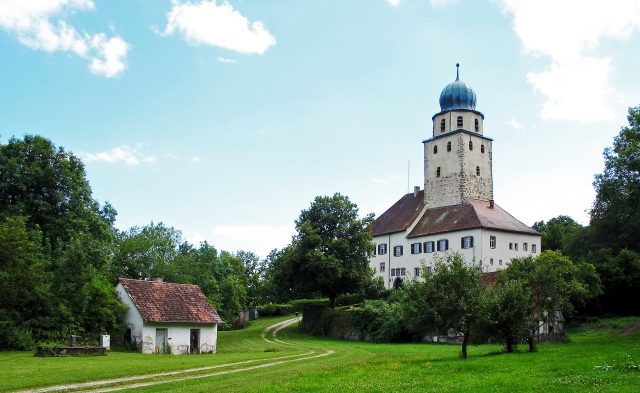
CastleStühlingen

Hohenlupfen Castle

Hohenlupfen Castle

To be privately owned

Hohenlupfen Castle is a castle in Stühlingen in the Waldshut district in Baden-Württemberg, Germany. The castle has existed in its current form since 1624.

The plateau on which the castle was built was probably already used by the Romans as a base for a signal tower.

The original Hohenlupfen castle complex was built by the Counts of Lupfen and first mentioned in 1093. In 1499, the castle was destroyed by the Confederates in the Swabian War. The reconstruction of the complex after 1499 was carried out poorly, which is why the castle was subsequently described as "dilapidated". This can be explained by the fact that the Landgrave at that time resided in Engen in Hegau and did not need his castle in Stühlingen.

After the well-known Pappenheimers took over the Landgraviate of Stühlingen as a fief, they rebuilt the dilapidated castle into the castle in its current form between 1620 and 1624 under Maximilian I.

Former owners of the castle

  • the Lords of Staufen
  • the Lords of Küssaberg
  • the Lords of Pappenheim
  • the Princes of Fürstenberg (House of Fürstenberg)
Current use+

The property, which also includes lands in the vicinity of the castle, was transferred in December 2011 from the House of Fürstenberg zu Donaueschingen to a private individual from the neighboring Swiss municipality of Schleitheim. No statement can currently be made about the further use of the complex.

The castle is situated on a freestanding rock plateau on the eastern edge of the Baden Albgaus high above the middle Wutach valley. The correct and formerly exclusively used name is Stühlingen Castle, from which the town of Stühlingen, located at the foot of the castle, can be derived. Since two side valleys from the left and right merge with the Wutach valley at the height of Stühlingen, a valley cross results. This cross served as a crossroads for the traffic routes running along the valley and thus gained a certain importance for the region. In this context, the placement of the castle diagonally opposite the mouth of the Schleitheim valley appears sensible. Furthermore, the right valley flank is about 60 meters higher, so that the opposite left valley flank and the adjacent Hallauer Berg can be easily overlooked.

Complex+

Since the Landgraves of Lupfen were very often in financial difficulties, the fortified walls probably made a fortified, but also poor impression. The keep was built in the typical square-practical castle style with thick walls. The loopholes in the castle tower are still clearly visible today, as is the original keep. The tower is accessible from the inner courtyard of the complex and has a wooden spiral staircase inside. During the conversion to a castle, the tower was supplemented by an octagonal structure and a Welsch spire.

The main building is designed as a generously proportioned manor house. At the northern end of the main wing, a keep and a servants' wing adjoin at right angles. At this end of the main wing, the knight's hall is located on the upper floor. Between the knight's hall and the servants' wing, there is a continuous connection that nestles against the outside of the tower. In the basement below the knight's hall, there is also the castle chapel.

On the valley side, the complex is protected by a defensive wall, which is replaced to the south and west by a moat.

In the northern forecourt there is an outbuilding, which was half destroyed by a fire. The archway has been preserved as the only access to the castle today.

The old road to the castle, which begins towards Bonndorf to the left of the hairpin bend at the water reservoir on the district road, is heavily dilapidated, rising steeply directly on the valley cheek to the valley-side defensive wall and the forecourt of the castle.

Myths and Legends+

Like many other castles and fortresses, various myths surround the Stühlingen landmark, which are explained in more detail below.

The Snail Dispute

Clementia von Montfort, the wife of Count Sigismund II of Lupfen, is said to have once demanded a corvée from the serfs. She ordered her subjects to collect snail shells in the forest to use them as spools. This arbitrary act of the Countess so aroused the displeasure of the Stühlingen farmers that they rebelled against the Landgrave and rose up in the Peasants' Revolt in 1524.

The legend vividly describes the arbitrary and authoritarian treatment of the counts and princes with their subjects. However, the pitfalls, as always, lie in the details. The Count of Lupfen had already resided in his seat of power in Engen for a long time. Already in 1499, he no longer personally experienced the destruction of his castle in Stühlingen by the Confederates, but left this to his deputy, the chief bailiff. The castle was then rebuilt so poorly that it was described as "dilapidated" in the records. However, the Lupfeners led an extravagant lifestyle in Engen, which was financed by the people through tithes, corvée, etc.

The Lake under the Castle

Under the castle, there is said to be a lake of unfathomable depth that once threatened to break out. A Capuchin monk stopped the hole with his hood, and if it ever rots away, the lake will sweep away all the places in the (middle and lower) Wutach valley.

It is striking about this legend that several small spring streams originate from the castle slope, which were formerly used, among other things, to fill the moat around the town with water. The plateau south of the moat is called "Seegärten" (Lake Gardens) because it often flooded there in the past. So water gushes out from everywhere under the castle...

The Daring Leap

Landgrave Max of Stühlingen, a strong and agile giant, bet during a drinking party on the upper floor of Stühlingen Castle that he would get on the back of his horse faster than his competitor. Both horses stood in front of the castle. He granted his opponent, a baron, a floor's head start. While the baron rushed to his horse, the Landgrave jumped from the upper floor directly onto the back of his white horse and won the bet.

It remains unclear to this day what aids the Landgrave used. A jump from at least six meters high directly into a saddle, without being able to absorb the momentum with his legs, seems very daring.

Take Mobile History with you

You are reading this text for free. Premium adds what matters on the road: descriptions read aloud, sites found through your camera, whole regions taken offline.

  • Every description, including the ~17,700 Premium sites
  • Audio guide: have descriptions read to you on location
  • AR finder: see sites through your camera, with distance and bearing
  • Unlimited saved sites

14 days free, then from €2.99 a month. Cancel anytime.

Source: Wikipedia · Licence: CC BY-SA 4.0

This description draws on the facts documented in the linked Wikipedia article; Wikipedia content is licensed under CC BY-SA 4.0. Wording and editing: Mobile History.

Location: 47.7417, 8.4353