CastleTübingen

Hohentübingen Castle

Hohentübingen Castle

Museum

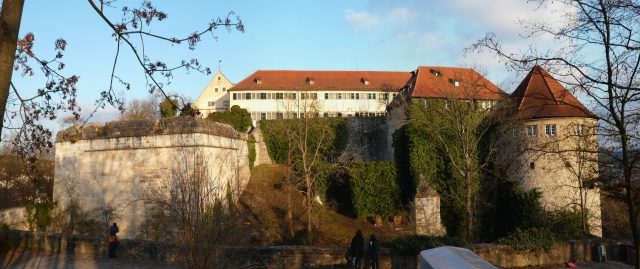
Hohentübingen Castle is centrally located in the city of Tübingen. It was built starting in the 11th century, expanded in the 16th century, and in its current form represents a mixture of a medieval castle, a modern residence, and a Württemberg state fortress.

Presumably, Hohentübingen Castle was built around 1037; according to Weiss, the "... stone walls ... were, however, only erected in the course of the 12th and 13th centuries; before that, the castle was only surrounded by wooden palisades." In 1078, the structure was first mentioned in writing: The Zwiefalten Annals describe the siege of a castle "Duwingen" by King Henry IV during the Investiture Controversy; at the same time, a certain Count Hugo III of Tübingen is mentioned in "... another source ...".

A Trier manuscript ("gesta Trevir") referred to Hohentübingen, on the occasion of whose siege Archbishop Udo of Trier died, as "Tuingia castru Alemanorium". Other authors (Sattler, Schmid) stated the year of the siege as 1079 or 1080 and claimed that the castle and city had been conquered. The Counts of Tübingen were first mentioned in 1081 and elevated to Palatine Counts in 1149 by the Roman-German King Conrad III (see also County Palatine of Tübingen). In 1342, the indebted Palatine Counts of Tübingen sold their city and castle to the Counts and later Dukes of Württemberg, who used Hohentübingen as a residence alongside Stuttgart or Urach. Under Duke Ulrich (1495–1550), the castle was expanded and provided with bastions; it now served as a state fortress alongside the fortifications of Hohenneuffen, Hohenurach, Hohenasperg, Hohentwiel, as well as Schorndorf and Kirchheim (Teck). Duke Friedrich I (1593–1608) had Hohentübingen additionally expanded and fortified at the beginning of the 17th century. He crowned the work in 1607 with a magnificent Renaissance-style portal.

Following the Battle of Nördlingen in 1634, after the defeat of the Swedish-Protestant army, Hohentübingen was surrendered without a fight to the Duke of Lorraine. In 1647, a French force besieged Hohentübingen Castle, blowing up one of its corner towers. The fortress was shortly thereafter handed over to the French by the Bavarian occupation.

Since its designation in 1817 by Johann Gottlieb Bohnenberger, the northeast tower of the castle has been considered the cartographic zero point of Württemberg, from which Bohnenberger measured the entire Kingdom of Württemberg. Today, the castle houses a museum of the University of Tübingen, established in 1994 and open to the public since 1997, featuring the teaching collections of the Institutes for Older and Younger Prehistory and Early History, for Classical Archaeology including the Numismatic Research Unit, Egyptology, the Cast Collection, and the Ancient Near Eastern Seminar, as well as Ethnology.

Take Mobile History with you

You are reading this text for free. Premium adds what matters on the road: descriptions read aloud, sites found through your camera, whole regions taken offline.

  • Every description, including the ~17,700 Premium sites
  • Audio guide: have descriptions read to you on location
  • AR finder: see sites through your camera, with distance and bearing
  • Unlimited saved sites

14 days free, then from €2.99 a month. Cancel anytime.

Source: Wikipedia · Licence: CC BY-SA 4.0

This description draws on the facts documented in the linked Wikipedia article; Wikipedia content is licensed under CC BY-SA 4.0. Wording and editing: Mobile History.

Location: 48.5194, 9.0504