Private ownership
CastleHohenzieritz
Hohenzieritz Castle
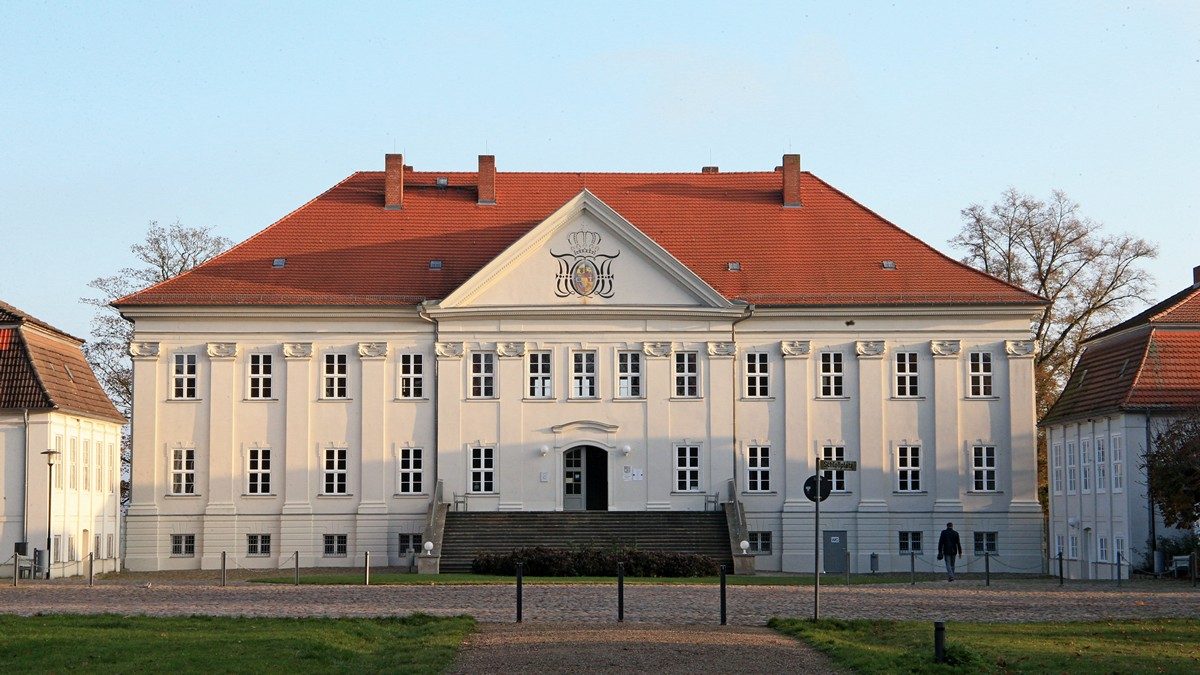
Hohenzieritz Castle is located in the municipality of Hohenzieritz in Mecklenburg-Vorpommern, approximately halfway between Neustrelitz and Neubrandenburg.
History+
Of a predecessor building of the castle, it is only known that it burned down in 1712. The then feudal tenant, Hans Altwich von Holtzendorff, apparently only had a provisional replacement building erected. In 1733, Johann Christian von Fabian was enfeoffed with Hohenzieritz. The castle was built on his behalf from 1747 to 1751, using parts of the previous building. The complex was built as a single-story manor house in plastered half-timbering with a high basement and a high hip roof. After the death of Hans Altwich's son Adam Friedrich von Fabian, Hohenzieritz reverted to the Strelitz dukes in 1768 as an expired fief and passed to the regent's brother, the later Grand Duke Karl II, in 1770. Shortly after taking possession, he had the attic rooms expanded and a staircase to the garden built by the Neustrelitz doctor and mayor Johann Christian Wilhelm Verpoorten. In 1776, the castle was also extended by Verpoorten with two single-story pavilions with pilaster facades and mansard roofs, which together with the main house enclose a courtyard of honor. Around this time, a gardener's house was built next to the southern pavilion and a stable next to the northern pavilion in the mid-19th century. In 1790/91, a second half-timbered story was added to the castle, with the forestry and surveying engineer Johann Christoph Dräsecke overseeing the execution and largely establishing the current state. The interior was not completed until 1795 by Wilhelm Ebel, who drew on the Zopf and Empire styles. In 1802, the building received the current sandstone staircases on the courtyard and garden sides, with the garden-side staircase being double-flight and enclosing a vine arbor.
Hohenzieritz Castle, her father's summer residence, was always the main destination of the three family visits of Queen Luise of Prussia, a born Duchess of Mecklenburg from the House of Mecklenburg-Strelitz. Luise died here on July 19, 1810. Her death room, already converted into a memorial in 1813, rearranged in the taste of the late 19th century, and restored in this style for several years, is now a memorial. Until the November Revolution, the castle remained in the possession of the ducal family and came to Prince Julius Ernst zur Lippe in 1926 as part of the princely compensation, the brother-in-law of the Strelitz Grand Duke Adolf Friedrich VI, who died in 1918. Parts of the castle, especially Queen Luise's death room and adjacent rooms, continued to be used as a museum. Among other things, a larger collection of children's toys from the princely family's estate was displayed here. During the Second World War, Hohenzieritz Castle was an external storage location for art possessions from the Mecklenburg state collections, with significant losses due to looting by the population. The castle survived the end of the Second World War without major damage, although the interior disappeared. Owners and tenants were expropriated in the course of the land reform in autumn 1945. Like many similar buildings, it initially served as refugee accommodation. Among other things, the windows of the Egyptian Hall facing the garden were bricked up. In 1947, the castle was placed under monument protection. From 1952, it was used in the GDR as a sales outlet, cultural center, school, kindergarten, and administrative building. From 1962, it housed the council of the local community and the scientific center for agriculture of the Neubrandenburg district. From 1950 to 1953 and from 1960 to 1963, the complex was renovated. The basement was used for the local youth club from 1987. After German reunification, the castle, which was threatening to fall into disrepair, was not used between 1992 and 2000.
In 1993, a support association for the preservation of the castle was formed. From 2000, extensive restoration and repair took place. Afterwards, Hohenzieritz Castle became the seat of the Müritz National Park administration. In addition, the castle houses a Queen Luise Memorial. It cannot be visited with the exception of the memorial, but the park is freely accessible. The operator of the memorial until the end of 2015 was the Hohenzieritz Castle Association. After the dissolution of the association, the Palaces and Gardens Administration of the State of Mecklenburg-Vorpommern also took over its sponsorship. After extensive redesign, the Queen Luise Memorial has been presented since June 3, 2017, as a modern place of information about and remembrance of the Prussian queen of Mecklenburg descent, her last days in Hohenzieritz, and the history of her remembrance. In addition to Hohenzieritz, one of the few permanent exhibitions on Luise (Luise veneration in the imperial era with an extensive library) exists in Crimmitschau in the Villa Vier Jahreszeiten.
Building Description+
The entire complex opens with a courtyard, forecourt green areas, and access road towards the northwest.
Source: Wikipedia · Licence: CC BY-SA 4.0 · Image: Frank Liebig · Wikimedia Commons · CC BY-SA 3.0 de
This description is a machine translation of an excerpt from the linked Wikipedia article. The source text was written by its authors, the translation is by Mobile History; like the original it is licensed under CC BY-SA 4.0.
Location: 53.4439, 13.1022