To be privately owned
Hovestadt Castle

Hovestadt Castle, also known as Haus Hovestadt, is located in the municipality of Lippetal in the district of Soest. It dates back to a knight's seat, which was later expanded into a castle. The current complex was built as a moated castle at the end of the 16th century in the style of the Lippe Renaissance. In the 18th century, Johann Conrad Schlaun added Baroque elements, particularly to the outer bailey.
In 1152, a knight's seat of a Dietrich von Hovestadt was first mentioned in Hovestadt. The Archbishops of Cologne, who pursued territorial interests in this part of Westphalia, had a castle built here to protect the Lippe crossing. The castle was primarily directed against the Bishops of Münster, but also against the County of Arnsberg, the County of Mark, and the noble lords of the Lippe. The castle was completed around 1276. It provided space for a Droste and 20 castlemen and their families. Hovestadt Castle was destroyed several times – for example, in 1303 and 1346. After that, it was always rebuilt. During the Soest Feud from 1444 to 1449, it had strategic importance for Archbishop Dietrich II of Moers. In 1483, the castle and the Hovestadt office came as a pledge to Godert Ketteler. It remained in the Ketteler family. Goswin von Ketteler had the castle converted into a palace between 1563 and 1572.
The Hovestadt line of the Ketteler family died out in the 17th century, and the property passed to the Barons von Haiden zu Schönrade and Boke in 1649. In 1710, Baron – later Count – Friedrich Bernhard Wilhelm von Plettenberg-Lenhausen acquired the property. The Plettenberg-Lenhausen family moved their main residence from Lenhausen Castle to Hovestadt. This also marked the beginning of new construction activity.
Complex+
The main architect of the castle was the Dutch master builder Laurenz von Brachum. Other craftsmen and artists also contributed.
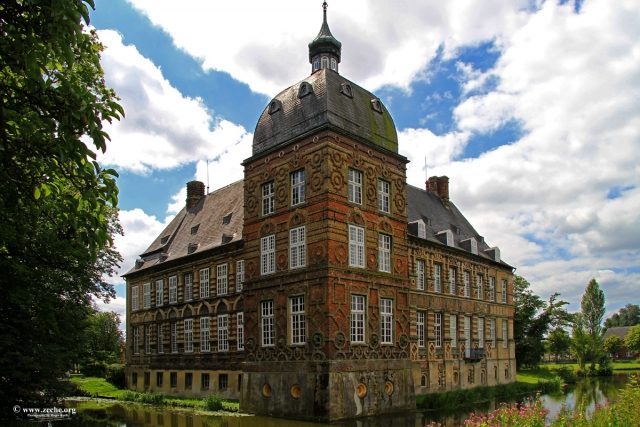
The main house of Hovestadt was planned as a two-story, four-wing complex. However, only the north and east wings were built. Both were erected over a high basement floor and have a hip roof with dormers and dwarf dormers. There are also ornate chimneys on the roof ridge. The facade is partly adorned with diverse architectural decorations in the Mannerist style. The brick decorations on the water fronts include circles, rhombuses, bands, and lion heads. On the other facades, however, ornamentation was used sparingly. Inside, rich stucco work, attributed to Antonio Rizzo, still exists. At the intersection of both wings is a three-story tower. This has a curved dome with a lantern at the top.
The castle is a two-island complex surrounded by moats, which also includes a pond. Access to the castle is provided by a stone bridge.
After the transition to the Plettenberg-Lenhausen family, Johann Conrad Schlaun undertook the first restoration measures and alterations in 1733. This included the redesign of the farm buildings in the outer bailey in the Baroque style. In the outer bailey are single-story farm buildings. The gatehouses also date from him. In the middle is a chestnut avenue that leads to the bridge to the castle.
Particularly noteworthy at the end of an orangery is the castle chapel with illusionistic wall paintings.
Park+
The castle also includes a French-style park from the mid-18th century, whose plans partly originated from Clemens August von Vagedes. The park was reconstructed in the 1990s, also includes a hedge theater unique in Westphalia, and is a station of the European Garden Heritage Network.
The entire complex of castle, outer bailey, and park is surrounded by a moat.
Take Mobile History with you
You are reading this text for free. Premium adds what matters on the road: descriptions read aloud, sites found through your camera, whole regions taken offline.
- Every description, including the ~17,700 Premium sites
- Audio guide: have descriptions read to you on location
- AR finder: see sites through your camera, with distance and bearing
- Unlimited saved sites
14 days free, then from €2.99 a month. Cancel anytime.
Source: Wikipedia · Licence: CC BY-SA 4.0 · Image: http://www.zeche.org/
This description draws on the facts documented in the linked Wikipedia article; Wikipedia content is licensed under CC BY-SA 4.0. Wording and editing: Mobile History.
Location: 51.6586, 8.1456