CastleRottenbach-Innersee

Innersee Castle
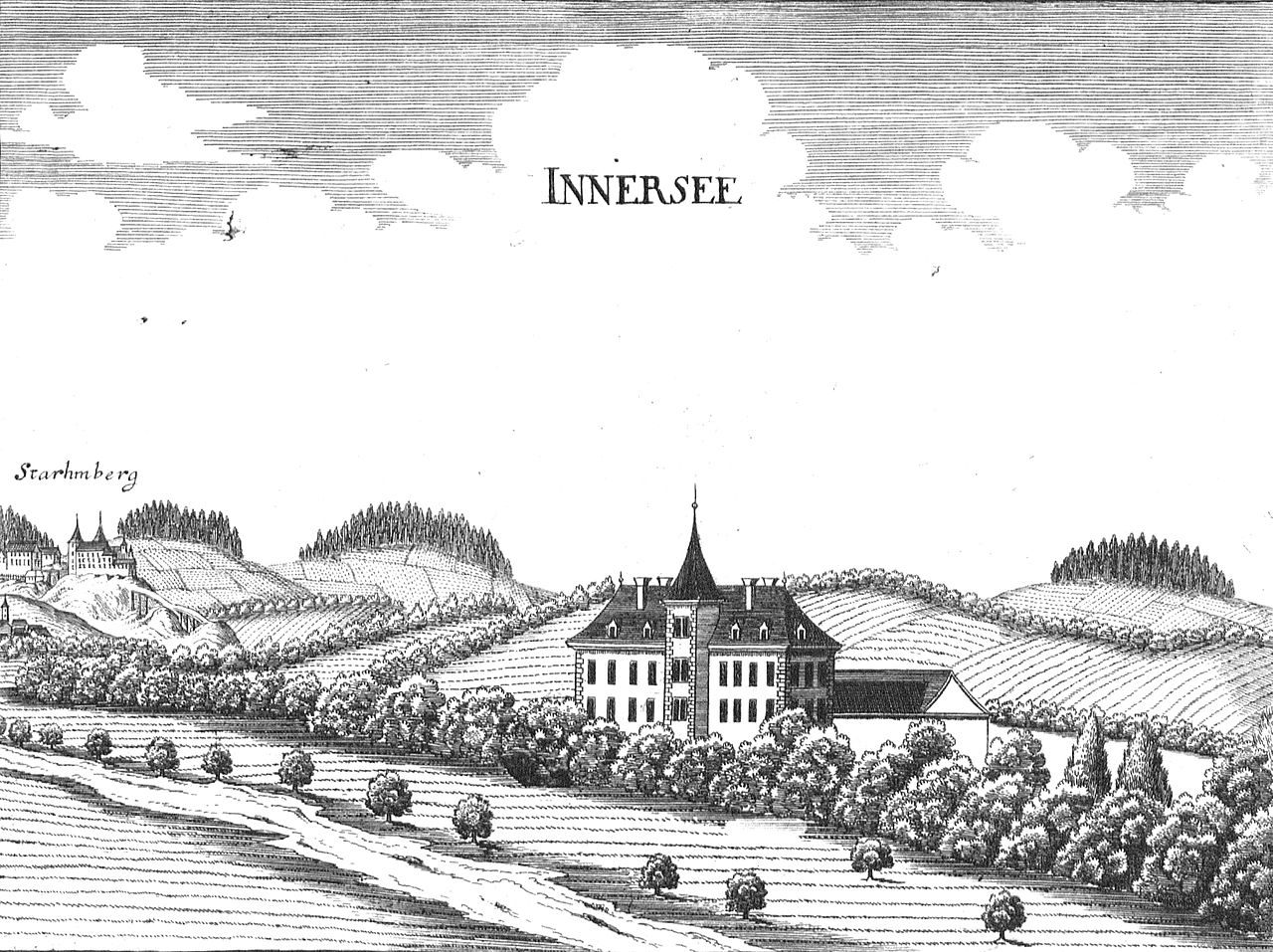
Innersee Castle

To be privately owned

Innersee Castle is a Renaissance castle located in the Innersee district of the municipality of Rottenbach, which in its current form dates from the early 17th century.

Innersee was founded by Hans Innerseer, a vassal obliged to Starhemberg Castle, who was first mentioned in 1286. Innersee Castle itself (formerly also referred to as Indersee or Innernsee) was first documented in 1301. The Innerseer family remained in possession of the original moated castle until 1595. Then, the last Innerseer, Hans Paul, had to sell the castle with all its associated estates due to economic difficulties. The Frankinger family followed as owners for a few years, but they sold it to Bartholomäus Freiherr von Dietrichstein as early as 1579. He converted the castle into a palace. During the Peasants' War in 1626, the castle was captured and burned down by the rebellious peasants. Christoph von Kher bought the "Brandstatt" (burnt-out site) from Freiherr von Dietrichstein and had the castle rebuilt. Georg Matthäus Vischer's engraving from 1674 shows a single-story building with a central tower. In 1635, the Fieger family acquired the restored castle. In 1679, the property came as a dowry to the Willinger family, who united Innersee with the Hinterndobl estate. The castle then passed by inheritance to Johann Ludwig von Gabelkoven.

In 1777, Innersee, together with Hinterndobl, was sold to Ernst Ignaz Gemberly Ritter von Weidenthal. This Gemberly had been ennobled by Empress Maria Theresia for his services to the improvement of agriculture. His son Ernst Gemberly von Weidenthal, an engineer and imperial and royal captain, was married to Rosalia, née von Meyer zu Lauterbach. After his early death in 1795, Rosalia was the sole owner of the Innersee and Hinterndobl estates until 1842. Their son Ernst Franz Josef remained unmarried, and his sister Rosalie Elisabeth married the Royal Bavarian Post Councillor Josef Maximilian Heyß. Their son Franz Maximilian Heyß inherited Innersee and Hinterndobl from his grandmother. With his wife Karoline, née von Rund, he had ten children. He himself was a member of the Imperial Council in Vienna and the first freely elected mayor of Rottenbach. After his death in 1867, his wife Karoline remained the sole owner until her death in 1895. The children living in the castle, who remained without descendants, took in Josefine Heyß, the daughter of their brother Johann, who lived in Laibach. Josefine married the estate owner Adolf von Payrhuber in 1916, and both took over the property from their aunts Karoline and Anna Heyß in 1917. Their daughter Josefine Payrhuber married Ignaz Sickinger in 1946, and they inherited the estate in 1953. Ignaz Sickinger, like his ancestor, was also mayor of Rottenbach (1962-1982). Next, in 1983, Adolf Sickinger and his wife Hedwig became owners; today, the property belongs to Bernhard and Brigitte Sickinger and their children Kerstin and Anja.

Architectural History+

Innersee was originally a moated castle. A pond located on the western side of the castle remains from the moat. At the back and front of the castle, this moat was probably filled with material from the castle wings destroyed in the fire catastrophes. On the east side, a dry ditch also indicates a previously existing pond. During excavation work, seashells were also found in the soil east of the castle, proving a significantly larger body of water. As can be seen in Georg Matthäus Vischer's engraving, the two-story castle still had a gate tower in the mid-17th century. Only the portal and the remarkably thick walls in the entrance area remain of this. In the 17th century, a west wing, not belonging to the original castle, was added, which is no longer present today.

Present Day+

Today, Innersee Castle appears as an imposing structure situated on a plain, with an integrated east wing. Passing through the gate hall, one enters an inner courtyard bordered on two sides by the castle and on one side by a pond. To the north is an old mill, which formerly belonged to the castle. In the middle of the courtyard stands a Florianibrunnen (St. Florian's fountain), recently erected by the owner. The entrance wing has a short loggia on the ground floor and an open arcaded walkway on the first floor of the right wing, which is enclosed by windows in the main wing of the castle. The beautiful Renaissance portal of the castle is striking, showing on the left side the coat of arms of the former owner Ernst Ignaz Gemberly von Weidenthal. To its right is a sundial with the important dates of 1626, the burning of the castle during the Upper Austrian peasant uprising, and 1990, the beginning of renovation work by the current castle owners.

The castle includes an old manor farm with an agricultural operation covering 75 Joch (a unit of land area). In the ground floor of the east wing, a "Ritterstüberl" (knight's parlor) was set up, which was formerly (until 2008) available for catering to closed groups. The castle has been extensively renovated through private initiative. Today, the castle is no longer publicly accessible but is inhabited by the owner family and used only for private purposes.

Take Mobile History with you

You are reading this text for free. Premium adds what matters on the road: descriptions read aloud, sites found through your camera, whole regions taken offline.

  • Every description, including the ~17,700 Premium sites
  • Audio guide: have descriptions read to you on location
  • AR finder: see sites through your camera, with distance and bearing
  • Unlimited saved sites

14 days free, then from €2.99 a month. Cancel anytime.

Source: Wikipedia · Licence: CC BY-SA 4.0 · Image: Georg Matthäus Vischer / Public domain via Wikimedia Commons

This description draws on the facts documented in the linked Wikipedia article; Wikipedia content is licensed under CC BY-SA 4.0. Wording and editing: Mobile History.

Location: 48.2141, 13.6932