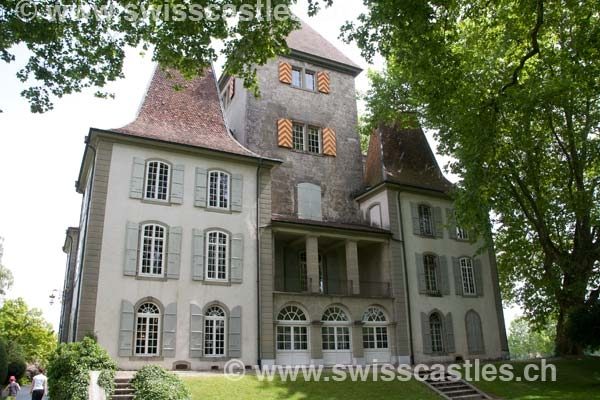
CastleJegenstorf

Jegenstorf Castle

Jegenstorf Castle

Museum

Jegenstorf Castle is located on the eastern edge of the village of the same name, within a wooded park. In the Middle Ages, it likely served to secure the old road from Bern to Solothurn, which passed to its west. Due to its location on a flat plain, there were no particular topographical advantages for natural protection. Therefore, the original castle was surrounded by a wide moat, fed by a stream not far from the castle that flowed into the village brook.

The early history of its ownership is largely obscure. The Lords of Jegistorf, documented since the first half of the 12th century, appear as the first in a long line of owners. They were vassals of the Dukes of Zähringen and, after the death of the last Zähringer and founder of Bern, Berchtold V, in 1218, entered the service of his heirs, the Counts of Kyburg. The fact that Cuno von Jegistorf was Schultheiss (mayor) of the city of Bern from 1225-1226 – as a representative of the Hohenstaufen Emperor Frederick II – illustrates the considerable standing of the family.

During the 13th century, at least parts of the manorial rights in Jegenstorf likely passed to the Lords of Schwanden and, in 1275, as a dowry for his wife, Elisabetha von Schwanden, to Rudolf Frieso von Friesenberg. In 1310, these rights passed to Peter the Elder von Krachthal. However, certain shares may have already come to Castellan Ulrich von Erlach through marriage towards the end of the 13th century. He bequeathed them to his two sons Rudolf – who would later become the leader at Laupen – and his younger brother Burkhard. In 1316, the brothers divided their inheritance, and Burkhard was likely primarily allocated the Jegenstorf shares. When he then married Adelheid, the daughter of Peter the Elder von Krauchthal, in 1321, he became the owner of the "Gesesse (castle)... moat and within the moat" in Jegenstorf. However, a part of the rights remained with Adelheid's brother, Peter the Younger. His share only fell to the von Erlach family in 1425 after the death of Petermann the Younger von Krachthal.

During the 15th and 16th centuries, the castle and lordship of Jegenstorf belonged to various lines of the von Erlach family, until Ulrich von Bonstetten bought the property from the widow of Hans Rudolf von Erlach, who died of the plague in 1578. Ulrich von Bonstetten was one of the wealthiest Bernese of his time and acquired larger estates through his marriage to Countess Anna von Neuenburg. As a colonel in French service and later also as an envoy to Savoy and to the court of Henry IV, he made a name for himself. From him, Jegenstorf passed to his son Karl von Bonstetten. He bequeathed it to his daughter Anna Maria, who in turn brought it into her marriage in 1675 as a paternal inheritance to her husband Niklaus von Wattenwyl.

In 1720, the von Erlach family once again became owners of the castle, as the building-enthusiastic Albrecht Friedrich von Erlach bought the castle and lordship from Samuel von Wattenwyl-von Diesbach for 14,000 Bernese pounds and subsequently had the castle extensively rebuilt. Albrecht Friedrich – who later played an important role himself as Schultheiss of Bern – was the son of the famous Schultheiss and builder of Hindelbank, Hieronymus von Erlach, whose unfinished city palace, the Erlacherhof, he completed. After receiving the lordship of Hindelbank from his father in 1746, he handed Jegenstorf over to his son Karl Ludwig. In 1759, the latter sold "his beautiful Jegenstorf Castle, garden and meadows to Mr. [Captain Anton Ludwig] Stürler for 23,000 pounds, but reserved the manorial rights for himself, such that he now owns the lordships close together: Jegenstorf, Urtenen, Mattstetten, and no manorial house in any of the three places" (Gruner).

The manorial rights remained in the hands of the von Erlach family until the collapse of the Ancien Régime (1798). In 1812, an exchange took place within the Stürler family. Johann Rudolf von Stürler exchanged the castle estate with his cousin Rudolf Gabriel von Stürler von Serraux for his Mühlimatt estate in Thierachern. The castle remained family property of the von Stürler family until 1936. After the death of the merchant Arthur Vinzenz von Stürler, it passed to the newly founded "Association for the Preservation of Jegenstorf Castle". This association made it accessible to the public and began to establish a museum for Bernese residential culture of the 17th - 19th centuries within it. Especially since 1948, temporary exhibitions on this and other topics have been held regularly at the castle. Today, the "Jegenstorf Castle Foundation", established in 1954, maintains and manages the property, while the "Jegenstorf Castle Association" oversees the exhibitions.

Take Mobile History with you

You are reading this text for free. Premium adds what matters on the road: descriptions read aloud, sites found through your camera, whole regions taken offline.

  • Every description, including the ~17,700 Premium sites
  • Audio guide: have descriptions read to you on location
  • AR finder: see sites through your camera, with distance and bearing
  • Unlimited saved sites

14 days free, then from €2.99 a month. Cancel anytime.

Source: Wikipedia · Licence: CC BY-SA 4.0

This description draws on the facts documented in the linked Wikipedia article; Wikipedia content is licensed under CC BY-SA 4.0. Wording and editing: Mobile History.

Location: 47.0478, 7.5094