The Castle can be visited
CastleJindřichův Hradec
Jindřichův Hradec Castle
More pictures
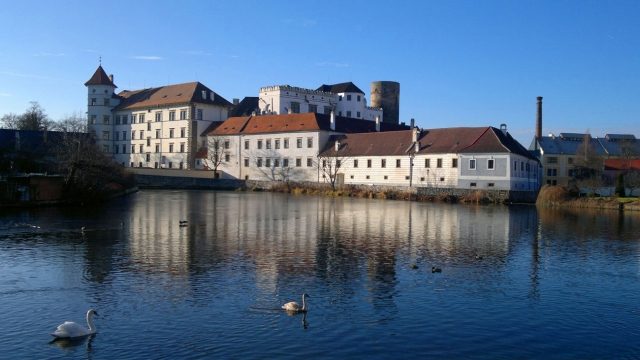
Jindřichův Hradec Castle (German: Neuhaus; literally translated: Henry's Castle) in the eponymous town of Jindřichův Hradec belongs to the Jindřichův Hradec District in the Czech Republic. The castle has been a protected monument since May 3, 1958, and has been listed as a National Cultural Monument of the Czech Republic since November 15, 1995.
History+
Original Castle+
The original castle was probably built in the 10th century on a rampart above the confluence of the Hamerský potok and the Nežárka. It was first mentioned in 1220 and referred to as "Novum castrum". The owner was Henry I of Neuhaus, the founder of the Witigonian branch of the Lords of Neuhaus. The Czech place name attribute Jindřichův, used from 1410 onwards, goes back to him. The oldest parts of the castle (keep, Romanesque-Gothic palace with the Holy Spirit Chapel) were built by 1259. The German-inscribed wall paintings were created in 1338. They show a comprehensive cycle on the legend of St. George as well as the founder Ulrich III of Neuhaus and the Neuhaus commander. A gallery of coats of arms depicts 19 noble lords who participated in the crusades of the order to the Prussians and Lithuania between 1322 and 1337.
Conversion to a Renaissance Castle+
In the 16th century, the castle was converted into a representative Renaissance castle under Joachim of Neuhaus and his son Adam II, and expanded with the New Building. The late Gothic palace became part of the so-called Spanish Wing. Particularly noteworthy are the arcades connecting the building parts, as well as the Rondel completed in 1596, which, with its magnificent vault and gilded relief decoration, is one of the main works of Bohemian Renaissance. The conversion was carried out according to designs by the Italian architects Antonio Ericer and Baldassare Maggi. After the death of the last male descendant of the Lords of Neuhaus, Joachim Ulrich, his younger sister Lucie Otilie, who had been married to Wilhelm Slawata since 1602, inherited his possessions. His descendants bequeathed the castle and lordship of Neuhaus to the Lords Czernin of Chudenitz in 1693. A Baroque fountain was built in the inner courtyard between 1688 and 1696. In 1773, a fire destroyed large parts of the castle.
History of Modern Times+
Eugen Czernin of Chudenitz, who rediscovered the St. George cycle in 1838, earned merits for the reconstruction and preservation of the castle. He moved the Czernin archive to Neuhaus Castle, which also houses the archives of the families of Neuhaus and Slawata and is the second largest noble archive in Bohemia. In 1945, the Czernin family was dispossessed. The castle, estate, and archive became state property. The castle was extensively renovated between 1976 and 1993.
Special Sights+
With its architecture and valuable interior, which also includes a painting gallery, Jindřichův Hradec Castle is one of the most important cultural objects in South Bohemia. Despite multiple conversions in various stylistic periods, the overall complex of the castle presents an architecturally harmonious overall picture. In the painting gallery, the painting of the Madonna of Jindřichův Hradec, created in 1460, is particularly significant. The cycle of paintings from 1338 depicting the legend of St. George in a room next to the castle chapel is also of art-historical interest.
Take Mobile History with you
You are reading this text for free. Premium adds what matters on the road: descriptions read aloud, sites found through your camera, whole regions taken offline.
- Every description, including the ~17,700 Premium sites
- Audio guide: have descriptions read to you on location
- AR finder: see sites through your camera, with distance and bearing
- Unlimited saved sites
14 days free, then from €2.99 a month. Cancel anytime.
Source: Wikipedia · Licence: CC BY-SA 4.0 · Image: Robby-BF
This description is a machine translation of an excerpt from the linked Wikipedia article. The source text was written by its authors, the translation is by Mobile History; like the original it is licensed under CC BY-SA 4.0.
Location: 49.1420, 15.0015