To be privately owned
Juliusburg Castle
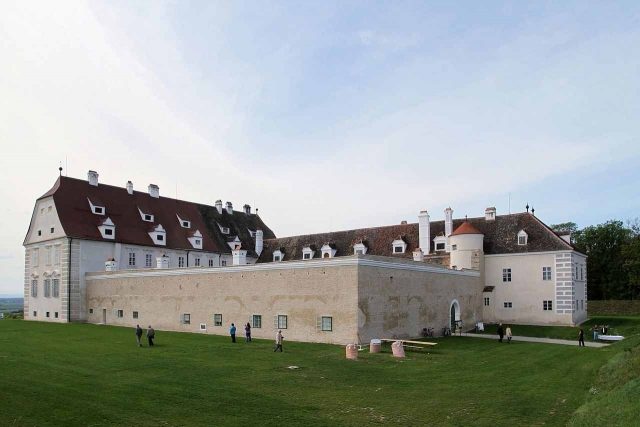
Juliusburg Castle (or Stetteldorf Castle) is located in Stetteldorf am Wagram, in the southwestern Weinviertel region of Lower Austria, on the Wagram ridge.
Count Julius II zu Hardegg had the castle built in 1588, after acquiring the lordship and market of Stetteldorf from the Starhemberg family in 1582. The master builder was Andreas Piazoll. He had previously built a sheep farm, a granary, and a mill here, and with the castle, he created a residence befitting his status, which he named after himself. There was no previous building at this location.
After Julius II died in 1593, Count Georg Friedrich Hardegg had the castle surrounded on three sides by a moat and three rondels built in 1596. For the new layout of the famous castle garden, he even hired a gardener from Vicenza. In 1602, he laid out the court garden below the Wagram. According to Schweickhardt, BUMB. VI, it contained a pleasure house, a hunter's lodge, and a hermitage. For strolling, there were gravel paths, water basins, and fountains with statues. A wall, equipped with round towers with pointed roofs and portals, served as an enclosure. An engraving from 1672 and the fresco in the castle's ballroom by Johann Melchior Thalmann from the first half of the 18th century still bear witness to this. Despite these fortifications, the castle was severely plundered by Lennart Torstensson's troops during the Swedish invasion of 1645. In 1675, this magnificent garden was visited by Emperor Leopold I and his wife. Count Georg Friedrich also maintained a very expensive stud farm in Schmida.
The Sobieski wing with the former tower commemorates the war council held at the castle in 1683, where Polish King Jan Sobieski, Duke Charles of Lorraine, and German princes planned the liberation of Vienna from the Turks.
Under Johann Julius IV Count Hardegg, the architect Johann Jacob Castelli undertook the baroque redesign of the complex from 1705 to 1709, which Johann Lukas von Hildebrandt was able to complete. The mighty double gate through the rampart is his work. In 1749, an earthquake severely damaged the castle, so that the three-story tower of the castle, which had been baroque-styled with a Welsch cap, had to be demolished. During the baroque reconstruction, not much consideration was given to the castle's statics, which led to problems in this regard. Fortunately, these could be remedied during the restoration in 2008.
In the 1950s, murals were discovered and uncovered in the castle's largest hall, the playroom, so named because badminton used to be played there. The paintings depict the possessions of the older line of the Hardegg family. The then owner, Countess Mechthild von Hardegg, née Baroness von Sturmfeder, had an artistic hand; she restored the paintings herself. The Countess was the childless widow of the last entailed lord Johann Friedrich von Hardegg in Stetteldorf; he fell in the last days of the war in 1945. At the end of the war in 1945, the castle was plundered and devastated. Irreplaceable works of art and the magnificent interior were lost. The almost complete loss of the archive must have been particularly painful for the family. The restoration of the castle was hardly expected, but almost 60 years after the end of the war, the miracle happened! The owner, Mr. Georg Stradiot, achieved the improbable; he saved the castle with great effort. Juliusburg will soon shine again in new old splendor; the country owes him its gratitude.
Take Mobile History with you
You are reading this text for free. Premium adds what matters on the road: descriptions read aloud, sites found through your camera, whole regions taken offline.
- Every description, including the ~17,700 Premium sites
- Audio guide: have descriptions read to you on location
- AR finder: see sites through your camera, with distance and bearing
- Unlimited saved sites
14 days free, then from €2.99 a month. Cancel anytime.
Source: Wikipedia · Licence: CC BY-SA 4.0 · Image: http://commons.wikimedia.org/wiki/File:Stetteldorf_-_Schloss.JPG
This description draws on the facts documented in the linked Wikipedia article; Wikipedia content is licensed under CC BY-SA 4.0. Wording and editing: Mobile History.
Location: 48.4053, 16.0231