To be privately owned
Kaiserhammer Castle

Already in the 16th century, the Selb Forest was one of the most popular hunting grounds of the Margraves of Brandenburg-Kulmbach. Initially, the hunting parties lodged in the market town of Selb, located at the edge of the forest, where Margrave Georg Friedrich had a hunting lodge built in 1580 in place of a medieval moated castle. In 1701, Margrave Christian Ernst had a new wooden hunting lodge built in the middle of the extensive forest area near Kaiserhammer, under the direction of the Italian architect Antonio Porta.
Margrave Friedrich, also an enthusiastic hunter, commissioned the architect Johann Friedrich Graël in 1737 to renovate and expand the building, which had by then fallen into disrepair. In 1755, the Margrave decided to build a new hunting lodge in Kaiserhammer. Under the direction of the young architect Carl Gontard, a large, three-winged castle building was constructed in the years 1756 and 1757. In 1757 and 1768, a whole army of carpenters, locksmiths, blacksmiths, glaziers, plumbers, and coopers from the surrounding area worked on the furnishing of the castle, and after the court stucco artist Rudolf Albini had finished his work in the winter of 1759/60, it was ready for occupancy. On the occasion of a princely stay in 1761, a wooden comedy house was also erected near the castle.
The adjacent forest was transformed into a parforce hunting garden by star-shaped clearings. A large hunting star was created, in the center of which the Prince had a hunting pavilion built in 1761. In the center of the small hunting star on the Tannenberg, a salon was erected in 1762, but its completion was abandoned after the death of Margrave Friedrich in 1763.
The new hunting lodge Kaiserhammer was only granted a short period of prosperity. Already under Margrave Friedrich's successor Friedrich Christian, who had no interest in parforce hunts, the decay of the facilities in Kaiserhammer began. Margrave Alexander ordered the sale of the buildings to private hands in 1770. However, since no buyer could be found for the actual castle building, after the transfer of the land to Prussia, the governing minister Hardenberg ordered the demolition of the main wing in 1792. The hunting pavilion on the rotunda had already been demolished beforehand, and the salvaged building material had been used for the construction of the bathhouse in Alexandersbad.
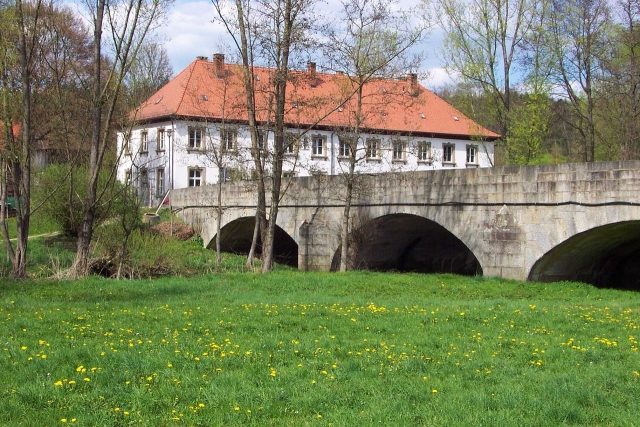
Of the buildings of the former Kaiserhammer Castle, the former kitchen and stable wings remain. The large hunting star in the Rondellwald has become a popular local recreation area; in place of the former hunting pavilion, there stands a mighty linden tree. The remains of the salon on the Tannenberg are known as the Schlößlein ruin.
Take Mobile History with you
You are reading this text for free. Premium adds what matters on the road: descriptions read aloud, sites found through your camera, whole regions taken offline.
- Every description, including the ~17,700 Premium sites
- Audio guide: have descriptions read to you on location
- AR finder: see sites through your camera, with distance and bearing
- Unlimited saved sites
14 days free, then from €2.99 a month. Cancel anytime.
Source: Wikipedia · Licence: CC BY-SA 4.0
This description draws on the facts documented in the linked Wikipedia article; Wikipedia content is licensed under CC BY-SA 4.0. Wording and editing: Mobile History.
Location: 50.1284, 12.0801