Cultural Events
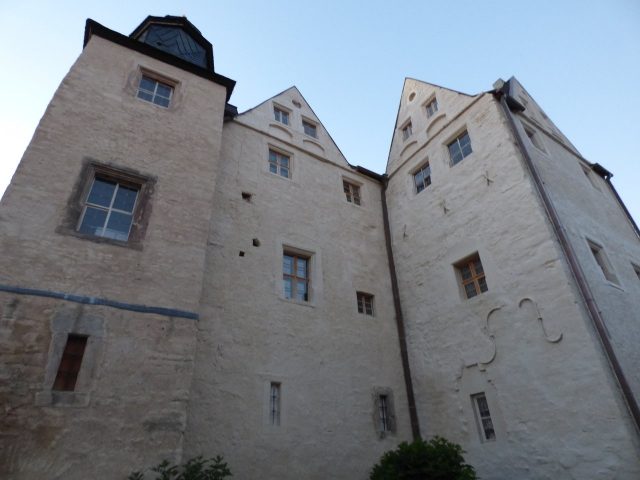
Kannawurf Castle

The ministerial family of Kannewurf, named after the town, was first mentioned in 1221 and had its ancestral seat in Kannawurf until 1350. A moated castle originally stood on the site of the castle that has been preserved to this day. At that time, the lords of the castle protected and controlled the road leading from Erfurt via Weißensee and Sangerhausen to Magdeburg.
In 1564, Georg II. Vitzthum von Eckstedt built the Renaissance castle of Kannawurf, which is still preserved today, on the estate that had been in the family's possession since 1539; there were also three other knightly estates in the village. Inscriptions on doors and windows date to the period between 1563 and 1565. The tower bell from 1586, which is still preserved today, is adorned with the family coat of arms. The north wing housed the reception rooms, including a large hall, while the south wing was reserved for economic and residential functions, including the castle kitchen. A dungeon, bell tower, a 16th-century wooden gallery, and imposing cellar vaults complete the ensemble. After Georg's death in 1570, his five sons inherited the castle. Johann Friedrich I von Eckstedt leased the estate in 1661, as he was indebted due to the Thirty Years' War.
In 1685, the von Bose family acquired the property at auction. During a renovation phase in the 18th century under the aegis of the Bose family, changes were made to the room layout and the roofscape. In 1726, the property passed to the von Helmholt family, later to other owners, and in 1839 to the Princes of Schwarzburg-Sondershausen. The castle is still surrounded by a large farmyard today, whose spacious buildings were built after 1860. In 1914, the estate became a state domain, and during the SBZ and GDR eras, it was a state-owned enterprise. The castle garden had to make way for stables and new farm buildings. The castle increasingly fell into disrepair, and in the 1980s, the north wing collapsed. The final decay seemed sealed. After the fall of the Berlin Wall in the early 1990s, emergency securing of the collapsed building parts and roofs was carried out with federal and state funds, followed by renovation measures. Since 2007, owned by the Thuringian Heritage Conservation Center and the Künstlerhaus Thüringen e.V., the partially renovated castle now serves for cultural events.
Take Mobile History with you
You are reading this text for free. Premium adds what matters on the road: descriptions read aloud, sites found through your camera, whole regions taken offline.
- Every description, including the ~17,700 Premium sites
- Audio guide: have descriptions read to you on location
- AR finder: see sites through your camera, with distance and bearing
- Unlimited saved sites
14 days free, then from €2.99 a month. Cancel anytime.
Source: Wikipedia · Licence: CC BY-SA 4.0 · Image: http://www.wehrbauten.de/thread.php?threadid=2039
This description draws on the facts documented in the linked Wikipedia article; Wikipedia content is licensed under CC BY-SA 4.0. Wording and editing: Mobile History.
Location: 51.2702, 11.1369