Hotel
Kassegg Castle

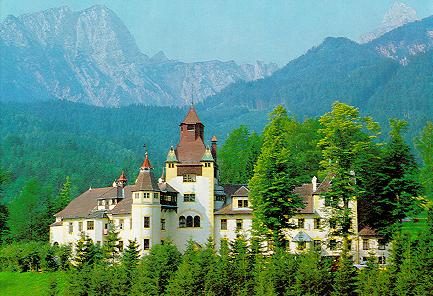
Kassegg Castle is a romantic hunting lodge built around 1886 in the Styrian Gesäuse mountains on the Erbsattel (between Großreifling and Sankt Gallen). Its architectural style and history show parallels to the castles of Bavarian King Ludwig II. According to unconfirmed accounts, a Munich architect, who was also involved in the construction of Neuschwanstein Castle, designed Kassegg Castle and built it for the industrialist Georg Ritter von Aichinger.
Countless renovations and alterations have significantly changed the castle's original appearance. Elements typical of romantic historicism were partly removed, such as the characteristic chimneys, most recently (around 2005). Towards the end of World War II, Kassegg Castle was completely plundered. Due to an incorrect dating of the construction period, shifted to the turn of the century, renovated parts, especially inside, are more in the Art Nouveau style.
The history of Kassegg Castle is poorly documented. Apart from a few old postcards that can be dated with reasonable accuracy, hardly any meaningful documents about the castle have surfaced so far. This documentation is largely based on personal memories and research.
Around 1885, Georg Ritter von Aichinger, initiator of the Kronprinz Rudolf Railway, bought the farm with the house name "Kahsegger" on the Erbsattel. The cellar and parts of the stone walls of this farmhouse were integrated into the south wing during the construction of Kassegg Castle. Extensive timber felling in Gstatterboden (in the Gesäuse) for the construction of Kassegg Castle is documented for 1886. From 1899 to 1902, static problems with the west tower, which threatened to collapse, led to the major reconstruction of Kassegg Castle. The west wing was shortened, and part of the tower was relocated. The castle chapel fell victim to the reconstruction work.
In 1911, Baron von Carg presumably bought Kassegg Castle. Seven years later, in 1918, the last foreign minister of the Imperial and Royal Monarchy, Count Czernin, acquired Kassegg Castle and retired there after the Sixtus Affair. In 1938, Kassegg Castle was confiscated by the National Socialists and incorporated into the staff office of "Reichsforst- und Jägermeister Hermann Göring". For this office, it served several functions in the following years until 1945, including two years as a children's home for children from Graz. Partially, the castle stood empty during this time and was plundered. In 1946, Count Czernin received the empty and damaged castle back but immediately sold it to a Viennese real estate agent. Around 1948, the farmer Wörnschimmel bought Kassegg Castle together with the Bruckwirt Alm, an alpine pasture at the foot of the Tieflimauer. Five years later, in 1953, Gustav Franz de Paul Hoffmann acquired the complex with approximately 4.5 hectares of land (including a wild castle park) for 70,000 Schilling.
From 1954 to 1964, Kassegg Castle served as a boarding school and special school on behalf of the state of Upper Austria, before becoming a leading tourist establishment in the region from 1964 to 1988 as a children's and youth holiday home with 196 beds. Under the management of the couple Gustav and Gerlinde Hoffmann, the holiday home recorded up to 35,000 guest nights per year during peak times. A private ski lift complemented the offer for children's and youth groups in winter, which for over 15 years also included the European Schools from Brussels.
In 1976, the facade of Kassegg Castle was renovated and redesigned. In 1979, the west wing received an extension on the first floor, serving as a dining hall, replacing the long wooden balcony. In 1983, Wolfgang Hoffmann took over the management of the Kassegg Castle children's and youth holiday home from his parents, under whom a general renovation and conversion into a modern hotel operation took place in 1988/89. Subsequently, from 1989 to 1991, youth tourism in the style of a club hotel was cultivated under the motto "Adventure and Fairy Tale Club Kassegg Castle". In 1991, Armin Leebmann from Rotthalmünster bought Kassegg Castle to establish a health resort. From August 31, 1991, Kassegg Castle then stood empty.
In 2004/2005, Kassegg Castle was completely renovated again, completely changing its visual appearance, for example, by removing the typical chimneys. However, the renovation work was not completed, despite 4.6 million Euros already invested. In 2006, the regional weekly newspaper Der Ennstaler reported that the future of Kassegg Castle, for which the establishment of a drug rehabilitation clinic had been discussed at the time, remained uncertain. The project failed due to the lack of provision of systematized beds for a special hospital. In 2008, Kassegg Castle was again for sale for 4.5 million Euros.
On March 12, 2011, the "Kleine Zeitung" reported that Kassegg Castle was to become a "bed fortress," transforming into a three-star hotel for young people and families from summer 2011. On July 2, 2011, the castle was then ceremoniously re-opened as "Natur Hotel Schloss Kassegg."
Stories+
- Eyewitnesses reported on the major reconstruction between 1899 and 1902: "The construction often stood still for months because the owner disagreed with a detail. Then the architect had to travel from Munich, and long negotiations took place until work resumed."
- Count Czernin went big-game hunting in Africa in the 1920s. From one of these trips, he is said to have brought back a large gorilla, which lived in the castle for several years. The population told strange stories about the "gorilla in the castle." The gorilla met its end because it found and drank a bottle of Sidol (silver polish) in the horse harness room.
- The horns of the Hammerschmiedteufel have come a long way. From his big-game hunts, Count Czernin also brought back several buffalo and antelope trophies. Shortly after Gustav Hoffmann bought the castle, he discovered large trophies with the inscription "O.C. 1926 Sudan" at an antique dealer in Waidhofen/Ybbs. There was no doubt: "O.C." stood for Count Czernin, and the trophies thus returned to Kassegg Castle. After the change of ownership in the 1990s, the horns of these trophies were made available for the costumes of the "Hammerschmiedteufel," who wreak havoc around St. Nicholas in St. Gallen every year.
Take Mobile History with you
You are reading this text for free. Premium adds what matters on the road: descriptions read aloud, sites found through your camera, whole regions taken offline.
- Every description, including the ~17,700 Premium sites
- Audio guide: have descriptions read to you on location
- AR finder: see sites through your camera, with distance and bearing
- Unlimited saved sites
14 days free, then from €2.99 a month. Cancel anytime.
Source: Wikipedia · Licence: CC BY-SA 4.0 · Image: Wolfgang Hoffmann / CC BY-SA 3.0 via Wikimedia Commons
This description draws on the facts documented in the linked Wikipedia article; Wikipedia content is licensed under CC BY-SA 4.0. Wording and editing: Mobile History.
Location: 47.6542, 14.6647