Evangelical Home Foundation
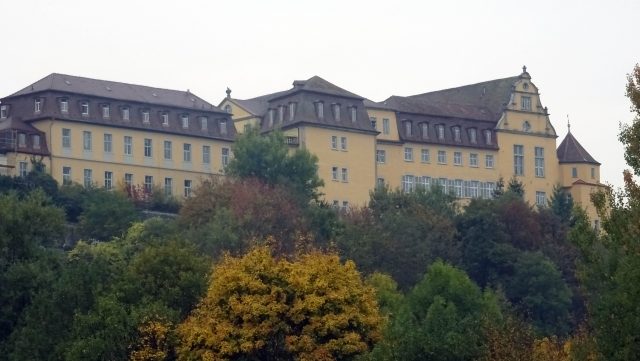
Kirchberg Castle
Kirchberg Castle in Kirchberg an der Jagst is a former princely Hohenlohe castle.
Around 1240, a first castle with a chapel was built; the first documentary evidence in 1265 mentions Raben von Kirchberg, who came from the von Sulz family (Sulz Castle), as the builder. The Lords of Kirchberg were probably vassals of the Counts of Flügelau; they are attested until 1464. The facilities were expanded until 1400. When Kirchberg came into the possession of the imperial cities of Rothenburg, Dinkelsbühl, and Hall in 1398 and was itself developed into a city, the castle complex was included in the city fortifications.
Ludwig Kasimir von Hohenlohe bought the castle back in 1562. Under Kasimir and his sons, extensive changes took place: From 1590 to 1597, the medieval castle was transformed into a Renaissance castle. From this period date the hall building, which was erected on the site of the first castle, two transverse buildings, and connecting corridors, thus a four-winged complex in total, which was provided with bastions towards the city. Of the medieval stock, only the neck ditch, some foundation walls, and a tower with keyhole embrasures on the northeast side, probably built around 1500, which may have replaced an older tower, remained. In 1650, Count Joachim Albrecht von Hohenlohe came into possession of Kirchberg and made the castle his residence. In 1675, Kirchberg again came into the possession of Langenburg, from 1699 to 1861 it was the seat of the Hohenlohe-Kirchberg line.
Leopoldo Retti planned the conversion into a residential castle under Carl August von Hohenlohe, which took place from 1738 to 1745. To the old building stock were added the Widow's Building, which became the town hall in 1800, the stable building, a fountain house and a guardhouse, as well as the castle moat with bridge, coat of arms stone, Neidkopf, and sentry box.
Economic buildings were grouped around the rear courtyard. The octagonal superstructure of the defensive tower on the hall building once housed the art and curiosities cabinet. The front transverse hall contained a Rococo hall, the rear one the so-called Knight's Hall. The originals of the ceiling paintings by Joachim Georg Creutzfelder from Pfedelbach, as well as the interior furnishings of the castle, are now in Neuenstein Castle. Kirchberg Castle was inhabited by members of the House of Hohenlohe-Kirchberg until 1861, then passed into Öhringen possession and was used as a museum until 1945. A part also served as a forester's house. Until 1964, the front parts of the complex were used as a school, and since the end of the Second World War, it has also housed an old people's and nursing home, which emerged from an institution of the Inner Mission for old refugees.
The castle has been owned by the Evangelische Heimstiftung since 1952 and can only be visited by prior arrangement; the castle park is freely accessible.
Description+
From the city side to the southwest, the complex is entered via the courtyard of honor, which is flanked by the Widow's Building and the Stable Building. A bridge leads to a passage through the transverse building and to the next courtyard, the inner courtyard. From the third courtyard, finally, where the tower is also located, one reaches the tip of the mountain spur at the northeastern end of the complex, on which the complex was built. The path leads over a terrace, possibly the former Zwinger.
Take Mobile History with you
You are reading this text for free. Premium adds what matters on the road: descriptions read aloud, sites found through your camera, whole regions taken offline.
- Every description, including the ~17,700 Premium sites
- Audio guide: have descriptions read to you on location
- AR finder: see sites through your camera, with distance and bearing
- Unlimited saved sites
14 days free, then from €2.99 a month. Cancel anytime.
Source: Wikipedia · Licence: CC BY-SA 4.0 · Image: Jörg Heldt
This description draws on the facts documented in the linked Wikipedia article; Wikipedia content is licensed under CC BY-SA 4.0. Wording and editing: Mobile History.
Location: 49.2062, 9.9831