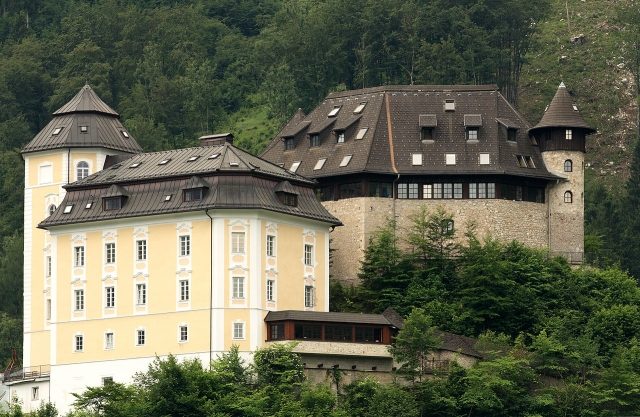
Youth hostel
Educational Institution
Klaus Castle

Klaus Castle is a castle complex in Upper Austria, whose origins date back to the 12th century, and which today houses a Christian youth recreation center and educational facility. The complex is situated on a rocky outcrop in the Steyr Valley, at the foot of Mount Brennet, the southernmost spur of the Kremsmauer.
Initially, it was a fortress on the road through the narrow valley near Klaus an der Pyhrnbahn. The first documentary evidence dates back to 1175. In 1282, Albrecht von Habsburg enfeoffed Albero de Buchheim with the "strong fortress Klaus" as a reward for loyal military service. In 1512, the fortress came into the possession of the Storch family.
In 1578, Ulrich von Storch built a castle directly below the existing fortress, which was baroque-ized in 1758. In 1610, the subjects of Klaus, led by Ludwig and Christoph Storch, prevented about 8000 soldiers of the "Passau War Army" from passing through the narrow valley. In 1616, Ludwig von Storch built a Protestant mountain church above the castle. This was taken over by the Catholic parish church of Klaus in 1674 as a late consequence of the Counter-Reformation.
In 1708, the complex passed into the possession of Count Franz Ludwig von Salburg. In 1742, Baron von Trenck, serving Archduchess Maria Theresia, drew attention to Klaus. Bavarian and French soldiers invaded Upper Austria and also conquered the Klaus fortress. In the early morning hours of January 2, Trenck surprised them after a feast, conquered the castle and fortress, and captured 130 men after a brief battle. In 1760, Count Norbert Anton Oswald Salburg sold the property to the Spital am Pyhrn Abbey.
In 1809, the castle and fortress became the property of the Religious Fund. In 1878, the Princes of Schaumburg-Lippe took over the dilapidated castle and the fortress, which had fallen into ruin. The entire property, with 574 hectares of forest, was sold on December 13, 1940, to the Berlin landowner Sigismund von Treskow, who bequeathed it to his niece Ursula von Sydow in 1945. Since even the last owners could not inhabit the old castle, the basic prerequisite for the preservation of the historic building was no longer given. Immediately after the Second World War, the castle was used as refugee accommodation. From 1948, it served for two years as a convalescent home for children from the Diocese of Vienna cared for by Caritas. The structural condition deteriorated rapidly, and the last remaining walls of the castle ruin threatened to collapse. For this reason, the property became de facto unusable.
Since 1963, there has been a lease agreement between the von Sydow family and the Protestant church association Missionsgemeinschaft der Fackelträger (Torchbearers' Missionary Community). The first renovation works on the castle began, and a few months later, a Protestant youth recreation center and educational facility opened there.
Due to the high demand from guests, it was decided in 1983 to rebuild the castle ruin. Castle and fortress now offer two large assembly halls and 150 guest beds.
Take Mobile History with you
You are reading this text for free. Premium adds what matters on the road: descriptions read aloud, sites found through your camera, whole regions taken offline.
- Every description, including the ~17,700 Premium sites
- Audio guide: have descriptions read to you on location
- AR finder: see sites through your camera, with distance and bearing
- Unlimited saved sites
14 days free, then from €2.99 a month. Cancel anytime.
Source: Wikipedia · Licence: CC BY-SA 4.0 · Image: http://commons.wikimedia.org/wiki/File:Schloss-_und_Burg_Klaus.jpg
This description draws on the facts documented in the linked Wikipedia article; Wikipedia content is licensed under CC BY-SA 4.0. Wording and editing: Mobile History.
Location: 47.8236, 14.1547