Museum
CastleRadeberg
Klippenstein Castle
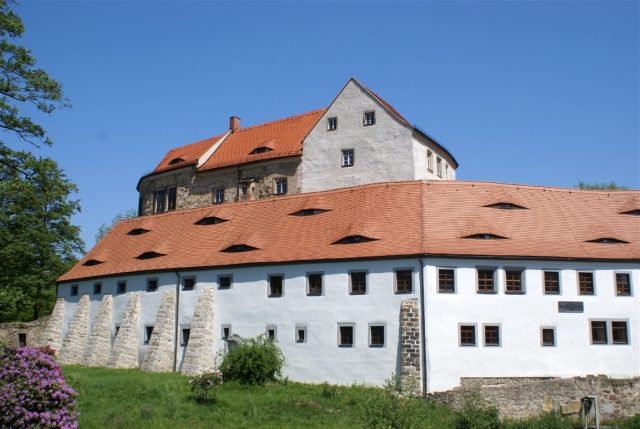
Klippenstein Castle is located in Radeberg near Dresden. The listed castle now houses a museum.
The first documented mention of Radeberg Castle was in 1289. The main castle, situated on a cone of Lusatian granite (two-mica granodiorite), consisted of a stone residential tower with five stories, the 70 cubits (approx. 40 m) high keep, and two other buildings. The castle enclosed the triangular castle courtyard with the Zwinger. To protect the access, it received the "Owl or Hunger Tower," which was used as a prison until 1810 and is now accessible. The Hofegrundbach, dammed into a pond, and the Große Röder additionally protected the castle.
In 1349/50, four outworks were mentioned in the feudal book of Margrave Friedrich the Elder in the Districtus Radeberg. In 1391, the Pulsnitz river became the border between Bohemian Upper Lusatia and the Margraviate of Meissen for over 250 years. Radeberg thus gained strategic importance.
During the Hussite Wars, the fortress was destroyed around 1430 but rebuilt afterwards. In 1463, Elector Friedrich the Gentle sought refuge from the plague in Radeberg Castle.
In 1543, Duke Moritz had the castle expanded by Hans von Dehn-Rothfelser into the Klippenstein administrative and hunting lodge. This was intended to better secure this strategically important location militarily. Further castle buildings were constructed in Moritzburg and Tharandt. The castle construction was completed in 1546. The result was a three-wing complex with characteristic Renaissance gables and dormer windows. The princely riding staircase, located on the sword side with low and very deep steps, leads from the lower castle courtyard to the higher main castle – it allowed riding up to the upper courtyard.
In 1551, by order of Elector Moritz, the official hereditary book for the Radeberg district (part of the Meissen Circle) was created. In 1554, Elector "Father" August stayed at Klippenstein Castle. In 1590, by order of the Elector, 120 hunting dogs were kept. In 1627, master builder Wilhelm Dilich, commissioned by the Elector, drew the oldest surviving view of Klippenstein Castle and the city. In 1628, master builder Ezechiel Eckhardt redesigned the castle.
Source: Wikipedia · Licence: CC BY-SA 4.0 · Image: Roland Neubert, Halle (Saale)
This description draws on the facts documented in the linked Wikipedia article; Wikipedia content is licensed under CC BY-SA 4.0. Wording and editing: Mobile History.
Location: 51.1192, 13.9253