The Castle can be visited
Klosterrode Castle

Usually, a castle was present first, which later became a monastic foundation. In this case, in Klosterrode, a district of Blankenheim near Sangerhausen, it was the other way around. Presumably at the beginning of the 12th century, according to documentary sources, a monastery was founded there by the Burgraves of Magdeburg.
Upon its foundation, the Rode monastery was occupied by Premonstratensian monks from the "Liebfrauenkloster Berge" near Magdeburg. The monastery was dedicated to Saint Albanus and was a daughter monastery of the Magdeburg monastery "Unser Lieben Frauen". Burgrave and Archbishop Wichmann of Magdeburg exerted great influence on this monastery.
The heyday of the Rode monastery, which grew to a considerable size, was between the 13th and 16th centuries. During the Peasants' War in 1525, the monastery got off relatively lightly; it was stormed and plundered, but not destroyed. The monks had fled from the rebellious peasants but later returned to the monastery. Later, however, around the year 1540, the monastery was secularized and converted into a manor house.
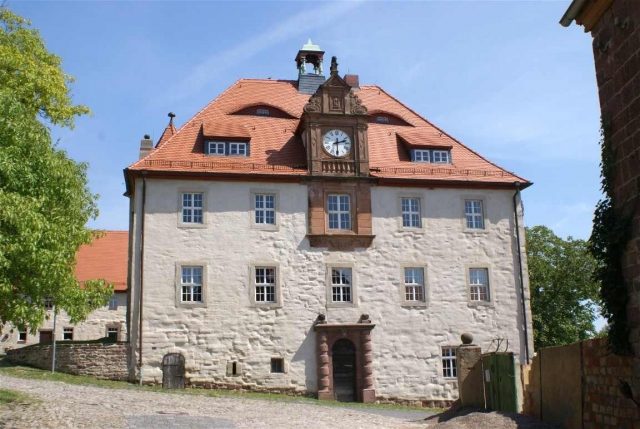
In 1569, Otto Heinrich von Bodenhausen acquired this manor and tore down part of the monastery buildings to erect a representative mansion, which is called "Altes Schloss" (Old Castle). The entrance to the tower is adorned with a beautiful Renaissance portal with seating niches, above the entrance the number 1569 can be read. Of particular importance is the refectory, an underground room, vaulted like a round arch resting on mighty pillars. It resembles a crypt and is popularly called "Rittersaal" (Knights' Hall).
Von Bodenhausen was succeeded as owner by Joachim Werner von Alvensleben. In 1739, Count von Schulenburg bought the manor from the von Alvenslebens for 66,000 Thalers and built the "Neue Schloss" (New Castle) between 1778 and 1783. After the line of the Counts of Schulenburg-Klosterrode died out in 1853, the manor was managed by various tenants. In 1936, it was then divided into 16 farms.
After the Second World War, the "Neue Schloss" was blown up and the land was distributed to new farmers, who were later forced into an LPG (agricultural production cooperative).
After reunification, the land returned to its former owners and the Old Castle became the property of the municipality, which has since been trying to renovate and preserve it. Since 1994, the History and Local Heritage Association has also been working to preserve the historical legacy of the former monastery. Guided tours can be booked through the mayor's office.
Take Mobile History with you
You are reading this text for free. Premium adds what matters on the road: descriptions read aloud, sites found through your camera, whole regions taken offline.
- Every description, including the ~17,700 Premium sites
- Audio guide: have descriptions read to you on location
- AR finder: see sites through your camera, with distance and bearing
- Unlimited saved sites
14 days free, then from €2.99 a month. Cancel anytime.
Source: Wikipedia · Licence: CC BY-SA 4.0 · Image: Roland Neubert, Halle (Saale)
This description draws on the facts documented in the linked Wikipedia article; Wikipedia content is licensed under CC BY-SA 4.0. Wording and editing: Mobile History.
Location: 51.4981, 11.4462