To be privately owned
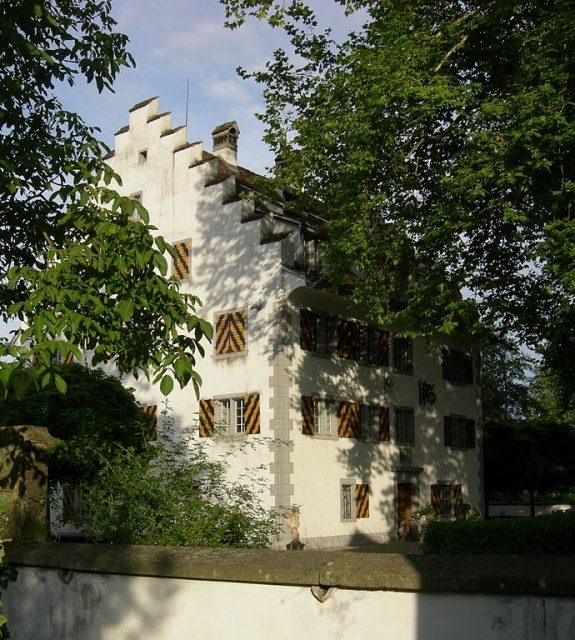
Knonau Castle

Knonau Castle is a castle under heritage protection in the municipality of Knonau in the district of Affoltern, in the southwest of the canton of Zurich in Switzerland. The castle, seat of the bailiff, was built around 1525. The Meierhof (manor farm) is considered the predecessor of the castle and was first mentioned in a document in 1240.
In 1547, a castle site was mentioned for the first time. In 1617, a castle with a moat was mentioned. However, such a building has not been archaeologically proven.
In 1507, Zurich moved the seat of the outer bailiwick of Hedingen-Freiamt-Maschwanden to the Meyerhof in Knonau. Five years later, Gerold Meyer von Knonau sold the manorial rights of Knonau, including the Meyerhof, to Zurich. In 1525, there were alterations and new constructions at the castle. The castle was damaged during the Second Kappel War. In 1534 and 1540, the castle was supplemented with a wall and a moat fed by the Wattbach with a drawbridge. The oldest surviving invoice dates from 1534 and refers to the drawbridge. After a popular uprising in 1545, the bailiwick lost the criminal court. The sword in the judge's chamber remained hanging in the castle until around 1800.
In 1584, an armory was set up on the ground floor of the castle. In the 18th century, a wine press with an apartment, shed, and a castle barn was built. In 1786, plane trees were planted at the entrance. Today they are considered the most magnificent in Switzerland.
From 1788 to 1789, the castle was rebuilt. The main entrance was moved from the north to the south side, there was a staircase and privy extension in plastered half-timbering, and the window axes were regulated. During the renovation, the three tower stoves were installed on the 1st and 2nd upper floors; one with musical emblems.
During the renovation, the moat was probably filled in, the surrounding wall was demolished and replaced by a new plastered rubble and boulder wall in a square layout, along with its outlying small buildings. A new garden wall, just under man-height, was erected, protecting a new symmetrical garden layout between the castle and the newly built outbuildings. Furthermore, a wash and bathhouse with servants' quarters and a prison with two salons were built. The prison was converted into a residential building in 1852.
In 1798, Knonau became part of the Mettmenstetten district; the castle was therefore leased. In 1816, Knonau became the district capital of the district of the same name and the castle became the seat of the district authority under the chief magistrate. In 1832, the castle was sold to municipal president and postmaster Caspar Syz and remained in the possession of his descendants until 1900. Until 1887, it served as the "Goldener Löwen" inn and post office building. From 1833 to 1834, the courthouse was built south of the castle barn. In 1837, Affoltern am Albis became the district capital, whereupon in 1839 the district authorities left the castle grounds and in 1847 the courthouse was converted for residential purposes. In 1837, a cheese hut was built by a corporation. In 1848, a barn was added to the west of the wine press building. Between 1854 and 1855, the courthouse and the castle barn were rebuilt after a fire. In 1865, a bowling alley was built on the northern garden wall, which was converted into a laundry drying facility in 1932 and provided with two head buildings serving as garden pavilions.
In 1926, Dr. Jakob Klaesi acquired the entire castle grounds and established a private psychiatric hospital there. In 1929, water supply was installed in the castle, and in 1932, oil heating was installed and the exterior plaster was removed. In 1949, at the instigation of the then owner, the castle and its surroundings were to be placed under monument protection. Despite a positive attitude from the cantonal building authority and a draft protection ordinance, no legal measures were taken.
In 1963, facade renovations took place again at the castle; removal of the plaster on the southeast and northwest facades. In 1979, the castle was included in the inventory of supra-municipal protected objects as a monument of cantonal importance and in 1981 in the regional overall plan Knonaueramt as a cultural object of regional importance. In 1983, the interior furnishings were auctioned off.
During the years 1985 and 1986, it was classified as a protected object of cantonal importance. From 1986 to 1991, further restorations took place. In 1990, dendrochronological investigations were carried out by the LRD. In 1998, the castle was bought by the current owner.
Take Mobile History with you
You are reading this text for free. Premium adds what matters on the road: descriptions read aloud, sites found through your camera, whole regions taken offline.
- Every description, including the ~17,700 Premium sites
- Audio guide: have descriptions read to you on location
- AR finder: see sites through your camera, with distance and bearing
- Unlimited saved sites
14 days free, then from €2.99 a month. Cancel anytime.
Source: Wikipedia · Licence: CC BY-SA 4.0
This description draws on the facts documented in the linked Wikipedia article; Wikipedia content is licensed under CC BY-SA 4.0. Wording and editing: Mobile History.
Location: 47.2228, 8.4643