To be privately owned
CastleKobersdorf
Kobersdorf Castle
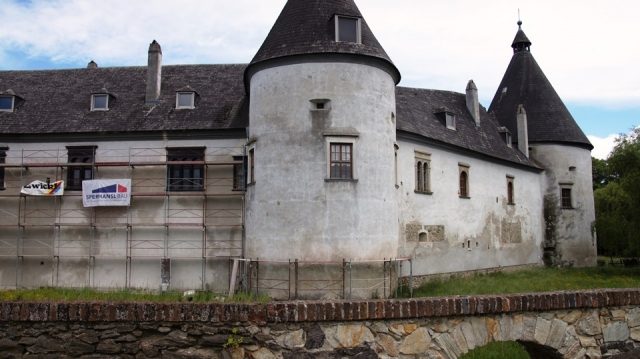
Kobersdorf Castle, a historic estate in Central Burgenland, emerged from a medieval fortress and is now considered a cultural asset. It is located in the market town of Kobersdorf.
History+
The origins of Kobersdorf Castle date back to around 1222, when King Andrew II handed over the area to Count Pousa, who then began building a castle. In 1229, Kobersdorf was first documented as a settlement with a castle. After its capture during the Güssing Feud in 1289, the castle changed hands several times and eventually came into the possession of the Mattersdorf-Forchtensteiner family. After their extinction around 1450, Duke Albrecht VI acquired the lordships of Kobersdorf and Forchtenstein, but was forced to sell them on to Emperor Frederick III in 1451. A gift to the Weisspriach family by Hungarian King Matthias Corvinus in 1466 led to extensions of the castle, including a late Gothic outer bailey and a Protestant chapel. In 1529, the outer bailey was converted into a Renaissance castle by Hans von Weisspriach. After the extinction of the Weisspriach family in 1553, the castle fell into disrepair and became the scene of crimes. Johann I Kery de Ipoliker established clear ownership in 1648 and completed the Mannerist-style expansion in 1656. In 1683, the castle was captured by the Turks and the original fortress was destroyed. The Kery family sold the estate to Prince Paul I Esterházy in 1704, after which it was neglected. In 1963, Professor Martha Bolldorf-Reitstätter acquired the dilapidated castle and began restoration work. A highlight was the completion of the Mannerist Knights' Hall in 2001. With her death in the same year, the castle passed to her daughter.
Location+
Kobersdorf Castle is located in the market town of Kobersdorf in the Oberpullendorf district, situated in the Austrian state of Burgenland. It stands at an elevation of approximately 315 m above sea level.
On site+
Kobersdorf Castle is currently privately owned. The castle chapel consists of two chapels, the smaller of which was later converted into the sacristy of the larger Gothic chapel. The chapel is adorned with late Gothic frescoes and the coat of arms of the Forchtensteiner family. The Gothic chapel, built in 1482 by the Weisspriach family, was originally consecrated as Protestant but was later re-Catholicized and redesigned in the Mannerist style, including 48 floating angels on the ceiling. The altar dates from the early 18th century. Today, the chapel is used for masses, weddings, and baptisms.
Take Mobile History with you
You are reading this text for free. Premium adds what matters on the road: descriptions read aloud, sites found through your camera, whole regions taken offline.
- Every description, including the ~17,700 Premium sites
- Audio guide: have descriptions read to you on location
- AR finder: see sites through your camera, with distance and bearing
- Unlimited saved sites
14 days free, then from €2.99 a month. Cancel anytime.
Source: Wikipedia · Licence: CC BY-SA 4.0 · Image: http://www.wehrbauten.at/bgld/burgenland.html
This description draws on the facts documented in the linked Wikipedia article; Wikipedia content is licensed under CC BY-SA 4.0. Wording and editing: Mobile History.
Location: 47.5974, 16.3919