CastleKönigs Wusterhausen

Königs Wusterhausen Castle
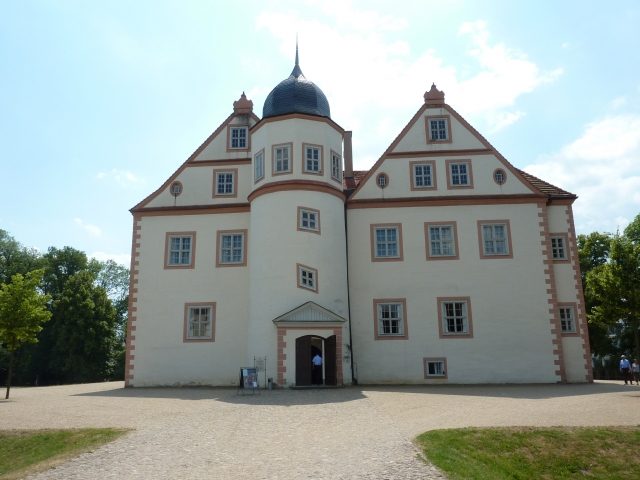
Königs Wusterhausen Castle

Cultural Events
Museum

Königs Wusterhausen Palace, located in the eponymous town southeast of Berlin in the state of Brandenburg, became known as the venue for the Tobacco College. The listed building has housed a museum since 2000.

The palace is based on a moated castle from the 14th century, first mentioned in 1382. In 1682, the estate was acquired by the Great Elector for his son Frederick I, who in turn gifted it to his son Frederick William I, the later Soldier King.

The Palace under the Soldier King

Frederick William I despised the baroque extravagance of his father, who had brought Prussia to the brink of state bankruptcy with the expansion of the palaces in Potsdam and Berlin. He used the simple palace in Wusterhausen as a hunting lodge and summer residence and, whenever possible, only stayed in the city residences during winter. In his honor, the town of Wusterhausen received the "Königs" prefix in its name from 1717 onwards.

The Soldier King preferred to live in this small palace; here he held his famous Tobacco Colleges, and here he could distract himself from state affairs with the training of his Tall Fellows or go hunting – one of the few aristocratic pleasures he allowed himself. To secure the game population, he had the Neue Mühle animal park laid out in 1725, which directly bordered the palace park. But the palace was not only a place of leisure and recreation; here he also signed the decree in 1730 that unhappily ended his son Frederick II's planned escape to England with the execution of his friend Hans Hermann von Katte.

The Palace after Frederick William I

After the death of the Soldier King in 1740, the palace fell into disrepair. Frederick II had no good memories of the place where he spent part of his unhappy childhood and which constantly reminded him of his hated father. He preferred to dedicate himself to the expansion of Sanssouci Palace in Potsdam.

In the 19th century, the hunting lodge was revived by the Prussian kings and furnished in the Historicist style. In 1913, the last great hunt took place under Emperor Wilhelm II. During the Weimar Republic, a museum was housed here for a time, and during World War II, it was used as a military hospital. During the German Democratic Republic, it was the seat of the district administration of the Königs Wusterhausen district.

Extensive restoration work took place from 1991, and in 2000, the palace and garden were again made accessible to the public; today, it is once again a cultural center. The palace serves as a museum again, and concerts and craft markets are also held here. It is managed by the Prussian Palaces and Gardens Foundation Berlin-Brandenburg.

Since 2001, the city of Königs Wusterhausen has organized a palace festival every two years in autumn.

Architecture of the Palace+

The palace, whose main building still dates from the Renaissance, consists of two houses connected along their long sides – a building style relatively unusual for this region but common in Northern Germany – a stair tower with a Welsche Haube (a type of onion dome) forms the only architectural embellishment. With this facade, it resembles Demerthin Palace, built at approximately the same time and also in the Mark Brandenburg. The interiors were adapted to the taste of the time for the king in the 18th century, albeit quite spartanly. Even today, paintings made by the Soldier King in his hours of leisure and exhibited here can be found.

In front of the palace are the two Cavalier Houses, which together form the trapezoidal palace courtyard. The palace includes a small palace park, which developed from a Renaissance garden and was extensively baroque-ized at the end of the 17th century. However, this garden is now only present in remnants.

Source image: www.wehrbauten.de

Take Mobile History with you

You are reading this text for free. Premium adds what matters on the road: descriptions read aloud, sites found through your camera, whole regions taken offline.

  • Every description, including the ~17,700 Premium sites
  • Audio guide: have descriptions read to you on location
  • AR finder: see sites through your camera, with distance and bearing
  • Unlimited saved sites

14 days free, then from €2.99 a month. Cancel anytime.

Source: Wikipedia · Licence: CC BY-SA 4.0 · Image: Joachim Schneeleopard

This description draws on the facts documented in the linked Wikipedia article; Wikipedia content is licensed under CC BY-SA 4.0. Wording and editing: Mobile History.

Location: 52.2983, 13.6250