To be privately owned
Königsbach Castle

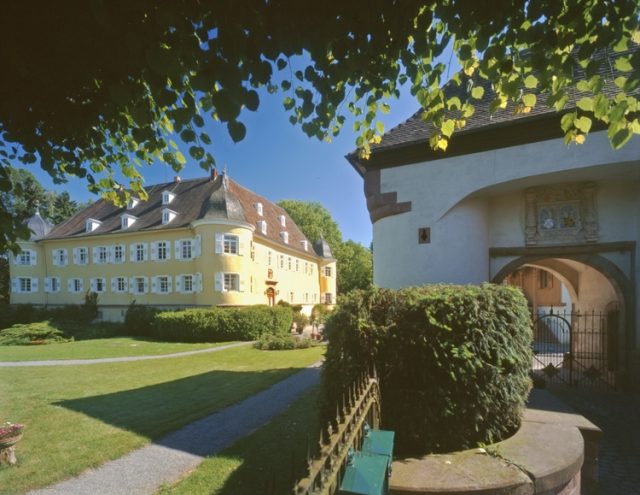
Königsbach Castle is the castle in the Königsbach district of the municipality of Königsbach-Stein in the Enz district.
- 1375 first mention of a moated castle, shortly thereafter demolition of the building
- around 1400 construction of a new moated castle, on whose foundations the present castle is built
- 1429-1650: The castle is owned by the Nobles of Venningen zu Königsbach.
- 1554 Erasmus von Venningen introduces the Reformation in Königsbach
- 1622/1623 (Thirty Years' War): Parts of the castle are destroyed
- Since 1648, the Imperial Barons of Saint André, a noble family from the Dauphiné in France, have owned Königsbach Castle
- In the 20th century, the family died out in the male line. Olga Marie von Gemmingen Guttenberg, née von Saint André, is the lady of the manor in Königsbach.
- November 1, 1990 Death of Olga Marie. Through the adoption of the orphaned Achim von Arnim under the name St. André, the family name is continued. Baron Achim has two sons who bear the name St. André-Arnim.
Prehistory+
Near Singen, the Kämpfelbach valley, formerly called Remchinger Tal, merges with the Pfinz. Near the old village of Königsbach, it turns in the same direction as the upper Pfinztal. Above the bend, on the south side of the valley, the height, the Heustatt, rises quite steeply, from the east and north the steep slopes of flat ridges approach the village. On one, the church with its tower and gable rises impressively, the other was once crowned by a castle, of which only minor remains of walls are preserved. A deep neck ditch still clearly separates the castle site from the long ridge of the Steinhausberg. To the west, the castle path apparently led up. On the spot that could once have borne the keep, there is now a water tank with rather unappealing "architecture". Here, without a doubt, was the seat of the "von Königsbach", who died out around 1500. After some changes, the property soon came into the hands of the other noble family that was resident in Königsbach, the von Venningen-Königsbach.
They owned the moated castle down in the meadows, "in the Remchinger Tal, below the mountain called Heustet" and, in addition to stately own property in fields and vineyards, 5/12 of the Vogtship, the lower court in Königsbach, including associated meadows and forests. Now they also acquired the sixth of the Vogtship that the "von Königsbach" had held as a fief, so that they united 7/12 of the Vogtship in their hands. The remaining 5/12 belonged to the Margrave of Baden. The Venningen share of the Vogtship was a fief of the Margraves of Brandenburg, in particular of their Ansbach line.
The castle on the Steinhausberg, which was already described as a rather miserable residence in the 15th century, remained abandoned and gradually fell into disrepair. A destruction in the Peasants' War is nowhere recorded, and the castle in the valley did not arise only after such destruction.
This lower castle can be traced back to the 14th century. In 1375, Heinrich von Niefern, called Wolgemut, bought from the widow of a Sigmund von Balshofen "as free property, as unencumbered and unburdened good" a Burstadel in the meadows in the valley near Königsbach. In 1399, Heinrich Wolgemut von Niefern, the Younger, was enfeoffed with a third of the Vogtship of Königsbach, which his father had also owned. He built a new castle near the Balshofer Burstadel, which he surrounded with two moats. With the excavation of the moats, he had those of the old Burstadel filled in and its entire area leveled into a meadow. According to the enfeoffment letters and witness statements in a feudal dispute in 1465, the castle consisted of a residential building, a forecourt in front of it with a granary and a garden. Moats surrounded the castle and forecourt. In general, it will therefore have corresponded to the present complex.
Heinrich Wolgemut, the Younger, died without a male heir. Through the marriage of his daughter Christine to Seyfried von Venningen, the castle and the associated share of the Vogtship came to the Lords of Venningen, and from their possession, Colonel Daniel Rollin von Saint-André acquired the lordship of Königsbach in 1650. To this day, the castle and lordship have remained with the Barons of Saint-André. The condominium with Baden ended in 1803.
Take Mobile History with you
You are reading this text for free. Premium adds what matters on the road: descriptions read aloud, sites found through your camera, whole regions taken offline.
- Every description, including the ~17,700 Premium sites
- Audio guide: have descriptions read to you on location
- AR finder: see sites through your camera, with distance and bearing
- Unlimited saved sites
14 days free, then from €2.99 a month. Cancel anytime.
Source: Wikipedia · Licence: CC BY-SA 4.0 · Image: http://www.pfenz.de/wiki/Datei:K%C3%B6nigsbach_Schloss.jpg
This description draws on the facts documented in the linked Wikipedia article; Wikipedia content is licensed under CC BY-SA 4.0. Wording and editing: Mobile History.
Location: 48.9628, 8.6127