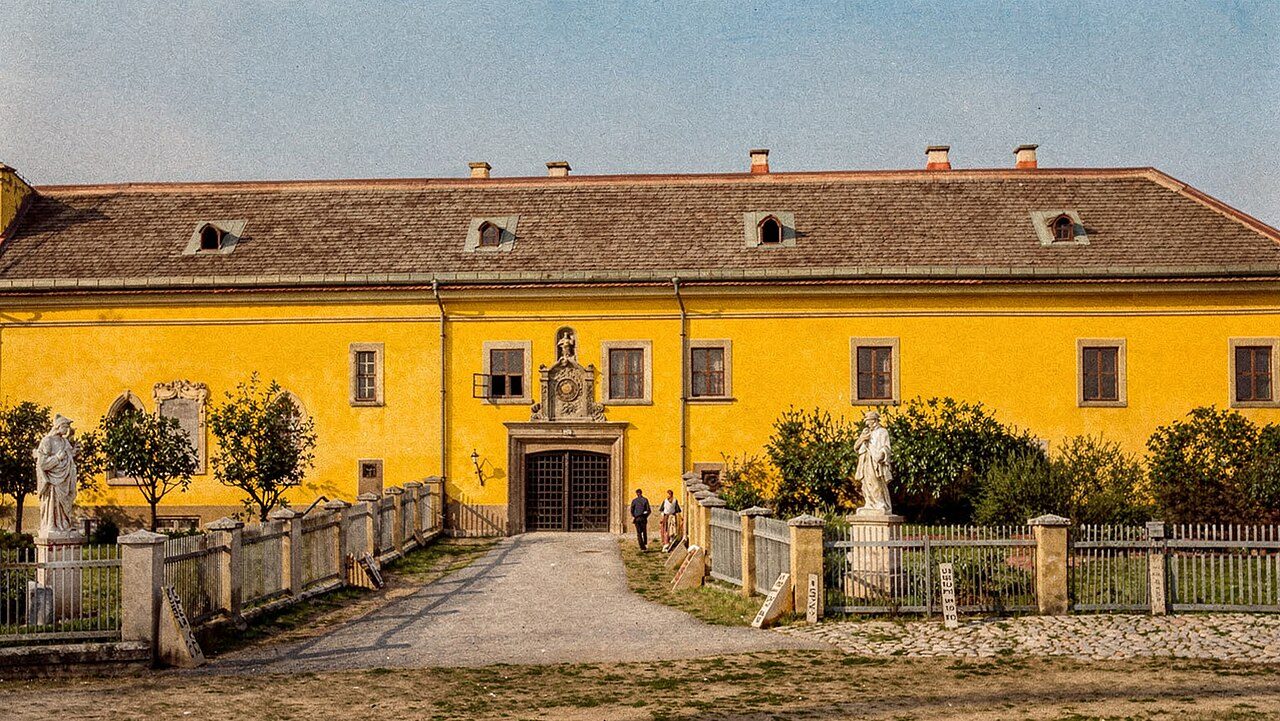
CastleKönigshof

Königshof Castle

Königshof Castle

To be privately owned

Königshof (Hungarian: Királyudvar) was the administrative center of the Hungarian possessions of Heiligenkreuz Abbey until 1912. Afterwards, it was owned by the Austrian Federal Treasury and self-administered by the Königshof Army Economy.

In the Latin records of the Heiligenkreuz Abbey archive and the church registers of the parishes of Kaisersteinbruch and Winden, Königshof is always referred to as Aula Regia.

Roman Castrum+

Near the chapel ruin on the monastery meadow west of Kaisersteinbruch, archaeologist and Colonel Maximillian Groller von Mildensee conducted excavations in 1903 on behalf of the "Carnuntum" Antiquities Association, which confirmed that Cistercian living quarters had been located here. The Antiquities Association had excavations carried out here because it was suspected that a Roman castrum had existed at this site. The suspicions were confirmed, as building remains with a well-preserved hypocaust (heating system) were found. It was proven that the Roman road, which led from Carnuntum on the lake shore via Winden, Eisenstadt to Ödenburg (Scarabantia), passed by here. For the purpose of monitoring this road, this Roman estate (manor house) was built, which shows similarities to the Eisenstadt manor house on the Gölbesäcker. It was a fortified camp for the guard soldiers.

Epitaphs

The Roman city of Ulmus was located in Upper Pannonia; it is mentioned in the Tabula Peutingeriana, a Roman road map. Groller suspected it to be near Königshof. Its exact location is still being researched today.

This location is on the Bruckneudorf-Kaisersteinbruch military training area, therefore excavation is prohibited.

Frankish Königshof+

In Carolingian times, an earth castle measuring 109x130 m was built across the Roman foundations, a Königshof fortified with a corner tower and entrenchments, which served as quarters and a supply station for emperors who did not yet have a permanent residence during their travels in the empire. Later, the area passed into the possession of the Hungarian kings.

Such Königshöfe, which no longer had a military necessity, were often handed over to the church.

Deserted Monastery+

The strip of land between Leitha and the northern shore of Lake Neusiedl was assigned to Heiligenkreuz Abbey by King Imre in 1203 as a colonization area. This property, encompassing almost the entire municipal area of Kaisersteinbruch, was once the hunting ground of Hungarian kings. The hunting lodge itself was then located on a hill near the so-called Deserted Monastery and was briefly named Königshof. It was to be inalienable and serve only the greater glory of God and the welfare of the subjects. "We grant for all eternity to Heiligenkreuz Monastery the strip of land which the Bissener once possessed..."

Abbot Clemens Schäffer decreed in 1673 monthly masses and requiems for the greater benefactors of Heiligenkreuz Abbey. In July for Emerik, King of Hungary, who, with the consent of his wife Constance of Aragon, gave the estate of Königshofen to the abbey.

The monastery was richer endowed by foundations in Hungary than in Austria, so from 1206 to 1209 it considered a transfer to Western Hungary. The monks, true to their monastic rule "ora et labora" (the certainty that the path to God leads only through prayer and hard work), transformed the wilderness then prevailing around Lake Neusiedl into a cultural landscape. This was confirmed several times by the Hungarian kings (1208, 1230 and 1236), and again after the Tatar destruction in 1270 (1272, 1317). The construction of a church had begun. The large-scale church remained unfinished. Six bays of the nave without transept and eastern choir originate from this complex. The General Chapter of the Order changed the plan.

As conversi in this grange, the brothers Ulrich, Wulfing, Konrad Suevus and Heinrich are documented in 1239 and 1248. The life there is attested by the stewards Rudolf (1278, 1285), Thomas (1326), Seyfried (1338), Dietrich (1348), Leopold (1352), Albert (1366) and Andreas (1371, 1372). The Königshof mill was built by the Cistercians; it is first mentioned in a document from 1285.

The rubble-stone chapel ruin from the 14th century with windows and buttresses, as well as foundations of a third complex that partially utilized the earth castle, belonged to a monastery building that the Cistercians of Heiligenkreuz began to erect. This old Königshof was destroyed by the Turks in 1529, and the adjacent settlement at Waldbruch was also plundered and burned down. A larger number of inhabitants managed to flee to the Einsiedlerbruch. The abbey fell into such distress that Abbot Johann V mortgaged the estate for 50 years in 1531. During this time, the settlement fell into disrepair, except for the mentioned church ruin.

Hermitage at the Deserted Monastery

At the Deserted Monastery near Kaisersteinbruch, there was a hermitage connected to Heiligenkreuz Abbey. The respective hermit was supplied with food and fuel by the abbey.

The hermitage was built by Johann Baptist Regondi. It was located near a St. John's Chapel, where masses were celebrated several times a year. After the abolition of the hermits under Joseph II, an old man, a beggar, settled in the hermitage and lived there with his wife.

Königshof near Wilfleinsdorf - Aula Regia+

Today's Königshof was built at the beginning of the 17th century near the mill at Wilfleinsdorf on the Leitha bank. It was newly erected as a castle-like estate, and already in 1621 it was burned and devastated by Gábor Bethlen's rebels.

Tower Clock

Abbot Christoph Schäffer (1614–1637) ordered a tower clock with four dials for Königshof on December 16, 1636, from the clockmaker Martin Schmidt in Mödling for 180 guilders.

Trinity Chapel

Abbot Clemens Schäffer (1658–1693) commissioned the construction of the large Trinity Chapel in Königshof Castle in 1676. The altar was supplied by Thomas Rueff, court cabinetmaker from Vienna, on June 30, and the statues of St. Benedict and Bernard were made by the sculptor Georg Niclas Mayr. A large and a small painting were placed on the altar, for which the painter Mathäus Managetta received 60 guilders on October 16.

Again, the estate was plundered and devastated by the Turks in 1683. Hardly restored, it suffered severe damage from marauding Kuruc forces in 1703.

Abbot Gerhard Weixelberger (in office 1705–1728) had the damage repaired. His coat of arms is located above the main portal of the building. His connection to Königshof dated back to the period from 1693 to 1696, when he was parish administrator in the quarry area.

Abbey Administration in Königshof Castle

From January 1, 1601, to 1912, Königshof Castle housed the manorial administration for the surrounding possessions of Heiligenkreuz Abbey, with the administrator as the abbot's representative being the highest authority. The names of all administrators from January 1, 1601, to January 7, 1913, are documented in the abbey archive.

Column of Honor for Elias Hügel

After the death of the manorial administrator of Königshof, Father Raymund Vitali, on September 13, 1740, the Kaisersteinbruch brotherhood was freed from a heavy burden. He acted in the manner of an inquisitor and had dishonorably deposed Elias Hügel as judge. Johann Paul Schilck, as master of the stonemason's guild, initiated the erection of a column of honor for Master Elias Hügel. Due to the events of the war and the dissolution of the municipality of Kaisersteinbruch, this column is not in its original place in the quarry area, but in front of Königshof Castle. Only remnants of it remain; a precise copy was erected in Gemünden am Main, Hügel's birthplace, in 1996, based on an existing drawing.

Reconstruction of the Castle Chapel

Court stonemason master Elias Hügel was also the stonemason of Heiligenkreuz Abbey. During the reconstruction of the main chapel in Königshof in 1745, he directed the stonemasonry work. This included the exterior plinth, 3 feet high all around, the cornice all around, a door, four windows, stone for the capitals, and two shield plates.

1789 Establishment of an Indigo Factory+

The estate with its meadows, pastures, and fields located on the Leitha was to be sold in 1789 to an interest group for the purpose of establishing a factory. And the remaining larger part of the property, mainly consisting of meadows, forest, and fertile arable land, was to be divided among the communities of Kaisersteinbruch and Winden. The idea of mercantilism, the pursuit of autarky, also led to the growth of many factories in Austria and Hungary. Thus, the first indigo factory was established under the Counts Rumpf, Kurzböck, and Friedrich Kaut. After the Leitha floodplains near Königshof were recognized as excellent soil for the indigo plant, the entrepreneurs approached Emperor Joseph II in 1789 with the request to demand the Königshof estate from Heiligenkreuz Abbey for these purposes. The emperor was all the more willing to do so, as he already intended to secularize the monastery.

On October 31, 1789, a Most High request was sent to Abbot Maximilian Mayla to announce the value of the Königshof dominion, as an expansion of the indigo cultivation factory was planned. The abbot pointed out that Königshof, as an indispensable center of the abbey's dominion in Hungary, where all administrative affairs were conducted, could not possibly be ceded. A sale would only be conceivable if their possessions in Wilfleinsdorf, Arbesthal, Höflein, Kaisersteinbruch, and Winden were also acquired. The owners declared their willingness to redeem everything.

Thus, the value was estimated at 336,000 guilders, 29 shillings, 28 pennies, with the abbey reserving the patronage over the parishes and other freedoms. The death of the emperor († February 20, 1790) changed the situation. His successor Leopold II had no intention of interfering in ecclesiastical matters.

The Königshof Estate was united with the municipality of Kaisersteinbruch in 1903+

The Hungarian state decreed that the larger Königshof estate, as the seat of the dominion, be united with the small municipality of Kaisersteinbruch - thus creating the greater municipality of Kaisersteinbruch. In the same year, the Cistercians celebrated 700 years of rule over the Königshof estate in the presence of the county authorities and the owner of the neighboring estate, Count Theodor Batthyány.

Sale of Kaisersteinbruch to the Military+

On October 31, 1912, the sales negotiations, for which Abbot Gregor Pöck was responsible, were concluded, and the area of the quarries, given "for eternal times," was handed over to the Imperial and Royal War Ministry. The abbey received 3,500,000 Kronen and Styrian forest areas. The demands of the Bruck camp for more training grounds were met.

The Deserted Monastery on the Military Training Area+

The heavily retraced lines on the sketch show wall sections with sharp edges in the entrance area as still existing remains in 1990. The Federal Ministry of Defense rejected the placement of an information board in this area for military reasons. Years later, this became unnecessary, as nothing of these remnants could be recognized anymore.

Take Mobile History with you

You are reading this text for free. Premium adds what matters on the road: descriptions read aloud, sites found through your camera, whole regions taken offline.

  • Every description, including the ~17,700 Premium sites
  • Audio guide: have descriptions read to you on location
  • AR finder: see sites through your camera, with distance and bearing
  • Unlimited saved sites

14 days free, then from €2.99 a month. Cancel anytime.

Source: Wikipedia · Licence: CC BY-SA 4.0 · Image: Gutsverwaltung Königshof, endet 1912. / Public domain via Wikimedia Commons

This description draws on the facts documented in the linked Wikipedia article; Wikipedia content is licensed under CC BY-SA 4.0. Wording and editing: Mobile History.

Location: 48.0108, 16.7187