CastleHeidesheim

Königsklinger Aue Castle
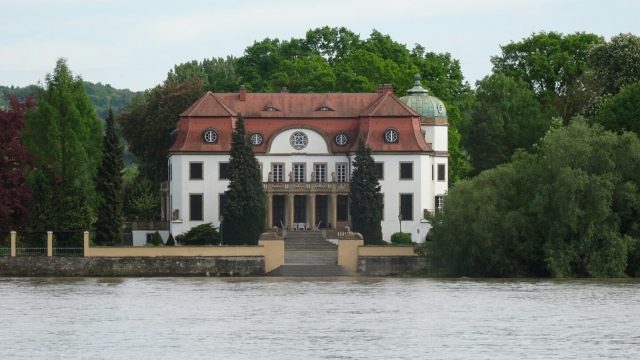
Königsklinger Aue Castle

To be privately owned

The Königsklinger Aue or Eltviller Aue is a natural inland island in the Island Rhine between Mainz and Bingen. With an area of around 80 hectares, it is the largest Rhine island in this section, even larger than the Mariannenaue, which is only about 700 meters southwest (downstream). 2.8 km upstream, the Rettbergsaue is the closest of the Rhine meadows. The Königsklinger Aue is about twice the size of Mainau Island in Lake Constance. The island belongs to the municipality of Heidesheim am Rhein in Rhineland-Palatinate. Only the northeastern, upstream tip of the island still belongs to the municipality of Budenheim. It accompanies the Eltville Rhine bank from the first villa properties to the swimming pool over a length of 2.15 kilometers (river kilometers 510.0 to 512.1, not counting the flow control structures). It lies between the main shipping channel in the north and the left bank in the south. At its widest point, the island is 500 meters wide. Flow control structures largely block off the Rhine arm between the Aue and the left bank, so that it has transformed into a still water zone with only slight current, which is completely interrupted during extremely low water.

In place of the Königsklinger Aue, there were three smaller islands in 1575, which later connected and enlarged through accretion and Rhine correction. To the west lay, depending on the reading, the Ringelaue or Kingelaue, further upstream the Landschreiberaue, and to the east the Neue Sand. For the Kingelaue, there were also the spellings Kungelaue, Konigelauwe (Rabbit Aue) and at the end of the 18th century Königlingesaue, which sounds very similar to the current name. The name could be explained by the fact that this was the Aue where Emperor Louis the Pious died in 840 "opposite Ingelheim". However, there is also reason to believe that this event took place on the Mariannenaue. In any case, the island was owned by Eberbach Abbey until the French Revolution, and the Landschreiberaue must also have belonged to the Electoral Mainz Rheingau according to its name. Thus, the designation Eltviller Aue is justified by centuries of ties to the Rheingau.

In the Peace of Lunéville in 1801, the shipping channel for downstream vessels was defined as the border of France. Thus, the Aue belonged to the Left Rhine Bank and is part of the municipal area of Heidesheim am Rhein. This demarcation between Eltville and the Eltviller Aue has remained in place through all the vicissitudes of German history ever since. Both after the Congress of Vienna and after the founding of the German Empire, and also after the Second World War, a state border was drawn in the main shipping channel.

As a result of secularization, the Eltville merchant Johann Maria Kertel acquired the Aue, which was then called Kertelaue. After his death, it was owned by the Langwerth von Simmern family from 1831 to 1851. The next owner was Salomon Marix, a silk merchant from Lyon, who had settled in Eltville in the same year. In 1853, he had a first manor house, the so-called Krimschlösschen, built on the island. After her marriage, Marix's daughter Olga inhabited the island inherited from her father, which was then popularly called "Olga Island". In 1888, Baron Carl Ferdinand von Stumm-Halberg acquired the island, which after his death in 1901 passed to his daughter Berta von Lucius (1876–1949). She had the old manor house demolished and the present villa built between 1904 and 1909 according to plans by the architect Wilhelm Kreis. In 1912, Berta von Lucius married Cavalry Captain Count Adalbert von Francken-Sierstorpff (1856–1922). When he died on May 27, 1922, his wife had him buried in a mausoleum on the eastern part of the island. The island remained in the possession of this family until 1955 and has since changed hands several times. Today, the island is owned by the Mayer family, who also own the Karl Mayer Textilmaschinenfabrik in Obertshausen.

Nature+

Since 1992, the island has been part of the Haderaue-Königsklinger Aue nature reserve, which has an area of 165 hectares. The purpose of protection is the preservation and development of the remaining relics of a formerly extensive floodplain landscape, including the island "Königsklinger Aue" located in front of the land, with its water and fluctuating water areas, riparian zones, sandbanks, floodplain meadows and remnants of floodplain forests as habitats for rare wild plant species and plant communities, as habitats and partial habitats for rare wild animal species, and for scientific reasons.

Take Mobile History with you

You are reading this text for free. Premium adds what matters on the road: descriptions read aloud, sites found through your camera, whole regions taken offline.

  • Every description, including the ~17,700 Premium sites
  • Audio guide: have descriptions read to you on location
  • AR finder: see sites through your camera, with distance and bearing
  • Unlimited saved sites

14 days free, then from €2.99 a month. Cancel anytime.

Source: Wikipedia · Licence: CC BY-SA 4.0 · Image: Jörg Heldt

This description draws on the facts documented in the linked Wikipedia article; Wikipedia content is licensed under CC BY-SA 4.0. Wording and editing: Mobile History.

Location: 50.0214, 8.1281