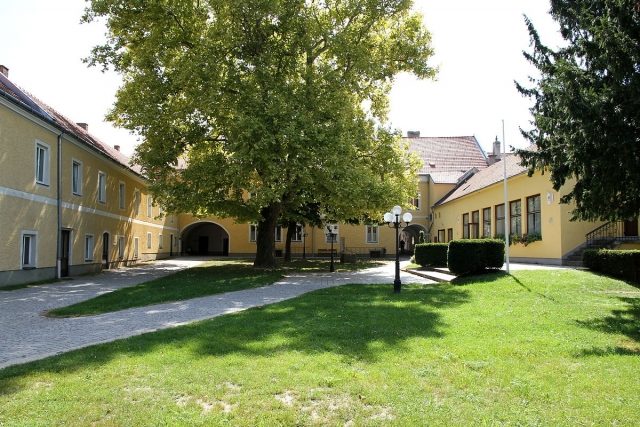
CastleKönigstetten

Königstetten Castle

Königstetten Castle

Municipal offices

The place name surprisingly does not refer to royal property. As early as 836, the entire eastern Tullnerfeld came into the possession of the Diocese of Passau through a royal donation. The place was formerly called Chunihohestettin after the personal name Chunihoh. As such, it is first mentioned in a document in 985. The regional administrative center of the Passau bishops was initially Zeiselmauer, but Passau ministerials have been residing in Königstetten since the 12th century. Around 1324, it was the Knights Matseber, who were followed by the Wallseer. In 1410, the lordship belonged to the Hofmeister Albrecht von Ottenstein as a free allod. However, it was already pledged to the Starhemberger in 1418. Shortly thereafter, the bishops moved their administrative seat from Zeiselmauer to Königstetten. From 1420 to 1803, the castle was the seat of a Passau rent office. In 1590, the building was damaged by a severe earthquake but was soon rebuilt. Its first documentary mention occurred in this context. With the secularization of the Diocese of Passau, the lordship was taken over by the state in 1803 and administered by the State Property Administration until 1824. Then it was sold to the Counts Bellegarde. In 1846, the Barons and Bankers Pereira-Arnstein took over the castle. After the decline of the banking house Arnstein & Eskeles, it belonged to the banker Josef von Hirsch from 1865 to 1867 and then to the Bavarian Counts Bray-Steinburg. Currently, it serves as the municipal office for the market town of Königstetten. The local police also have their headquarters here.

The former castle is today an inconspicuous building opposite the parish church. Only the prominent address "Hauptplatz 1" indicates its former importance. It is a simple two-story building from the early Baroque period. The slightly curved front shows eleven window axes. The windows, framed with plaster fascias, are consistently modern. Of the two symmetrically arranged barrel-vaulted driveways, one is now built up. The other still shows a portal with a stone frame and the year 1613 on the keystone. In the gate hall, a door clad with iron plates from around 1700 has been preserved. The cellar rooms have barrel vaults with lunettes and transverse arches. On the upper floor, one finds groin vaults and remnants of plaster mirrors. Otherwise, nothing of the original furnishings has been preserved. On the courtyard side, the driveways are opened by wide segmental arches. The tree-lined courtyard is bordered on its east side by an elongated two-story utility wing. To the north, it is enclosed by a simple wall. A fountain trough is marked with 1647.

Take Mobile History with you

You are reading this text for free. Premium adds what matters on the road: descriptions read aloud, sites found through your camera, whole regions taken offline.

  • Every description, including the ~17,700 Premium sites
  • Audio guide: have descriptions read to you on location
  • AR finder: see sites through your camera, with distance and bearing
  • Unlimited saved sites

14 days free, then from €2.99 a month. Cancel anytime.

Source: Wikipedia · Licence: CC BY-SA 4.0 · Image: http://de.wikipedia.org/wiki/Liste_der_denkmalgesch%C3%BCtzten_Objekte_in_K%C3%B6nigstetten#mediaviewer/Datei:K%C3%B6nigstetten_-_Schloss.JPG

This description draws on the facts documented in the linked Wikipedia article; Wikipedia content is licensed under CC BY-SA 4.0. Wording and editing: Mobile History.

Location: 48.3012, 16.1453