To be privately owned
CastleKossenblatt
Kossenblatt Castle
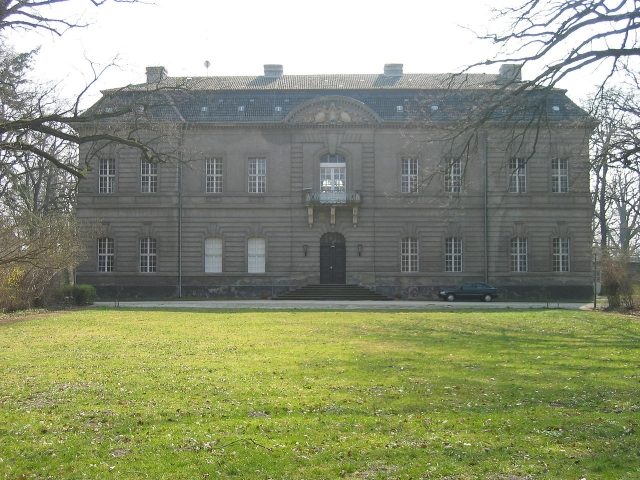
Kossenblatt Castle is a former Royal Prussian residential castle. It is located in the village of Kossenblatt, in the municipality of Tauche near Beeskow in the Oder-Spree district, and is considered the favorite castle of the Soldier King Frederick William I.
In 1581, the Brandenburg Lord Chamberlain Georg von Oppen acquired the old manor house in the village of Kossenblatt, whose name derives from the Slavic Cossinbloth, meaning "crooked swamp". The old manor house, of which only the cellar vault survived as part of the official residence, remained in the possession of the von Oppen family for three generations.
In 1699, Field Marshal Hans Albrecht von Barfus acquired the modest estate, located on an island in the Spree, for a sum of 32,000 thalers and 100 ducats. Barfus intended to undertake a major renovation of the small manor house. In 1702, the Dutch master builder Van Spieren began the work. Due to the unfavorable subsoil along the river, the foundation had to be reinforced with tree trunks, which extended the construction period until 1712. The client, von Barfus, died on December 27, 1704, so he was never able to inhabit his castle. Barfus was buried at the Kossenblatt village church.
His widow, Eleonore von Barfus, née Eleonore Countess von Dönhoff, finally had the construction completed between 1705 and 1712, presumably by Jean Baptiste Broebes or Jean de Bodt. According to legend, shortly before her death, she gave instructions to burn all of Barfus's castle inventory to the detriment of her son.
In 1735, King Frederick William I came to Kossenblatt from a hunt at Königs Wusterhausen Castle. There, he was impressed by the newly built castle and asked the heir to sell it to him. Count Barfus refused the king's request and demanded the inflated sum of 180,000 thalers, assuming it would never be paid. Frederick William I requested an appraisal, which determined a value of 125,000 thalers. For this price, Count Barfus, who could not refuse the king this wish, sold Kossenblatt Castle. The king added it to his dominion of Königs Wusterhausen and handed Kossenblatt over to his son August Wilhelm as a summer residence.
However, Prince August Wilhelm probably never resided there, as he clearly preferred Oranienburg Castle. Nevertheless, the court administration had the curved monogram A. W. affixed to the large front balcony of Kossenblatt Castle. King Frederick William I himself spent many months at Kossenblatt in his last years of life to cure his gout. In the castle, he engaged in painting and created many works himself despite his pain. He also maintained a lively exchange with the pastor of the village church.
In 1801, the son of the royal treasurer Buchholtz became bailiff of Kossenblatt, which he received in 1811 as an hereditary leasehold from Frederick William III. In 1851, the Buchholtz family finally acquired Kossenblatt, which was granted the status of a knight's estate in 1868. In 1862, Buchholtz led Theodor Fontane through the castle, who also stayed there overnight (Fontane Room) and mentioned it unfavorably in his work: Wanderungen durch die Mark Brandenburg.
In 1900, District Administrator von Tilly from Beeskow acquired the castle. In 1907, it was acquired by Cavalry Captain Erich Merkens. In 1917, it was acquired by Walter Schütze from Kramso. In 1918, it was bought by First Lieutenant Lüben from Berlin. In 1919, it was bought by the juice manufacturer Jacob Kirberg.
In 1945, the Kirberg family was dispossessed by the land reform law. In 1947, the estate became public property and was handed over to the state government in Potsdam for administration.
Source: Wikipedia · Licence: CC BY-SA 4.0
This description draws on the facts documented in the linked Wikipedia article; Wikipedia content is licensed under CC BY-SA 4.0. Wording and editing: Mobile History.
Location: 52.1140, 14.0721