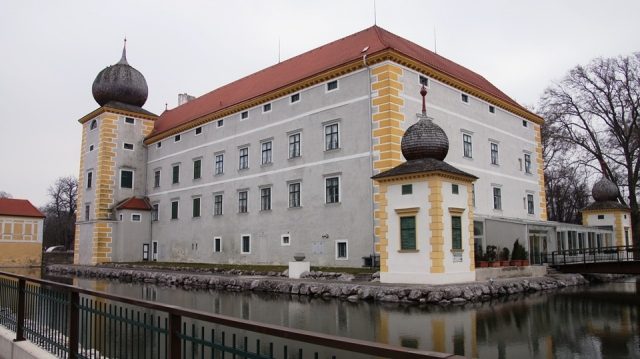
CastleKottingbrunn

Kottingbrunn Castle

Kottingbrunn Castle

Municipal offices
Restaurant


The first moated castle was probably built in the time of the Babenberg Margrave Adalbert around the middle of the 11th century, in timber construction. It was destroyed by the Hungarians after the Battle of Fischa in 1146. Duke Heinrich II had it rebuilt as a solid structure around 1150.

Around 1268, a "Knight Dietrich von Prunn" is mentioned. The first stone moated castle was destroyed in 1291 during the struggles of Duke Albrecht against the Austrian nobility and against the Hungarian King Andreas III. In 1327, the brothers Ulrich and Gaitmar (Stuchse von Bruck) bought the moated castle. The Stuchse family resided here until 1375 and called themselves von Brunn. They built the farmstead as an outer bailey.

Afterwards came the Pottendorfer family. In 1469, Georg von Pottendorf sold the castle and lordship to the administrator of Rauhenstein, Rupert Kreutzer. His daughter married Gandolf von Kienburg in 1484. Their descendants held Kottingbrunn for over 100 years. During the war between Emperor Friedrich III and Matthias Corvinus, Kottingbrunn was probably devastated. The reconstruction was completed around 1508. At the time of the Second Turkish Siege of Vienna in 1683, the castle was completely burned down, as it was abandoned and not defended by Franz Sigmund Graf Lamberg. Subsequently, it was rebuilt as a representative manor by Leopold Josef Graf Lamberg, receiving its current appearance. He had acquired the burnt ruin from his brother Franz Sigmund in 1688.

From the 17th to the end of the 19th century, the noble owner families changed quite rapidly. These included the Brandis (1637-1661), Lamberg (until 1740), Colloredo (until 1751), Dietrichstein (until 1767), Batthyány-Strattmann (until 1784), Bartenstein (several times), Peter Ritter von Bohr (1819-1840), Bethlen (1869) and Rumerskirch (1877). In 1894, the Austrian Jockey Club acquired the castle. During the years of the economic crisis, the castle was sold to Oskar Weiß. He was dispossessed in 1938, but his heirs received the building, which had been managed by the Russian USIA after the war and was accordingly dilapidated, back in 1957.

It was sold to several interested parties but continued to be neglected. Only the last private owner, Heinrich Jezek, began serious renovation work after 1981. In 1991, the municipality of Kottingbrunn acquired the castle. After its comprehensive restoration, which was completed in 2001, it now houses the municipal office, the local museum, and a restaurant.

Take Mobile History with you

You are reading this text for free. Premium adds what matters on the road: descriptions read aloud, sites found through your camera, whole regions taken offline.

  • Every description, including the ~17,700 Premium sites
  • Audio guide: have descriptions read to you on location
  • AR finder: see sites through your camera, with distance and bearing
  • Unlimited saved sites

14 days free, then from €2.99 a month. Cancel anytime.

Source: Wikipedia · Licence: CC BY-SA 4.0 · Image: http://www.wehrbauten.at/noe/niederoesterreich.html

This description draws on the facts documented in the linked Wikipedia article; Wikipedia content is licensed under CC BY-SA 4.0. Wording and editing: Mobile History.

Location: 47.9517, 16.2296