Uninhabited
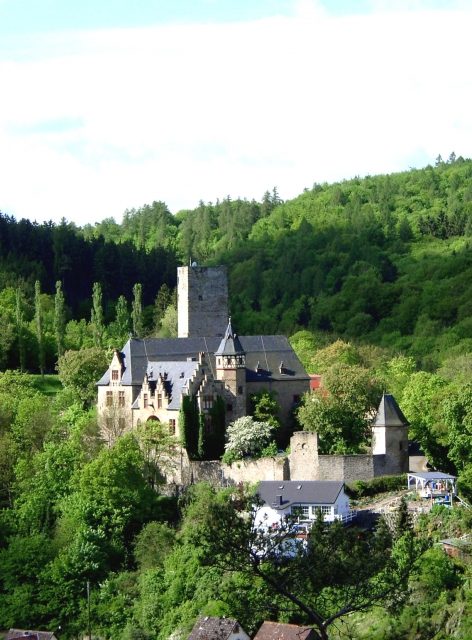
Kransberg Castle

Kransberg Castle is a castle of unknown feudal affiliation in the village of Kransberg, which today belongs to Usingen in the Hessian Hochtaunuskreis, about 30 kilometers north of Frankfurt am Main and about 50 kilometers northeast of Wiesbaden.
A so-called "Feldgericht" (field court) had existed in the area for a long time, documented as early as the 7th century. It was located only about 500 meters as the crow flies from the site of the present castle on a hill where a chapel still stands today. In the 11th century, a simple defensive structure was operated in the area of the present castle, presumably at the same strategically favorable location.
First Mention
In 1170, Kransberg was built by the Staufer as one of the first stone castles, as part of a defense chain Friedberg-Kransberg-Königstein-Kronberg, to defend against the Bishops of Limburg. The keep is the only and oldest element of the entire complex preserved from this period. The first separate documentary mention of the castle dates from 1220, in connection with the expansion of the complex and the construction of the palas and the stairwell tower. Both buildings exist today as part of the main building.
Change of Ownership
In 1310, the noble family of Cransperk died out, and the castle passed to the noble family of Falkenstein. 123 years later, in 1433, the castle fell to the Lords of Eppstein and was extended with the intermediate building. From 1522 to 1533, the castle briefly belonged to the Lords of Königstein and then passed into the possession of the Counts of Stolberg.
In the course of the Landfrieden (public peace) of 1590, the complex came into the possession of the Archbishop of Mainz. The residential annex to the main building was constructed. The Counts of Bassenheim acquired the property in 1654 after the destructions of the Thirty Years' War. The estate was extended with a manor house and stables and primarily served agricultural purposes.
In 1854, the property was sold to the Duchy of Nassau and became Prussian in 1866 due to the lost war against Prussia. In 1875, the von Biegeleben family bought the estate and thoroughly renovated it. The former castle became known as Cransberg Castle.
In 1920, a Mrs. von Scheitlein acquired the property, and it was henceforth used as a party castle.
Military Use
In 1939, the castle was confiscated by the Nazi regime and again fundamentally expanded and renovated as part of the Adlerhorst complex. The deep bunker, the knight's hall, and the garages were built during this period, until Kransberg Castle was captured by the Americans in 1945.
From 1946, the British forces used the complex and operated Camp Dustbin there, where, among others, Albert Speer and Wernher von Braun were imprisoned and interrogated. In the summer, the first conference in world history on biological weapons took place here.
Subsequently, there were changing occupations, always by military users. The Gehlen Organization, the predecessor of the Federal Intelligence Service, originated here. Units of the Bundeswehr and the American Armed Forces also used the facility.
Current Use
The American armed forces left the building in 1990. It reverted to the Federal Property Administration, which sold it in 1995 to the heirs of the former owner, Mrs. von Scheitlein. An entrepreneur acquired the property from the community of heirs in 1999. Civilian use was applied for, and the property was converted to a mixed use of office, event, and residential purposes. Due to financial difficulties of the owner, the castle was foreclosed in 2007 and came into the possession of HmcS Real Estate GmbH. Currently, the castle complex is uninhabited and for sale. In 2011, the castle, as well as the village itself, served as a backdrop for the Tatort episode "Das Dorf".
Take Mobile History with you
You are reading this text for free. Premium adds what matters on the road: descriptions read aloud, sites found through your camera, whole regions taken offline.
- Every description, including the ~17,700 Premium sites
- Audio guide: have descriptions read to you on location
- AR finder: see sites through your camera, with distance and bearing
- Unlimited saved sites
14 days free, then from €2.99 a month. Cancel anytime.
Source: Wikipedia · Licence: CC BY-SA 4.0
This description draws on the facts documented in the linked Wikipedia article; Wikipedia content is licensed under CC BY-SA 4.0. Wording and editing: Mobile History.
Location: 50.3453, 8.5904