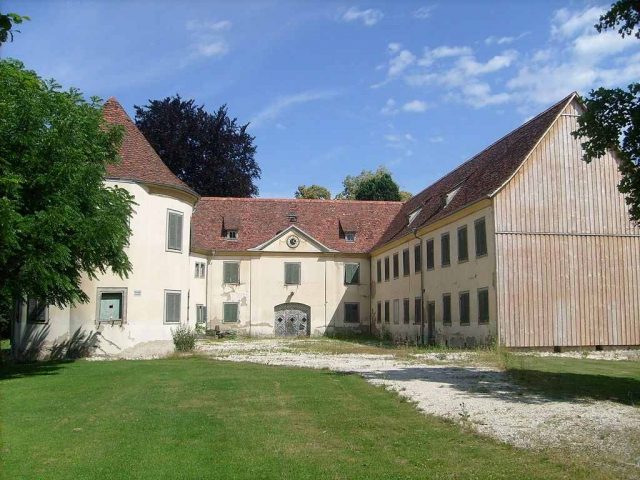
CastleKrauchenwies

Krauchenwies Castle

Krauchenwies Castle

To be privately owned

The Old Castle Krauchenwies is a Neoclassical castle in Krauchenwies in the district of Sigmaringen in Baden-Württemberg.

The castle complex is located at the southeastern corner of the Princely Hohenzollern Park on the outskirts of Krauchenwies, towards Sigmaringen on the busy B 311. Krauchenwies belonged to the Counts of Hohenzollern-Sigmaringen since 1595; here the Counts and later Princes of Hohenzollern-Sigmaringen had their summer residence.

The old castle in Krauchenwies, also known as the "Water Castle," originates from a medieval moated castle. In 1303, the castle was first documented as a tower of the lower noble family of the Lords of Leiterberg as the village lords of Krauchenwies. After renovations in the 15th century, the Ravensburg master builder Hans Waldner transformed the complex from 1595 to 1597 on behalf of the Counts of Hohenzollern-Sigmaringen into a Renaissance castle, presumably with four wings.

In 1633, during the Thirty Years' War, the castle complex was destroyed by Swedish troops under General Horn. During the Rococo period, between 1769 and 1785, it was redesigned into a two-story, horseshoe-shaped three-wing complex with a former chapel in the rounded west wing (bell tower) in the style of early Classicism. The east wing was extended to the south. The kitchen was located north of the chapel.

Prince Karl of Hohenzollern-Sigmaringen (1785–1853) lived with his family in Krauchenwies from 1808, while the court authorities were based in Sigmaringen Castle (residence city). After the new country house was built in the immediate vicinity from 1828 to 1832, the function as the (summer) residence of the princely house transferred to it. Initially, the old castle was still used as accommodation for high-ranking personalities. At the end of the 19th century, a single-story, wooden hall extension was added to the west side.

After that, the building had a varied history; it was initially still a residence for high-ranking personalities, then accommodation for a sewing school and homeless German soldiers. In 1941, it was used as a labor camp for civilian workers. Sophie Scholl completed her Reich Labor Service (RAD) here in Civilian Labor Camp 501 Krauchenwies from early April to late September 1941. Her rejection of National Socialism grew during her labor and war auxiliary service near Sigmaringen. From 1954 to 1979, it served as the "Malteser Children's Home Schloss Krauchenwies" of the Schönstatt Sisters of Mary. Afterwards, Vietnamese refugees and German foster children were housed there. Most recently, from 1981, the Old Castle served as accommodation for the training center of the Federal Finance Administration for several years. After that, it stood empty and visibly deteriorated. The renovation was estimated at seven million German Marks. Neither the municipality of Krauchenwies nor the House of Hohenzollern had the necessary funds.

The House of Hohenzollern and the municipality had hoped for a user for about ten years in vain. So, in 2001, the House of Hohenzollern applied for the demolition of the castle. However, this was rejected by the general public. In 2002, the State Office for Monument Preservation Baden-Württemberg decided against demolition.

In 2003, the German Foundation for Monument Protection partially funded the securing of the timber framework and the roof. In a rescue operation in 2006, a conservation renovation of the castle complex, which had been vacant for decades and was in a desolate state due to neglected maintenance, was carried out. This was financed by state monument preservation, the German Foundation for Monument Protection, the Monument Foundation Baden-Württemberg, and the Princely House of Hohenzollern. Parts of the castle infested with dry rot and beyond saving (which had been added as later extensions) were demolished, and the roof was renovated. The original form of the three-wing complex could be preserved.

In its current state, the castle is a three-wing complex open to the south in the early Classicist style. It is a two-story, plastered half-timbered building with high hip roofs and triangular gables adorned with coats of arms above the main portals. The castle is a protected monument and is owned by the Hohenzollern family. It is unused, still in need of renovation, and is for sale. Electricity, water, and sewage connections are available on the 4,000 to 5,000 square meter plot. The castle occupies a footprint of approximately 1,000 square meters, with the total usable area being about 800 square meters more.

It was named "Monument of the Month January 2007" by the Monument Foundation Baden-Württemberg.

Take Mobile History with you

You are reading this text for free. Premium adds what matters on the road: descriptions read aloud, sites found through your camera, whole regions taken offline.

  • Every description, including the ~17,700 Premium sites
  • Audio guide: have descriptions read to you on location
  • AR finder: see sites through your camera, with distance and bearing
  • Unlimited saved sites

14 days free, then from €2.99 a month. Cancel anytime.

Source: Wikipedia · Licence: CC BY-SA 4.0

This description draws on the facts documented in the linked Wikipedia article; Wikipedia content is licensed under CC BY-SA 4.0. Wording and editing: Mobile History.

Location: 48.0205, 9.2487