To be privately owned
CastleOsterburg-Krumke
Krumke Castle
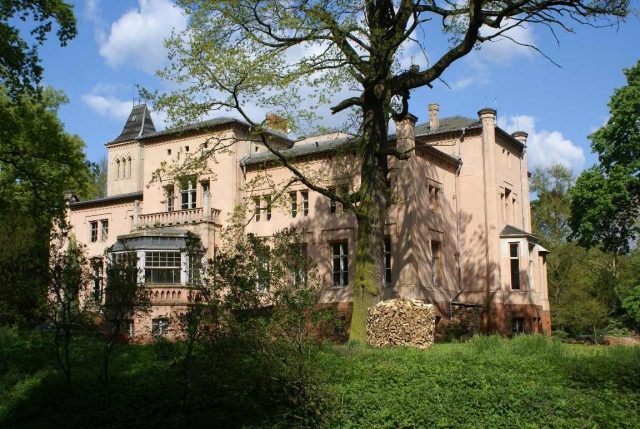
Krumke is a district of the Hanseatic city of Osterburg (Altmark) in the Altmark region of Saxony-Anhalt.
Notable features include the castle, the associated manor house, the orangery from 1751, the Cavalier House (with gastronomy), the patron church, and the coach house. The accompanying park, designed in the style of an English landscape garden, is freely accessible. It houses numerous dendrological treasures and has been included in the list of the 40 most beautiful parks in Saxony-Anhalt ("Garden Dreams"). Krumke is home to an equestrian facility with two indoor riding arenas and outdoor areas. The facility is the base for one of Germany's most successful vaulting teams, the "Krumker Voltis," and an EU insemination station of the Brandenburg State Stud Neustadt/Dosse.
West of the castle flows a small stream, which is called "Krumme Beke" due to a bend. The old name "Krum-beke" is derived from it, which later became Krumke. The artificial moats of the castle were formerly fed with water from the "Krumme Beke." Today, the stream flows into the castle pond and the nearby Biese river.
Originally, a castle stood on the island, but its remains are no longer preserved. Krumke Castle, as a margravial castle, along with the castles of Osterburg, Rossau, and Gladigau, formed a line of fortifications against the Wends living on the other side of the Biese.
Krumke Castle must have existed as early as 1170, even if it was only mentioned in 1321.
Owners until 1945 were:
- until 1280 Vinzelberg
- 1280–1320 Duchess of Breslau
- 1320–1327 von Kröcher
- 1327–1607 von Redern
- 1607–1611 von Winterfeld
- 1611–1649 von Bülow
- 1649–1762 von Kannenberg (including Christoph von Kannenberg)
- 1762–1911 von Kahlden
- 1911–1932 von Gwinner
- 1932–1945 Klingler
In 1762, the von Kannenberg line died out, and Krumke came into the hands of the Lords von Kahlden. In 1854, a new castle was built on the island, and the garden created in the 18th century was altered.
In 1911, Arthur von Gwinner, then spokesman for the board of Deutsche Bank, acquired the Krumke estate and castle with its park. He had it completely renovated and partly redesigned. Gwinner had the old manor house demolished around 1913 and built the Cavalier House in its place. Through inheritance, his daughters Charlotte and Margarethe acquired ownership of the estate, and the latter then transferred the property to her husband, Prof. Karl Klingler, a significant violinist of the 20th century and first violinist of the quartet of the same name.
Source: Wikipedia · Licence: CC BY-SA 4.0 · Image: Roland Neubert, Halle (Saale)
This description draws on the facts documented in the linked Wikipedia article; Wikipedia content is licensed under CC BY-SA 4.0. Wording and editing: Mobile History.
Location: 52.7973, 11.7149