To be privately owned
Museum
Kuckuckstein Castle
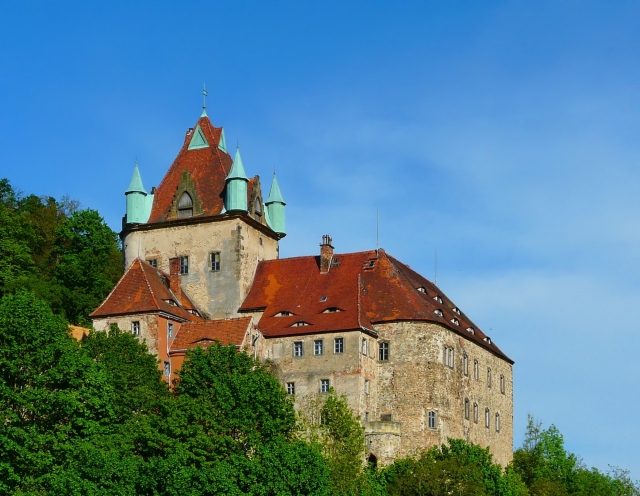
Kuckuckstein Castle in Liebstadt is situated on a rocky outcrop (380 m above sea level) above the Seidewitz river valley, at a very favorable location for controlling the trade route from the Elbe valley over the Eastern Ore Mountains to Bohemia (Kulmer Steig).
Liebstadt, and thus Kuckuckstein Castle, is located approximately 15 km southwest of Pirna in a valley between the deeply cut valleys of the Gottleuba and Müglitz, at roughly the same elevation as Bad Gottleuba and Glashütte. At this point, Molchgrund and Hennersbacher Grund merge into the Seidewitz valley. The castle towers on a gneiss rock approximately 30 m above Liebstadt's market square.
Below the castle in the valley are the former manor house and the castle nursery. Above, remnants of an English-style landscape park can still be found.
Via the castle stairs or the access road to the castle slope, one reaches the actual castle via a drawbridge. The keep (with three superimposed vaults and another floor), gatehouse, and a connecting building enclose a first small courtyard. A narrow passage leads to the large courtyard, which is formed by the "Tafelhaus" (main building) in the southwest, the "Wasserhaus" (water house) in the southeast, and the kitchen building with a battlement in the northeast.
The castle was built on four levels. The lowest (cellar and mantle vault in the Tafelhaus) and the second level are partly carved into the rock. The second level is the lowest tower vault of the keep. The third is the main level, which is at the height of the drawbridge. The fourth level includes, in addition to the upper floors, the knight's hall located in the third vault of the keep and the "Kapellstube" (chapel room) above it. In the other buildings, the battlement and attics make up the fourth level.
The castle was first mentioned in a document in connection with the enfeoffment of Günther and Heinrich von Bünau by Frederick the Younger (Landgrave of Thuringia and Margrave of Meissen) on September 4, 1410. This occurred as a result of the Dohna Feud, in which the Burgraves of Dohna were defeated by the Margrave of Meissen (here still William I of Meissen) and completely lost their possessions in the Burgraviate of Dohna (including Liebstadt). The Bünau brothers were rewarded for their military services to the Margrave in this feud with, among other things, Weesenstein Castle (1406) and Liebstadt (1410).
However, it can be assumed that the settlement and the castle (probably more of a fortress in its early days) originated much earlier. Whether the settlement or the castle was built first is not clear. In a document dated October 19, 1286, the owner Otto von Dohna granted the town (civitas) to the Bishopric of Meissen. There is no mention of the castle here. The castle apparently remained in the possession of the Donins. Its existence can therefore be assumed, as otherwise a walled city at this location would have served no purpose. It is therefore very likely that the town and castle originated in the second half of the 13th century. Other traditions even suggest that the castle was built as a border fortress between 930 and 940 under Henry I.
The name "Kuckuckstein" first appears in 1791 in an alphabetical directory of all "Schrift- und Amtssässigen" (those with official and administrative seats) in the Electorate of Saxony. It is also unclear when this name began to be used. Since the cuckoo was referred to as "Gauch" until the 16th century, the castle should actually have been called "Gauchstein" until then. In the Middle Ages, the cuckoo was also a heraldic animal and stood for vigilance – in contrast to the lion (wildness – Lauenstein or Löwenstein Castle) and the bear (strength – Bärenstein Castle). This could explain why the Bünaus no longer used this name after the destruction of the castle during the Dohna Feud (1385–1402).
Reconstruction only began in 1453. The castle was built on the foundations of the old fortress in the style of Arnold von Westfalen. A corresponding inscription can still be found on the outer wall of the palas.
During the Thirty Years' War, Liebstadt, like many German towns, was often ravaged by mercenaries. In 1643, the castle was stormed and plundered by Imperial-Hatzfeld mercenaries.
For over 200 years, the castle was owned by the von Bünau family. In 1651, it passed to Lieutenant Colonel Detlev von Wedelbusch, the second husband of the widowed Anna Sophie von Bünau, who, widowed again, sold the castle on December 13, 1694, to Lieutenant General Cunno Christoph von Birkholz. During the ownership of the von Birkholz family (documented until 1741), the castle was extensively renovated in the Rococo style. In the following years, the ownership of the castle changed several times.
It was not until 1775 that district commissioner Hans Carl August von Carlowitz acquired the castle from the bankruptcy estate for 40,407 Thalers. In addition to the town and castle, the villages of Wingendorf, Herbergen, Göppersdorf, Döbra, and Berthelsdorf, as well as extensive forests, belonged to the property. The mining rights originally belonging to the castle, however, had already been ceded by the Bünaus to Duke Georg in 1492 for 700 Rhenish guilders, and the high hunting rights in 1737/38 by the Birkholz family to Elector Frederick August II for four pieces of game and 100 Meissen guilders annually.
The castle remained in the possession of the von Carlowitz family until 1931. Among the members of this family during this period were a number of physically and intellectually highly gifted individuals. Therefore, a new intellectual and social life moved into the castle. The castle was made more comfortable and partly re-furnished in the taste of Romanticism. For example, in 1798, Novalis was a guest at Kuckuckstein Castle as a friend of the family, and the lord of the castle, Carl Adolf von Carlowitz (1771–1837), had himself and his wife portrayed by the Dresden painter Anton Graff in 1805. Furthermore, the owner professed Freemasonry. At the same time, Carl Adolf also supported Heinrich von Kleist in publishing the magazine "Phöbus". In 1800, a Masonic lodge was established in the castle, decorated with mysterious, early Romantic paintings. The castle's library also contains some valuable Masonic writings.
The early 19th century left strong marks on the castle's owners and the entire region. The Coalition Wars, which peaked in the region around 1813, led to destruction, disease, hardship, and misery among the population; looting and arson occurred among both the French and the Russians. The battles between Russian and French troops and their allies led to a multitude of skirmishes between the Ore Mountains and the Elbe, of which evidence still exists today (Napoleon's redoubt near Herbergen, commemorative plaques and cannonballs in Dohna, and much more).
On September 9, 1813, Napoleon I spent the night in the castle after observing the enemy's retreat from the heights north of Liebstadt near Borna. His forces still comprised over 400,000 French soldiers, who were encamped in the town and surrounding area. Carl Adolf von Carlowitz actively opposed the Napoleonic occupation during this time and also entered the service of the Russian Tsar as a Major General of the Cavalry. However, he did not experience direct enemy contact, as he only reached the Saxon Jäger Corps (2,900 men) he had raised in April 1814. Paris, however, had already capitulated on March 16.
In the course of the 19th and early 20th centuries, a number of family members made a name for themselves, but not the castle. The hardship of the inflation period in the 1920s led to Kuckuckstein Castle having to be sold again. It was acquired by Ottomar Heinsius von Mayenburg in 1931. In 1945, the owners were dispossessed and expelled by the communists.
After the Second World War, the castle became public property and was administered by the Ministry of Agriculture and Forestry, and from 1952 by the town of Liebstadt. In 1954, the museum was established and initially managed by teacher Walter Jobst, who was very committed to the preservation of the castle and earned great merit in local historical research in the Eastern Ore Mountains with a multitude of publications. At the same time, he incorporated his collection of local history objects, especially from the local bird and plant world, into the museum's inventory. Furthermore, the museum has a number of historical objects from Freemasonry, such as lodge badges, Masonic aprons, and oil paintings depicting former lodge brothers from the Saxon lodges.
In 1995, the castle became the property of the town of Liebstadt, which put it up for sale in autumn 2003 due to excessively high maintenance costs. The market value was estimated at 380,000 Euros. Of the three bidders, the Austrian entrepreneur and business consultant Ralph Neunteufel was awarded the contract. According to media reports, he wanted to pay 300,000 Euros for the castle plus 41,000 Euros for the property. However, the conclusion of a hereditary building right contract failed because Neunteufel did not provide an additionally requested guarantee. The subsequent negotiations with the Saxon Homeland Security Association also remained inconclusive, as the association had to reject taking over the castle after reviewing the financial requirements.
In 2006, the Liebstadt city council again put the castle up for sale. Interested buyers included Michael Graf von Plettenberg (factory planner from Ludwigsburg, asking price negotiable), an association consortium consisting of the Landesverein Sächsischer Heimatschutz, the Förderverein Schloss Kuckuckstein, and the Kurortentwicklungs- und Förderverein Bad Gottleuba-Berggiesshübel (symbolic bid of 3 Euros), Günter von Bünau, a descendant of the former lords of the castle von Bünau (bid of 128,000 Euros), and again Ralph Neunteufel. The latter offered the highest bid of 155,000 Euros, which was decisive for the city council, so the sale to the Austrian was decided on July 4, 2006. His concept of use envisioned - after renovation - both public and private use of the castle. However, the castle has hardly been renovated so far, and the condition of this picturesque and defiant complex gives cause for concern.
Owners in chronological order+
930–940 probably built by Henry I around 1286 Otto von Dohna until 1402 in possession of the Donins 1402–1410 in possession of the House of Wettin 1410 enfeoffment of Günther and Heinrich von Bünau by Landgrave Frederick the Younger (?) 1461 Heinrich von Bünau (1) 1493 Günther (2) and Rudolph (3) von Bünau, siblings 1501 Günther (2) von Bünau 1515 Günther (4) von Bünau, son of Günther (2) von Bünau 1554 Günther (5) and Rudolph (6) von Bünau, sons of Günther (4) von Bünau 1592 Rudolph (6) von Bünau, remained childless 1615 Günther (7) von Bünau, son of Günther (5) von Bünau 1633 Rudolph (8), Günther (9) and Heinrich (10) von Bünau, under guardianship as minors 1651 Rudolph (8) von Bünau 1654 Günther (9) von Bünau, acquisition from Rudolph (8) von Bünau 1655 enfeoffment of Colonel-Sergeant Detlef von Wedelbusch (stepfather of Rudolph (8) von Bünau) as second husband of the widowed Anna Sophie von Bünau 1662 Anna Sophie von Bünau 1691 sale by Anna Sophie von Bünau to her son-in-law, the Electoral Saxon Rittmeister Cuno Christoph von Birkholz 1741 District Court Assessor Court Councillor Dr. Wolf Alfred Behrisch 1743 sale to the Pirna ship and merchant lord Commercial Councillor Johann Christoph von Hanisch (60,500 Thalers) 1751 sale to Commercial Councillor Carl Siegfried Francke (75,000 Thalers) 1775 acquisition by Hans Carl August von Carlowitz (40,407 Thalers) Carl Adolf von Carlowitz 1833 Friedrich Paul Aemil von Carlowitz 1851 Georg Carl von Carlowitz 1860 Carl Adolph von Carlowitz 1931 acquisition by Heinsius von Mayenburg (244,000 Reichsmark) from 1932 administration by Major General Eckart von Loeben 1945 transition to public ownership (administration by the Ministry of Agriculture and Forestry) 1952 Liebstadt becomes the owner of the castle 1995 transition to the ownership of the town of Liebstadt 2003 the castle is put up for sale 2007 The Liebstadt city council sells the castle to "Global Castle Management GmbH" (owner: Ralph Neunteufel)
Architectural Development+
It can be considered certain that the castle was built as a fortress with a protective function for the trade route from the Elbe valley over the Ore Mountains to Bohemia. Whether this happened in the 10th century or only in the 13th century is initially irrelevant for this function. It is also clear that with the destruction as a result of the Dohna Feud in 1402 and the Hussite incursions around 1429 (Kuckuckstein, together with the castles of Lauenstein, Bärenstein, and Weesenstein, belonged to the line of fortifications against the Hussites), hardly anything remained of the castle. With the reconstruction by Günter and Heinrich von Bünau from 1453 (this year is found on the soller), Liebstadt Castle was built on the foundations of the fortress. These foundations include a gate in the Wasserhaus (currently considered the oldest part), a late Gothic ogee arch window in the gatehouse, and a gate in the large courtyard. In the course of the reconstruction, Rudolf von Bünau, after a pilgrimage to the Holy Land in 1476, had a chapel room installed in the tower, as he was allowed to hold private services after this penance.
The castle underwent significant alterations and extensions between 1519 and 1554. The Wasserhaus with its Renaissance gables probably dates from this period.
After the castle was taken over by Detlev von Wedelbusch in 1655, the damage from the Thirty Years' War was repaired and the garden in the valley was started. His son-in-law, Christoph von Birkholz, had the garden in the valley extended in the French style and added a bathhouse to the Wasserhaus. He furnished the castle in the Baroque style.
After 1742, the castle was rebuilt again. Behrisch had the half-timbered floor removed, Hanisch built the Rote Vorwerk in the town and an inn on the site of the town hall.
With the transfer of the castle to the possession of Carl August von Carlowitz (1774), the castle underwent a thorough renovation (1774–1781), which, however, did not lead to changes in the overall complex. Rather, the estate was strengthened as an agricultural production facility. For example, a new sheep farm, an oil mill, and other mills were built. In addition, the outworks were extended and a new greenhouse was built in the castle garden.
Furthermore, in 1786, an English-style landscape park was created on the Schlossleithe with a pleasure house, and next to it in 1789, a "Kegelschub" (skittle alley) as well as some other elements in keeping with the style (vases, figures, grottoes). In accordance with the spirit of the Enlightenment, to which Carl August's sons Carl Adolf and his brother Hans Georg von Carlowitz also felt committed, structural changes and the furnishing of the castle were adapted in the early Romantic style.
Under the administration of Hans Georg von Carlowitz, the castle was rebuilt in the Neo-Gothic style from 1796 to 1802; the romantic "Kuckuckstein Castle" was created. For example, the tower top was blasted off and rebuilt by 1797 with a chapel room, soller, and spire. Likewise, the gate portal at the drawbridge was built in the Neo-Gothic style. Inside the castle, walls were moved, and painting, glazing, and carpentry work was carried out. Carl Adolf's study was created from two rooms with a cross vault and was decoratively designed (landscape paintings between the arches, sun, moon, and stars on the vaults). In 1798, a pleasure house (the so-called Schulenburg, probably named after the mother's maiden name) was built at the Rote Vorwerk, but it was burned down by Napoleonic troops in 1813. In 1800, a Masonic lodge was established in the castle, decorated with mysterious early Romantic paintings.
In 1851, the castle underwent another renovation by Georg Carl von Carlowitz (ogee arch windows in the Tafelhaus, roofing of the outdoor stairs). From 1886 to 1889, the large inner courtyard was created in its present form. Likewise, the "Rittersaal" (Knight's Hall) was extended in the third tower vault. In 1906, a wooden gallery with a pulpit bay window was built in the small courtyard. Most of the castle's interior was auctioned off in the 1930s, so that today hardly any furnishings can be found at Kuckuckstein Castle. This also applies to the originally very extensive library, of which little has been preserved.
Due to a lack of investment in recent years, the complex currently (as of January 2008) shows a number of structural defects. An expert report identifies 27 areas with an urgent need for action and renovation. Global Castle Management GmbH, with its acquisition in 2007, committed to investing 500,000 Euros in renovation measures within three years. However, the costs for a fundamental renovation are estimated at approximately 3 million Euros.
Significance and Current Use+
Kuckuckstein Castle is today considered a rare architectural monument of early Neo-Gothic and early Romanticism. Together with the large agricultural estate, a charming landscape was created at the end of the 18th century, with the castle complex and landscape park forming an impressive backdrop. The forms often have no function (embrasures that cannot be used as such, wooden capitals that simulate stone, or columns painted on walls). However, this is an expression of historicism at that time. The renovation forms a certain unity and is therefore valuable, especially since this early "sentimental" Neo-Gothic is very rare.
Since 1954, the local history museum has been housed in the castle, which also offers guided tours of the castle's rooms.
For several years, starting in 1985, the castle and the Knight's Hall were used as a setting for the GDR television program "Zauber auf Schloß Kuckuckstein" (Magic at Kuckuckstein Castle) with "Zauberpeter" Peter Kersten. This restored hall has served as a backdrop for romantic weddings for the Bad Gottleuba-Berggießhübel registry office since 1994; it can also be rented for other celebrations.
Take Mobile History with you
You are reading this text for free. Premium adds what matters on the road: descriptions read aloud, sites found through your camera, whole regions taken offline.
- Every description, including the ~17,700 Premium sites
- Audio guide: have descriptions read to you on location
- AR finder: see sites through your camera, with distance and bearing
- Unlimited saved sites
14 days free, then from €2.99 a month. Cancel anytime.
Source: Wikipedia · Licence: CC BY-SA 4.0 · Image: Thomas Eichler
This description draws on the facts documented in the linked Wikipedia article; Wikipedia content is licensed under CC BY-SA 4.0. Wording and editing: Mobile History.
Location: 50.8634, 13.8584